




US global positions an updated survey
The 1991 Gulf War and the implosion of the former Soviet Union caused a triumphalist euphoria in the United States as typified by political scientist Francis Fukuyama's bold projection of 'the end of history'. The Clinton years, therefore, were spent essentially for worldwide mop-up operations to pave the way for the ultimate global victory of liberal democracy and capitalist economy.
However, the Sept 11 terrorist attack on Washington DC and New York in 2001 has since changed the American view of the world as well as the world's views of the United States.
First and foremost, the attack has shown that even the homeland of the sole superpower on earth in the 21st century is vulnerable to war-like devastation caused, not by another superpower or any state, but merely by a tiny group of smart and 'dare-to-die' non-state actors of international politics. The American response in the form of an expeditionary war against the Taliban regime in Afghanistan, while empathised by most of the responsible states in the world, also triggered off the fear of a 'clash of civilisations'.
 The Huntingtonian fear was further exacerbated by the 2003 US-led war against the Saddam Hussein regime in Iraq which itself cause a worldwide explosion of anti-American feelings, sentiments and opinions not only in the Islamic world, but also amongst a large portion of non-Islamic Asia, Europe and Latin America.
Meanwhile, quieter shifts in the geopolitical balance of power seem to be taking place in Northeast and Central Asia.
Is the United States really as strong as it appears to be? Have the American leverages and statecraft for its diplomacy and conduct of international relations lost their traditional effectiveness?
The 1991 Gulf War and the implosion of the former Soviet Union caused a triumphalist euphoria in the United States as typified by political scientist Francis Fukuyama's bold projection of 'the end of history'. The Clinton years, therefore, were spent essentially for worldwide mop-up operations to pave the way for the ultimate global victory of liberal democracy and capitalist economy.
However, the Sept 11 terrorist attack on Washington DC and New York in 2001 has since changed the American view of the world as well as the world's views of the United States.
First and foremost, the attack has shown that even the homeland of the sole superpower on earth in the 21st century is vulnerable to war-like devastation caused, not by another superpower or any state, but merely by a tiny group of smart and 'dare-to-die' non-state actors of international politics. The American response in the form of an expeditionary war against the Taliban regime in Afghanistan, while empathised by most of the responsible states in the world, also triggered off the fear of a 'clash of civilisations'.
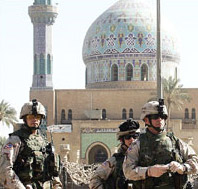 The Huntingtonian fear was further exacerbated by the 2003 US-led war against the Saddam Hussein regime in Iraq which itself cause a worldwide explosion of anti-American feelings, sentiments and opinions not only in the Islamic world, but also amongst a large portion of non-Islamic Asia, Europe and Latin America.
Meanwhile, quieter shifts in the geopolitical balance of power seem to be taking place in Northeast and Central Asia.
Is the United States really as strong as it appears to be? Have the American leverages and statecraft for its diplomacy and conduct of international relations lost their traditional effectiveness?
Universiti Kebangsaan Malaysia's Professor Lee Poh Ping shares his latest observations with malaysiakini on the global positions of American power and influence in light of the prolonged American military involvement in Iraq, its stand-off with Iran and North Korea, the leftwing swing in Latin American politics, the upgrade in Sino-Russian defence cooperation and relative decline of transatlantic relations:
Question: It seems that there is still no end in sight for peace, stability and normalcy in Iraq after the US-led coalition forces toppled the Saddam Hussein regime by entering Baghdad for more than three years now. Why? What went wrong?
Answer: The basic reason is the failure of the Bush Administration to anticipate Iraqi (particularly Sunni) resistance to American occupation. The administration calculated they could with an overwhelming display of American might, such as is brought about by American hi-tech prowess, and the destruction of the will to resist (as seen on the structural level with the disbanding of the Baath party and on a spiritual level with the toleration of the looting of Iraqi cultural relics), the Iraqis will have no will to resist. Hence, there is no need to commit a huge occupation force. We know what happened did not follow the American script.
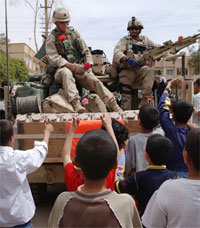 The Sunnis did not lose the will to fight, and if the Shiites (so far with a 'wait and see' attitude) turn against the Americans, the American occupation will soon become untenable. Also, not only is there resistance for the US to cope with, there is also the danger of a civil war, some will say it is already in existence, between the Sunnis and Shiites. A civil war will make a mockery of the American talk of going to Iraq to promote democracy that will bring about a better future for the Iraqis than they had under Saddam Hussein.
What led the Americans to invade Iraq in this manner despite the advice of many elder American statesmen on the limitation of US power and of many experts on the complexity of the Iraqi situation? There are many reasons that can be advanced but I will focus on one very important reason, a certain arrogance. At the time of the beginning of the Iraqi invasion, the US had stood as the lone superpower for slightly more than a decade. In that decade, it had fought a few wars with its hi-tech military in places like Kuwait, Bosnia and Afghanistan and won with very few casualties.
Yet many in the Bush administration and its neo-conservative supporters believe that respect for US power is not nearly enough, particularly under the weak Clinton Administration. A leading neo-con, William Kristol, was reported to have said that many in the world still have not enough awe of American power. Saddam Hussein was still around to thumb his nose against the Americans. In order to teach Saddam Hussein and those who might imitate him a lesson and to impress upon emerging powers such as China of the US determination to maintain its global hegemony, Iraq had to be invaded as a demonstration of US power and of US willingness to use it.
There is, of course, a background to this. Iraq is full of oil. Noam Chomsky, a well-known intellectual of the left, was once quoted as saying that if Iraq's only export had been lettuce and pickles, there would have been no invasion. Also, Iraq had been weakened by many years of sanctions and bombings and is hence easier to defeat. Present day Iran will be a different proposition. But the immediate propelling reason is the need for a demonstration of US power.
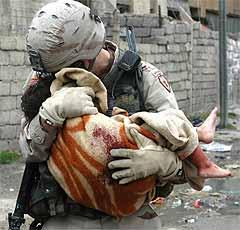 Will the US withdraw? I have argued elsewhere that Iraq is even more vital to the US than Vietnam (where the withdrawal was agonisingly slow) as not only is US credibility, like Vietnam, involved, but Iraq and the Middle East, because of the oil and Israel, are more vital to the US than Vietnam and Southeast Asia were. Hence, there is no reason to disbelieve Bush when he says the US will stay in Iraq until victory is achieved. Of course, there is US public opinion to consider, and if Congressional elections this year bring in great numbers of anti-war candidates, then pressure will be too great for Bush not to withdraw. But one thing is clear. Staying the course will result in more human and material sacrifices in Iraq and also in the US.
Despite many threats, the US has still not able to make Iran and North Korea to concede to its demand to abandon all projects of nuclearisation. Why? Does it, or does it not, suggest that American leverages and statecraft for its diplomacy and conduct of international relations have lost their effects?
As the US is so militarily stretched in Iraq, the threat of an invasion of Iran and North Korea with a large land force is not very credible. Hence both regimes believe they can continue their nuclear activities without fear that they will be militarily toppled, like Saddam Hussein. But this does not mean that there is no other military option for the US. The US can resort to air strikes to take out the nuclear facilities in both countries.
There are reports that the US has not ruled out using nuclear weapons. Such an option, however, is fraught with risks. The Iranians can retaliate in Iraq and, through their supporters, in Lebanon. They can also disrupt shipping in the waters around Iran and send oil prices skyrocketing. The North Koreans on their part can strike back at South Korea and the American troops there. Moreover, the Chinese reaction is uncertain, particularly if the air strikes were to destabilise the North Korean regime.
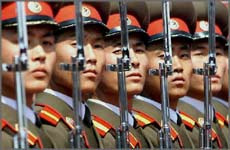 The US can impose sanctions as it is now doing in both countries. But for them to be effective, they have to be imposed collectively, particularly through the United Nations. But that is only possible if China and Russia are on board, which they are not. Does that mean that the US is now losing leverage? Yes.
But this has to be put into perspective. Despite Russian and Chinese resistance to US-suggested sanctions, the US is still a very dominant power in both situations. What it decides will still have a very great influence. What the present course of events suggest to me is that the US should stop going for regime change and resort to genuine diplomacy.
Do you see that anti-American feelings, sentiments and opinions in the world, especially among Muslims, have subsided? If yes, why? If no, why?
The present US policies in Iraq, Afghanistan and Palestine have alienated many Muslims. And for a smaller group of Muslims, particularly those represented by the followers of Osama bin Laden, the fact that the US is the strongest power in a Western civilisation that has historically colonised Muslim lands does not generate very positive feelings among them towards the Americans. Anti-American feelings can subside if the US were to change its policies towards the three aforementioned territories. Unfortunately this is not happening.
Has the transatlantic political relation between the United States and Europe changed for better or worse, three years after the split over Iraq War?
There have been some attempt on the part of the governments of the US and many European countries, especially in Germany under Chancellor Merkel, to patch up after the split over Iraq. Also, according to a public opinion survey by the Pew Research Group, there is an increasing convergence among the public of both areas on the threat posed by radical Islam. Still there are differences over Iraq, Guantanamo, the readiness of the US to resort to force and so on. The transatlantic alliance will not break up but it will not return to the closeness both sides enjoyed during the Cold War.
Many countries in the Latin America have turned to the Left by electing leftwing presidents and governments who are critical of US foreign and economic policies into power. What has happened there?
I think Latin America is disillusioned by the neo-liberal approach, backed by Washington, to bring about improved welfare of their people. So you have the rise of what maybe called 'soft' leftists leaders like those in Chile, Argentina and Brazil, and 'hard' leftists like Morales in Bolivia and Chavez in Venezuela. The latter two leaders are also the products of rising indigenous Indian nationalism in Latin America.
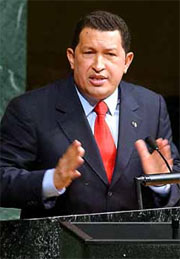 Such leaders, particularly the 'hard' leftists could prove inimical to US interests in the region. In the past, the US had dealt with such 'hard' leftist leaders through the instigation of military coups against them. The US helped the military leader, Pinochet, overthrow Salvador Allende in Chile in 1973. It is however more difficult this time. The US aided a coup against Chavez in 2002 but was not successful.
Conceivably, the US can use its own military force to topple these 'hard' leaders but this is not likely with the present US involvement in Iraq. Noam Chomsky once tantalisingly suggested that if the US had been successful in Iraq, it would probably have invaded the Andean region as the next target!
The attempts of the United States to extend its powers and influence in Central Asia seem to have encountered difficulties in the form of forces backed, or at least blessed, by Russia and China. What is your observation of the balance of power in Central Asia?
The Russians and the Chinese are anxious that the US does not dominate the Central Asian region. This region is rich in oil, a very important consideration to the Chinese. The US, on its part, considers the region very important for its global hegemony. It is part of the Eurasian area that one of the leading US strategic thinkers, Zbigniew Brzezinski, believes US control is vital to the maintenance of US domination of the world.
There is, of course, the oil that the US also covets. On their part, many of the Central Asian countries do not want the US completely out as they want it to balance the Chinese and the Russians. I foresee a rivalry among these three powers and perhaps the Indians might get involved, but given their proximity, the Russians and the Chinese will increase their influence there.
Since last year, China and Russia have drastically upgraded defence cooperation and strategic relations as symbolised by the large-scale joint exercise code-named Peace Mission 2005. What does this mean for the balance of power in the Asia-Pacific region, especially Northeast Asia?
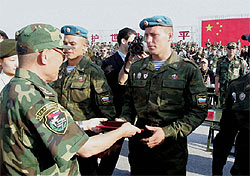 I do not think the upgraded defence cooperation has affected the power balance in Northeast Asia. It is not like the Sino-Soviet alliance of the 1950s which had a tremendous impact on Northeast Asia. Both sides have made it clear that their cooperation is not directed against any country. However, it will make it more difficult for the Japanese to enlist the Russians, an idea entertained by some Japanese, in any scheme to contain China.
How does the reality or perception of the current global positions of the US affect, positively or negatively, the gravitation or inclination of countries in Southeast Asia in their international relations?
Many Southeast Asians cannot be said to be happy with the US being the lone superpower without another superpower to check it. Such a US tends to be unilateralist and are inclined to ride roughshod over the sovereignty of other countries.
They would like to see a US more aware of the limitations of its power. They, however, do not want the US to withdraw from Southeast Asia, seeing it as a hedge against a rising China.
JAMES WONG WING ON is chief analyst of Strategic Analysis Malaysia. He is a former DAP member of Parliament for Kampar (1990-1995) and a former columnist for the Sin Chew Jit Poh Chinese daily (now Sin Chew Daily ). He read political science and economics at Monash University in Melbourne, Australia.


