




Ludicrous storm in a golden tea cup!
The spate of accusations and counter-accusations between an MP and the Malacca Customs Department rages on, sometimes almost daily on the media, without any prospect of an end to the whole stinking affair in sight any time soon.
In terms of its far-reaching consequences to the development of healthy democratic institutions, this incident is certainly much more worthy of considered comments than the mad raving of a former PM against the current PM.
The incident also triggered off a series of events involving parliamentary bodies, to the extent that Parliament seems to have come alive from its long rigour mortis. Stirring from its deep freeze under the wintry years of Mahathirean rule, Parliament proceedings have become interesting to follow, thanks largely to the charisma of a photogenic Shahrir Abdul Samad.
The crucial question is: did the MP interfere with the work of the administration, when he told the Customs officers to "close one eye" when dealing with allegedly illegal import of logs?
The spate of accusations and counter-accusations between an MP and the Malacca Customs Department rages on, sometimes almost daily on the media, without any prospect of an end to the whole stinking affair in sight any time soon.
In terms of its far-reaching consequences to the development of healthy democratic institutions, this incident is certainly much more worthy of considered comments than the mad raving of a former PM against the current PM.
The incident also triggered off a series of events involving parliamentary bodies, to the extent that Parliament seems to have come alive from its long rigour mortis. Stirring from its deep freeze under the wintry years of Mahathirean rule, Parliament proceedings have become interesting to follow, thanks largely to the charisma of a photogenic Shahrir Abdul Samad.
The crucial question is: did the MP interfere with the work of the administration, when he told the Customs officers to "close one eye" when dealing with allegedly illegal import of logs?
If we leave aside this particular incident for the moment, and turn to the larger question of how parliaments should work, we have to resort to the Doctrine of Separation of Powers that forms the bedrock of any parliamentary democracy.
In our system of constitutional monarchy, the parliament, the judiciary and the administration make up the three legs of the tripod under the King at its apex, constituting the nuclear structure of the Malaysian state, and working in harmony - in theory at least - according to the ground rules provided by the Federal Constitution.
The three branches of government are supposed to be independent of one another, each with its own boundaries outlining its power and responsibilities. Undue and unethical interference indeed would destroy the fabric of democracy, and the rights and interests of the people will be thwarted and eroded in the process. A perfect case in point is the prime ministerial interference in judicial proceedings in important cases involving massive public interest.
Fair, ethical criticisms
However, the separation of powers is not meant to mean that these three branches of government cannot criticise one another. Their independence is precisely to allow them to make fair and ethical criticism against one another without fear or favour according to established rules and convention.
In short, a parliamentary democracy can only work on the basis of mistrust of too much power in any one branch of the government - or in any one man for that matter. That those entrusted with the affair of state must be constantly watched through a system of checks and balances is the central tenet of Westminster style of political organisation.
For instance, MPs cannot name and criticise individual judges in the House, except with the moving of a substantive motion. Tabling that motion takes a great deal of political wrangling.
In addition, any individual or group of individuals wronged by the government or ministers can seek redress and justice through judicial review in court, where a judge may rule against the particular administrative action according to the law.
The Parliament, or strictly speaking, the lower house which is called the Dewan Rakyat in Malaysia, is the highest political forum in the land, consisting of elected representatives of the people, and representing the legitimacy of state by asserting the sovereignty and general will of the entire population.
The Parliament functions according to rules established under the House Standing Orders and certain unwritten parliamentary conventions. Their independence is guaranteed by their impunity from prosecution for anything MPs say in the House. In Malaysia, they are not exempt from the Sedition Act, and this is ridiculous.
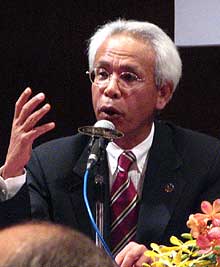 Therefore, it is the responsibility of MPs to speak out against administrative excesses of the government, and expose weaknesses in government policies and their implementation. To do this, MPs have to be non-partisan at times, as Shahrir had done when supporting the opposition motion to refer the Jasin MP to the Committee of Privileges. After all, the interest of the people must override the interest of partisan politics - in an ideal scenario.
Unfortunately in an infant - and often infantile - democracy like Malaysia, partisan political interest does and must override public interest, and hence the reprimand for Sharir's unusual action.
The theoretical principles of good governance in Malaysia has for decades been subverted by the political realities of a budding nation-state. Parliament is over-flooded by MPs from the ruling parties, and there is little prospect for the MPs to fulfil their role in providing checks and balances.
In fact, Parliament has been treated by the top political leaders in the country as if it is a sub-division under the PM's Department. Likewise, the media treated parliamentary proceedings as a mere formality, and parliamentary reports in the press have always tended to be petty, myopic and anaemic.
For many years under the former administration, the philosophy of depolitisation of Parliament has meant that MPs' primary task is reduced to that of looking after their respective constituencies, like a gardener tending to his flowers and vegetables.
Ambiguous relationship
MPs from the ruling parties are given a few hundred thousand annually for minor projects to be dispensed to whoever they want in their constituency. They are supposed to help the government in development. Opposition MPs turn to "servicing" the people, from filling out application forms of all sorts, looking at blocked drains and toilets, to organising protests against unpopular government projects.
Either way, MPs from both Barisan and opposition camps have to come into contact and work with government servants, especially those in the local authorities and city councils. Their relation is an ambiguous one, given that civil servants in this country are highly politicised.
All MPs have to get on the good side of civil servants, since they know that these little tin gods in the disguise of mandarins have the control over the resources that the MPs may need in "servicing constituents. On the other hand, it is a credit to our civil servants that whatever they may think on the quiet, they generally respect a YB coming to their office.
In ethical terms, MPs ought to have some concern for the well-being of his constituents, and should help them in any way they can. Sometimes, in knowing how the government machinery works goes a long way towards opening doors for the voters.
In principle then, when providing assistance to constituents, an MP is supposed to be serving public interests, though some voters do make very selfish demands aimed at furthering their personal interests only.
Practically, one could say that MPs are also working for their personal interest in that going around the constituency and interacting with voters ensure their popularity and their chance of getting re-elected.
This sort of going around government offices to open doors and helping to solve problems for voters can hardly be seen as "interfering" with government administration. Even if the MP goes to the local press to highlight an issue, and in the process, if he criticises government departments and officials, he is merely carrying out his parliamentary duties.
Unfortunately, as we all know, corruption has eaten its way into the Parliament, as it has into all revered institutions of state in Malaysia. MPs too have to meet huge expenses incurred in his election campaigns, as well as paying tons of bills in his political work. Relying on his relatively meagre allowance is a hard life to lead for many. Besides, he has to look after his family like everybody else. More than a few MPs seem to be fascinated by flashy cars. The temptation for corruption is difficult to resist.
The opportunity is there also. An MP carries quite a great deal of prestige, in businesses, in obtaining special permits of all kinds, and above all in obtaining government contracts. All these involve approval by government servants at all levels. Here, the MP can bring his weight to bear on the civil service to get what he wants.
Did MP misuse his office?
When an MP starts to put pressure on civil servants to further his personal gains and not for the welfare of his voters, then he is immediately guilty of conflict of interest, if not corruption outright. Ethically, in a more enlightened democracy, if such deeds are exposed, there will be a public outcry for his political blood.
Not too long ago, some British MPs were dragged over the coal for accepting payment for asking questions in the House of Commons.
 Viewed in this perspective, the question of whether the Jasin MP has interfered with government administration is a loaded one. Perhaps it was meant to be a red herring, to draw public attention away from the real issue.
The real question is this: did he misuse his office and influence with a government department for personal gain? If so, in the name of good governance, he should resign, or face prosecution of some sort.
A larger question looms. How many ministers, deputy ministers, and parliamentary secretaries, past and present, have been misusing their office and influence to secure undue advantage for personal gains?
Many ordinary citizens and many of that proverbial men-in-the-street have their individual titbits about corruption in high places. So long as the truth shall remain in the private sphere of the home dinner table, the cocktail parties and the coffee shop, the cynical hypocrisy of rampant corruption in public life shall continue to strangle the growth of our infantile democracy.


