




The gods must be crazy again
July has been a barmy month, not just for one region but for several. Five-time football champions Brazil were bundled out in the quarter-finals of the World Cup in Germany.
French superstar Zinedine Zidane head-butted Italian defender Marco Materazzi after alleged provocation in extra-time during the finals, and was promptly red-carded.
The celebrations around the world's most beautiful game and Italy's win weren't just marred, but hugely and swiftly overshadowed by other controversies. Grave ones.
July has been a barmy month, not just for one region but for several. Five-time football champions Brazil were bundled out in the quarter-finals of the World Cup in Germany.
French superstar Zinedine Zidane head-butted Italian defender Marco Materazzi after alleged provocation in extra-time during the finals, and was promptly red-carded.
The celebrations around the world's most beautiful game and Italy's win weren't just marred, but hugely and swiftly overshadowed by other controversies. Grave ones.
World oil prices surged sharply upwards to US$80 a barrel from the low US$70 just as Italian defender Fabio Grosso was nailing the French in a 5-3 penalty shootout win, and while all hell was breaking loose yet again in the Middle East, which is lurching towards all-out war.
 Visiting Germany, US President George W Bush, in his asinine way, talked up his optimism over a full-fledged democratic, pro-US, post-Saddam Hussein Iraq, even as it continues to slide towards civil war.
In Gaza, in post-Yasser Arafat Palestine, the violently militant Hamas kidnapped a 19-year- old Israeli soldier, then fired rockets into Israel which retaliated with fearsome firepower. The militant Hizbollah, backed by Iran and Syria, launched endless rocket attacks deep into Israeli territory from southern Lebanon, only for Israel to retaliate and promise to raze Lebanon to the ruins it had suffered 20 years ago.
Just one week after London observed the first anniversary of attacks on the Tube system, terrorists - possibly Lashkar-e-Taiba with bases inside Pakistan-controlled sections of Kashmir - blew up Mumbai's overcrowded commuter trains, killing 181 people and injuring scores of mostly Hindus on their way to work.
Pakistan's military dictator Gen Pervez Musharraf could only offer his condolences amidst his oft-repeated pathetic promises of bringing to heel the terrorist murderers that his government protects.
In New York, American national security agencies uncovered and unravelled a plan by terrorists linked to the bloody-minded cowards al-Qaeda to blow up the Hudson River underwater train tunnel system. In northeast Asia, lunatic North Korean leader Kim Jong-il fired seven missiles - all duds - into the Sea of Japan.
Jitters in world markets
Added to the ongoing debacle of American-led military adventurism in Iraq, these events have caused jitters in world markets. In fact all gave speculative oil traders, global oil companies and oil-producer states just the blessings needed to boost the bottom-line.
Region after region became roiled in crises that the lame duck United Nations, led by the laughably weak secretary-general Kofi Annan, cannot manage or even assuage. Perhaps the Federation of International Football Associations should take over running the U.N.
So, where to oil prices?
Consider this. There is strong and insatiable demand for crude oil from monolith developing economies like China and India. The long winter is coming to northern Asia, north America and Europe.
The world's oil reserves are probably about half what they were during the series of Organisation of Petroleum Exporting Countries (Opec) oil crises in the 1970s and 1980s. The reserves are not being replenished and oil-producing states are already pumping at full capacity.
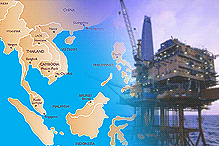 Global oil companies are not investing the billions upon billions of dollars required to locate new oil fields. Also, no state or any of the oil majors are putting time and money into developing alternative energy sources.
All of these can only have a single, unified effect on oil prices - a skyward price spike that will ultimately hurt the world economy, and hurt it very badly. World crude oil could soon fetch as much as US$100 a barrel within weeks.
Besides, what's to say certain oil-producer states won't subscribe to international blackmail by withholding production or supply, or indeed manipulating world oil prices? These are mainly populist regimes and to survive, they will do whatever populism dictates.
It would only take an Iran, a Nigeria or a Venezuela to trip the world economy over. They could retaliate against US imperialism or Zionist imperialism. After all, Bush gave his support to Israel, qualifying this by suggesting that every state has a right to defend itself. Isn't that exactly what Israel is doing?
Not according to the radical Shiite cleric Moktada al-Sadr, who said on July 14 that Iraqis would not sit by with folded hands while Israel struck at Lebanon. Thus the signal of a possible rise in attacks by his mercurial militia, the Mahdi Army.
"Eyes are shedding tears, and the heart feels pain and sadness for our people in Lebanon due to the bombing, terror and clear aggression that the Zionist enemy conducts and that is shielded by a number of countries, including the US. Let it be known to everybody that we in Iraq will not sit by with folded hands before the creep of Zionism," he said.
Sadr, like Hamas and Hizbollah, will no doubt get wholehearted support from Iran, Syria and al-Qaeda. Such geopolitical posturing only piles monumental uncertainties onto world markets.
 Who knows how oil speculators and companies do their sums to drive up world oil prices? These speculators are like thieves in the Ali Baba fable: they are short-run games theorists, and their profligacy calculus is the accumulation of fast and easy but bountiful profits at the expense of global stability, in political and economic terms.
What is happening in the Middle East now and where it could lead, cannot and should not be ignored in terms of future oil prices. The region has been trending towards war for some time now, but the actions of Hamas and Hizbollah will only bolster terrorist groups into attacking Muslim or Arab secular governments. They will also be boosted, radically and ideologically, toward a common cause: the annihilation of the state of Israel.
Problem is, these groups are also opening up several fronts in that war against Israel, just as they are opening up new fronts against the foreign infidels in Iraq or wherever US and its allied forces are based in Muslim or Arab states.
What's worse is that the US is already deep in the woes of its own imperial overstretch, and that can't be good for the future of world oil prices and the world economy.


