




A bullet through KTMB
Malaysian corporate players are abuzz with talk of massive investments by the government to reinvigorate the economy through developments planned for the 9th Malaysia Plan.
 The latest is the announcement by conglomerate YTL that it intends to raise private global financing through the so-called PFI initiative to build the region's first bullet train with speeds of 300km/h to link Kuala Lumpur to Singapore via the international airport KLIA in 90 minutes.
While the YTL managing director has claimed that both governments have been informed of the intention, the Malaysian transport ministry has denied any knowledge of the proposal. However the deputy minister said the government welcomes proposals to improve transport, later confIrmed by the prime minister after returning from his holiday abroad.
The idea of a bullet train has been met with skepticism by industry experts who are knowledgeable about the Malaysian rail transport system. Once again, this is clearly a proposal by contractors and manufacturers and not by rail operators.
Malaysian corporate players are abuzz with talk of massive investments by the government to reinvigorate the economy through developments planned for the 9th Malaysia Plan.
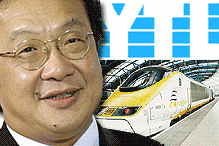 The latest is the announcement by conglomerate YTL that it intends to raise private global financing through the so-called PFI initiative to build the region's first bullet train with speeds of 300km/h to link Kuala Lumpur to Singapore via the international airport KLIA in 90 minutes.
While the YTL managing director has claimed that both governments have been informed of the intention, the Malaysian transport ministry has denied any knowledge of the proposal. However the deputy minister said the government welcomes proposals to improve transport, later confIrmed by the prime minister after returning from his holiday abroad.
The idea of a bullet train has been met with skepticism by industry experts who are knowledgeable about the Malaysian rail transport system. Once again, this is clearly a proposal by contractors and manufacturers and not by rail operators.
Proposals for bullet trains have appeared in press reports from as early as 1993 soon after the construction of KLIA began. In all of these proposals, the government was required to subsidise much of the project through indirect measures.
Former Malaysian railway experts said Malayan Railway (KTMB) had planned to link the KLIA via Kuala Lumpur to Subang Jaya and Shah Alam on a loop with the KL-Port Klang line as part of the Kuala Lumpur Klang Valley Area Transit system planned by KTMB and KL bus operators.
This government squarely rejected this in 1992, preferring to award the dedicated railway to a new inexperienced operator led by Tabung Haji Technologies.
Financial experts involved in the original financing package for the KLIA express rail project suggested that the present KLIA express train from Kuala Lumpur Sentral to KLIA has so many indirect support systems in place that it would be more correct to say it was really a government entity.
It is similar to the LRT projects which were originally touted as commercially viable, but ended with negative returns of investment and built at a highly inflated cost.
Even or elevated bridge?
Regional rail industry specialists point out there are some critical issues which have to be addressed in the case of the bullet train. If it is to reach Singapore, they point out that it will need a bridge crossing at an even gradient such as the causeway or something similar. However this runs counter to the plan of building an elevated bridge.
If this is the case, the bullet train will have to begin ascending along a slow gradient to cross the Johor Straits safely and dock on the Singapore side at an elevated rail terminal. Based on track design, the train has to begin ascending long before Kluang and thus denying Johor Bahru and even Senai airport this train service.
If the KL-KLIA-Singapore bullet train is to reach its 90 minute target, it will need to bypass other towns and the service will never reach critical mass to achieve economic viability.
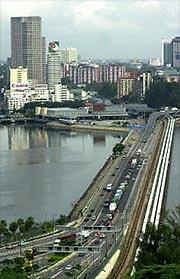 Having a high speed passenger train rush to Johor Baru, stop at two immigration and customs terminals and then complete a local journey from the terminal to Singapore city will increase travel time optimistically to three hours. So where will the saving be?
In fact the former KTM rail engineers point out that two European high speed rail operators had offered to build the high speed rail service in 1997-1998 but required the Malaysian government to subsidise the project. A Shanghai-type maglev train would be even more expensive.
The original designers, Transrapid of Germany, sold the technology to China since nobody in Germany wanted it and are now, as contractors, flogging it to Europeans and America. They have failed to tell potential buyers that it is the Chinese who built it. China has since upgraded this technology as reported by China's special technology department.
Dismemberment of services
The most critical issue will be the dismemberment of KTMB's services and its very survival. Banks and investment groups will baulk at the idea of building a bullet train when the government has already spent billions on the national railway and provided an annual subsidy of RM300 million.
They question why KTMB is not allowed to upgrade the system to operate a high speed train programme and then list this service on the market to benefit citizens. The 20-year-old idea of PFI financing won't take off without the proper revenue streams locked in. Results of PFI projects in Britain and the dismemberment of the British rail system to private operators have seen progressive governments paying exorbitant sums in hidden costs.
In the last few weeks there has been much said about KTMB's woes and its poor record over the last two decades, but some former experts feel that the real story has been left untold. A KTMB with its legs and hands tied has been told to run a 100m race while others are being given a handicap.
Government budgets have never been enough to build a proper railway system for KTMB, yet there has been an unending flow of funds to unqualified companies to build overpriced public transport networks. Instead of augmenting and enhancing existing infrastructure, new routes are built to secure property rights while KTMB struggles.
Railway specialists say that KTMB experts were never allowed to develop the railway from within and in regional alliances which would have transformed it as have other railways in the Asian region. They say that the Railway Pension Co-operative company Relk, KTMB and foreign public transit operations experts developed a series of self-financed programmes for KTMB in the 1990s but these were ignored by the authorities.
Instead, well-connected but inept and unqualified parties were allowed to dismember key components of KTMB's operational infrastructure for other use and private management groups with their similarly unqualified business consultants have run the railway into the ground.
Klang Valley transit system
KTMB and international rail operations specialists had proposed the enhancement and augmentation of the Seremban-Rawang and KL-Port Klang sectors, which would have resulted in the self-financed Kuala Lumpur and Klang Valley Area Transit System by forging an alliance between KTMB, the eight major bus companies and the 31 minibus companies.
The key feature was that the government would not have to pay anything, and derived a proven internal rate of return of 21 percent and backed by five international banks. This was the best of North America and Hong Kong designed with Malaysian characteristics and with no government support. The plan was also to include a commuter line to the KLIA looping to connect Shah Alam and Subang Jaya, providing commuters and air travellers a fast reliable service. It was also proposed at that time to have a central Public Transport Authority to co-ordinate this system.
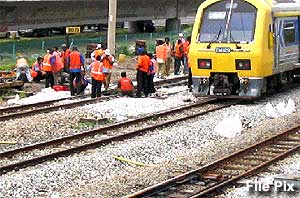 Despite submissions to all relevant government authorities, KTMB was told to drop the plan. Instead, it borrowed money from the government to buy EMUs. Light rail operations with heavy subsidies were installed instead with no significant bus connections. Consultants were appointed by Kuala Lumpur City Hall to undertake a bus study which did not consult the bus companies. We see the result today.
Reports about the Kuala Lumpur and Klang Valley Area Transit system appeared in The Malay Mail in 1993 and the international press as a unique system devised for specific commuters, with much public support. Again the Klang Valley Kuala Lumpur Area Transit system would have seen a new railway central station complex in KL Sentral.
Instead KTMB awarded the project to MRCB with vital rail shunting yards handed over for the project. Now KTMB has to pay more than RM 250,000 monthly as rent for its own land, while revenue from rental of floor space does not go into the KTMB coffers.
Excellent poppycock
Merak Unggul appointed by the government to corporatise KTMB, removed all essential benefits to workers including housing, communication equipment and transport for them to respond to emergencies. High salaries were paid to the new management and so called foreign experts, including huge bonuses to a truck freight operator from the US.
Within one year, KTMB handed the government a RM300 million loss. Renong, which part-owned Merak Unggu, also initiated a brilliant plan for inter-city buses to pick up passengers at the KTMB railway station, thus competing with railway passenger business. They bought over the most profitable bus company, Park May and ran that into the ground.
Some years ago, former KTM railway specialists developed a unique rapid freight railway for an international railway company which acted on behalf of local logistics operators to build a rapid freight link connecting Port Klang to Tanjung Pelepas and Pasir Gudang.
This unique railway plan called 'Tiger Rail' which was self-financing would have been a subsidiary operation for KTMB and would have generated revenue of RM1 billion. Submissions were made to key government authorities in 1997 but were ignored. Today there is a weekly service from Tanjung Pelepas to Kluang.
Combining the proposed Tiger Rail with a commuter rail system serving the Johore Bahru conurbation and Singapore with upgraded rail and rolling stock would provide the rapid rail services required and also serve the community. If fact the Singapore metro services offered to co-perate with the Johor Bahru city in 1997 to achieve this.
Industry experts will tell you the current railway projects are overpriced. Railway rolling stock is being refurbished at prices higher than if they were bought new. The fancy ideas going around even include plans to build elevated monorails to travel in tunnels just to support local industry when the world is turning to on-grade trams.
Right now, when the trade gravitational pull is northward, why would anyone suggest a bullet train south when Malaysia should be looking north in co-operation with Singapore?
Unless there is a proper Master Plan of co-ordinated main line, commuter and inner city rail operations, the railway will continue to run into a bottomless pit, with congested roads, sparsely filled light rail trains and huge public expenditure.
These railway men point out that the taxpayers will just have to continue biting the bullet.
DR KUA KIA SOONG is Suaram's director and a former member of parliament.


