



COMMENT | Political intrigue leads to capital outflow
COMMENT | Political intrigue can result in foreign net selling, meaning capital flows out from the country which can be inimical for the economy as a whole – with possible knock-on effects on the other variables such as employment levels, currency value, exchange rate and bond yields.
When the political leadership – which includes both leadership in the ruling and opposition coalitions – is distracted by the game of thrones and power play, this undermines economic stability.
A clear example of political intrigue is when a politician makes an unexpected statement about having the majority number to form a government without due respect to the legal process as enshrined in the Federal Constitution, or creates a political drama leading to the dissolution of Parliament with its concomitant snap election being called.
When these political machinations occurred amid a backdrop of a surge in the Covid-19 daily infection figures, this will cause the economic situation to degenerate even worse. As a result, the relationship between political intrigue and capital outflow
COMMENT | Political intrigue can result in foreign net selling, meaning capital flows out from the country which can be inimical for the economy as a whole – with possible knock-on effects on the other variables such as employment levels, currency value, exchange rate and bond yields.
When the political leadership – which includes both leadership in the ruling and opposition coalitions – is distracted by the game of thrones and power play, this undermines economic stability.
A clear example of political intrigue is when a politician makes an unexpected statement about having the majority number to form a government without due respect to the legal process as enshrined in the Federal Constitution, or creates a political drama leading to the dissolution of Parliament with its concomitant snap election being called.
When these political machinations occurred amid a backdrop of a surge in the Covid-19 daily infection figures, this will cause the economic situation to degenerate even worse. As a result, the relationship between political intrigue and capital outflow is part of a country's political economy.
According to an article from the Harvard University's DASH repository, it demonstrates the importance of political economy in explaining how political development affects financial development and financial volatility.
Based on a survey by the Merdeka Centre on 1,167 respondents aged 21 and above, 32.7% thinks there is political instability in our country, while a measly 1.2% thinks there is political stability in general. Thus, it can be seen that our country's politics is not stable.
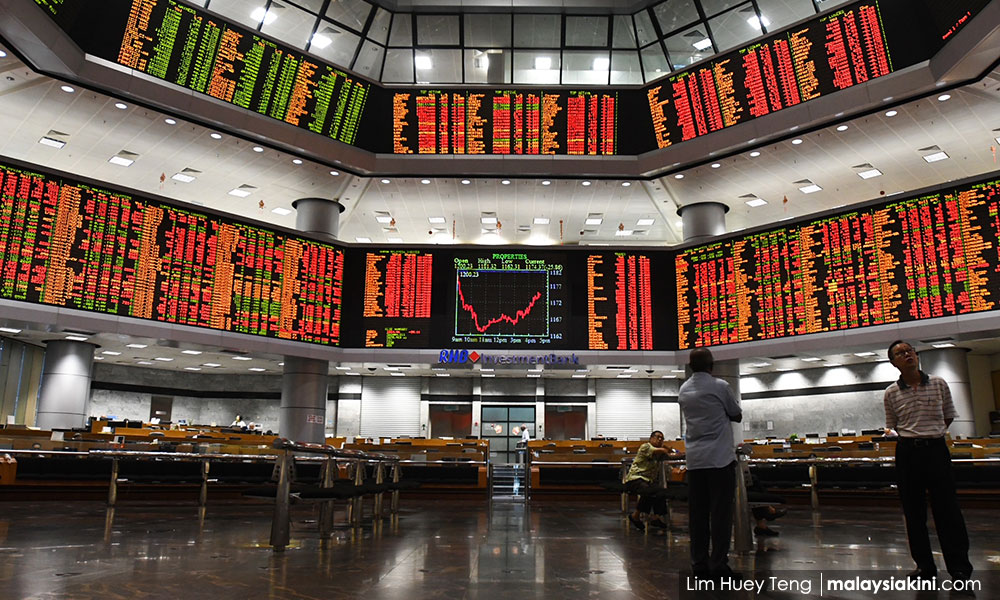
The "Sheraton Move" which occurred on Sunday, Feb 23, for instance, had triggered panic selling on Bursa Malaysia the following day, resulting in RM43.4 billion in market capitalisation being wiped out from the local bourse just in one day.
All the indices of Bursa Malaysia were in negative territory when the bourse closed on that fateful day, with Bursa Malaysia Construction Index hit worst – falling from 12.6 points to 194.81 or by 6.07%.
The benchmark FBM KLCI index fell below 1,500 points, skidding to an intraday low of 1,486.71 points, its lowest level since December 2011, closing at 1,490.06 – down by 2.69% or 41.14 points.
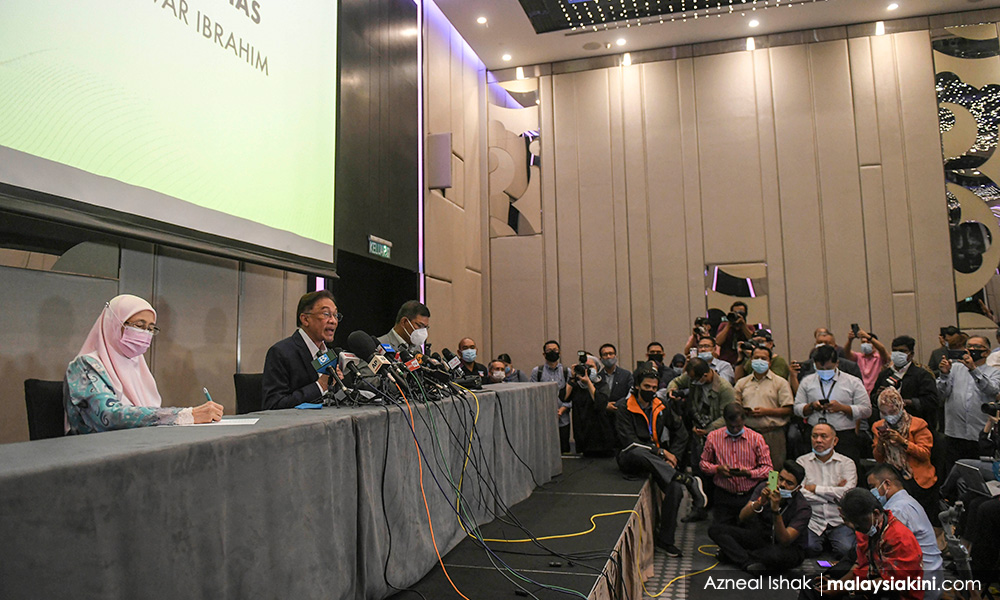
Let's now see the dynamics of the stock exchange on Sep 23 when opposition leader Anwar Ibrahim claimed that he had a formidable and strong majority to form a new government – another political intrigue in our country.
Minutes after Anwar's announcement, amid an already weak market sentiment, the FBM KLCI fell by 0.9% to 1,494.18, as of 12.22pm. Like a domino effect, it later fell by 17.24 points to 1,491.74 at 2.32pm.
But a few hours later, Prime Minister Tan Sri Muhyiddin Yassin gave the stock market some boost by announcing a new RM10 billion stimulus package. As a result, FBM KLCI ended down by 9.30 points, or 0.62%, at 1,496.48, down from the previous day's close of 1505.78.
In short, the FBM KLCI opened on the day of Anwar's announcement with a slight increase of 1.51 points at 1,507.29, but fluctuated between 1,491.17 and 1,509.15 throughout the day after his announcement before ending at 1,496.48. RM12.01 billion was wiped out from the bourse. The biggest losers on the FTSE Bursa Malaysia Kl index included a 1.9% drop by Axiata Group and a 1.78% drop by Petronas Chemicals Group.
The Sheraton Move and Anwar's bombshell show political intrigues will lead to financial volatility via fluctuation in the stock and bond market which, more often than not, leads to net capital outflow.
With the current spike in the number of Covid-19 infections, political intrigue will definitely lead to capital outflow, which in turn will result in slower economic growth, reduced employment rate, uncertainty in the bond market and a weaker currency.
According to some equity strategists and fund managers, political uncertainty has intensified since the split in Pakatan Harapan, with the Covid-19 pandemic casting a shadow over the outlook for global economic growth, further dampening already weak market sentiment.
On Sep 30, international financial rating agency, Fitch Solutions, predicts politics in Malaysia is expected to blunt economic growth for the next decade. Combined with slower population growth and reduced fiscal space to cushion against negative future economic shocks, Fitch predicts real GDP growth to be at just 3.4% over the next 10 years compared to 6.4% over the past decade.
Therefore, it is clear that there is a direct relationship between political intrigue and capital outflow, which will lead to financial volatility and a negative impact on the economy in terms of people's livelihoods and investors' confidence.
A frequent change of government within a short period of time means government policies will be in flux, with companies, especially foreign investors such as multinational corporations, unable to plan and make reasonable forecasts on their project, leading to their wait-and-see stance when it comes to their investment commitments in Malaysia.
Henceforth, we should resolve political uncertainty through a scheduled general election rather than political wrangling. By doing so, there is economic stability which will impact on the good performance of our country's economy.
In light of the unprecedented situation in our country, there shouldn't be any political intrigue or drama that either culminates in a power grab or a snap call election being called until Malaysia is declared Covid-19 free and the economy is on a firm footing or the 15th general election is called as scheduled in 2023, whichever comes first.
JAMARI MOHTAR and TAM MEI SI are part of the research team of Emir Research, a think-tank focused on strategic policy recommendations.
The views expressed here are those of the author/contributor and do not necessarily represent the views of Malaysiakini.



Report this comment
Are you sure you want to delete this comment?
This action cannot be undone.