




Engulfed in the sound of silence
After more than four decades of independence, Malaysian politics is nowhere on the road to maturity.
On the contrary, there is enough evidence to indicate that ethnic and religious polarisation is rearing its ugly head.
The only question foremost in the minds of Malaysia is whether such a state of affairs is going to result in something dreadful or awful.
After more than four decades of independence, Malaysian politics is nowhere on the road to maturity.
On the contrary, there is enough evidence to indicate that ethnic and religious polarisation is rearing its ugly head.
The only question foremost in the minds of Malaysia is whether such a state of affairs is going to result in something dreadful or awful.
Developments in the recent past provide some idea about the nature of the political trajectory of the country. The spat between former premier Dr Mahathir Mohamad and Prime Minister Abdullah Ahmad Badawi seems to have raised the nationalist temperature of the Malays.
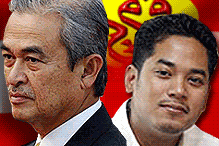 Mahathir's incessant attacks on Abdullah's administration on a wide variety of issues include unfavourable remarks about the latter's son-in-law Khairy Jamaluddin. These have caused deep concerns in Umno and in society.
Mahathir's anger with Abdullah for not standing up to Singapore on the half-bridge issue has brought to fore some of the concerns of ultra-Malay nationalists. The attacks have brought home the point that Malays have not benefitted under Abdullah and the message for him to leave the political arena seems loud and clear.
Abdullah's inability to defend himself has lent credence and legitimacy to some of the points raised. When Mahathir will stop his attacks against his chosen successor is not clear, but there are indications that he wants Abdullah to be removed from Umno and replaced by someone who is acceptable to himself.
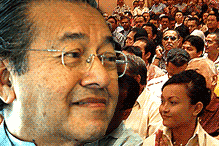 Whether Mahathir will be able to effect this change in leadership remains unclear. Some analysts are of the opinion that unless Mahathir has the support of powerful leaders in Umno he will not make much of dent in bringing about change. There is some truth in this analysis.
Given Umno's hierarchical structure, it would be difficult if not foolhardy for powerful politicians to take Mahathir's side against Abdullah. Given the power and prestige of the Number One post in Umno, it would be difficult to unseat Abdullah.
Even if Abdullah is not removed, there are indications that Umno may not be the strong party that people generally think it is. In the last few decades, due to rampant nature of money politics, Umno has lost its sense of direction and ideology in charting a future for Malays. Today it is the clamour for material rewards that propel Malays to participate in Umno activities.
The slogan of 'race, religion and nation' has been sucked into the quagmire of greed, power and corruption. Such is the intensity to acquire material wealth in Umno, that the larger goals of development, ethnic and religious harmony, and wealth distribution have all been sacrificed.
Erosion of image
Abdullah's image as an effective leader is fast eroding. He has not been able to counter Mahathir's serious and damaging accusations. More than this, he has not been able to defend his family and relatives from accusations of wrongdoing. If this continues, then Malaysians will gravitate towards the belief that he himself is guilty of wrongdoing.
Mahathir's attacks have more or less paralysed Abdullah's administration. While there is no open revolt within Umno, Abdullah seems to offer little or no effective leadership to steer the country towards a more stable situation.
Ethnic relations continue to suffer. Conservative elements, mainly from Parti Islam seMalaysia (PAS), have attacked public forums to debate Article 11 of the constitution that spells out the constitutional rights of non-Muslims.
Rather than allowing the flowering of the forums, Abdullah seems to have caved in to the demands of extreme Malay/Muslim forces. Recently, he warned that the government would take action against those involved in holding forums on the constitutional rights of non-Muslims/non-Malays.
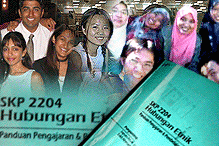 Abdullah, who talked so much about improving ethnic relations, seems not to have provided the crucial leadership. Indeed, his government seems to have damaged ethnic relations somewhat. The recent publication of a 'guidebook' to teach ethnic relations in Universiti Putra Malaysia (UPM) basically questioned the role of non-Malays.
In a more specific sense, the book co-authored by some UPM academics blamed the 1969 racial riots on the Democratic Action Party a leading opposition party; blamed the Kampung Medan racial attacks on Indian youths; and castigated the role of Suqiu, a Chinese organisation, as having 'extremist' tendencies.
Although the book has been withdrawn as result of Abdullah's directive, it has created doubts in the minds of many non-Malays as to the sensitivity of the government and educational institutions towards them.
The higher education ministry has since given permission for a new ethnic relations textbook, although the panel includes the same academic advisors responsible for the guidebook. Many wonder how this textbook is going to improve ethnic relations in campuses where racial and religious polarisation is at its height.
Time to take control
Some academics wonder why the government is bent on producing textbooks on ethnic relations as compulsory reading material. Apart from the need to make profit, textbooks written by narrow-minded academics do not contribute much to improve race relations.
On the contrary, ill-advised and badly written textbooks like the one withdrawn, cause more harm to already- strained ethnic relations. The ministry does not seem to be equipped with imaginative ideas in improving ethnic relations among young Malaysians.
Improvement of ethnic relations cannot emerge from ad hoc responses such as the production of textbooks or asking students and lecturers to take oaths of loyalty. In a more fundamental sense, a good start to improving ethnic relations should come by the way of the government eliminating various discriminatory policies against non-Malays.
 To many analysts, Abdullah's short term in office has been a disappointment. His campaign to rid the country of corruption has come to a dead end. Questions such as transparency and accountability do not feature as important concerns anymore.
There is strong belief the attacks by his predecessor has destabilised him and his administration so much so that the country is afloat without a firm hand on the tiller.
Abdullah has no choice but take control of himself and situation. He has to defend himself, his administration and his family against Mahathir's attacks. Failure would mean not living up to what citizens expect of the prime minister of Malaysia.
P RAMASAMY is currently editing a book on 'Rising India and Indians in East Asia' and researching on a book on Malaysian politics. This is a personal comment.


