




Migrating with dignity
Migrants are human beings. All human beings have rights, and all human beings have the right to have rights. This is a fundamental concept that should be at the core of all debate, policy and action on migrant workers in Asia.
This call has been made loud and clear in discussions on migration held in recent weeks at the national and regional levels in Asia, in the context of an upcoming United Nations meeting on international migration and development.
The Asian Forum for Human Rights and Development (Forum-Asia) was present at these consultations, along with government officials, representatives of national human rights commissions, UN agencies, non-governmental organisations, civil society activists, academic experts and, crucially, representatives of migrant communities themselves.
Migrants are human beings. All human beings have rights, and all human beings have the right to have rights. This is a fundamental concept that should be at the core of all debate, policy and action on migrant workers in Asia.
This call has been made loud and clear in discussions on migration held in recent weeks at the national and regional levels in Asia, in the context of an upcoming United Nations meeting on international migration and development.
The Asian Forum for Human Rights and Development (Forum-Asia) was present at these consultations, along with government officials, representatives of national human rights commissions, UN agencies, non-governmental organisations, civil society activists, academic experts and, crucially, representatives of migrant communities themselves.
In addition to providing input to the forthcoming UN High Level Dialogue on International Migration and Development (to be held in New York from Sept 14-15), these stakeholders have been debating the current state of migration in the Asian region.
The UN Dialogue will primarily be an inter-governmental forum to discuss the multi-dimensional aspects of international migration and development in order to identify appropriate ways and means to maximise the development benefits of migration and to minimise its negative impact.
Asian governments will be sending representatives to this discussion, and we believe this is the time for them to begin to bring coherence to their migration policies and to firmly locate these policies within a human rights framework.
Recent initiatives
Within the Asean context, member-states are currently discussing the creation of a multilateral framework to protect and promote the rights of migrant workers. Their commitment was recently re-affirmed at the fifth workshop on the Asean Regional Mechanism on Human Rights, held in Malaysia.
 Importantly, it affirmed "the need to encourage governments to ratify all relevant UN conventions and protocols related to migrant workers, refugees and asylum seekers, and to act on commitments made".
Parallel civil society initiatives seek to ensure that the voice of migrants is heard clearly throughout the Asean process, and that national and international human rights and labour law and standards are upheld at the highest common denominator.
Among other elements, civil society has stressed that the framework should address the human rights of migrants in a holistic manner, and has identified the need for the framework to incorporate a mechanism for systematic reporting on the situation of migrants in Asia.
Recent initiatives on migration in the region have also included a examination of the role of national human rights institutions in protecting the rights of undocumented and women migrant workers (organised by the National Commission on Violence Against Women in Indonesia), and a conference on the challenges of global migration and forced displacement (organised by the UN office in Malaysia as a prelude to the Dialogue).
Reality of migration
Who takes part in the movement of an estimated 50 million documented international migrants to Asian countries (in addition to the undocumented or irregular migrants who rarely appear on official statistics, the often uncounted millions of internal migrants, as well as Asians who move to other continents)?
While we must recognise the particular and special protection needs of refugees and asylum seekers who are fleeing serious human rights violation in their countries of origin, the fact remains that in Asia, refugees and migrants move together in search of security, safety from persecution, economic opportunity, and protection from deficits of development.
 In the cycle of movement, migrants can be in refugee-like situations as conditions in their home countries deteriorate, and refugees will require the same protections against abusive employers and unsafe conditions at their places of work as migrant workers.
Victims of trafficking, whether trafficked for forced prostitution or forced labour, will require protection from and redress for the abuse they have suffered.
We cannot turn a blind eye to the human rights violations that are so prevalent a feature of migration, or pretend that the current picture is a rosy one. It is only by being honest about these abuses, and the nature of the perpetrators (be they government officials or the employers of migrant workers, traffickers in people or transnational corporations) that the debate on migration will be able to move forward, and policy-makers will be able to construct realistic and rights-respecting policies.
Recent news reports of the operations of "gangster gangs" who prey on Burmese migrants on the Thai-Malaysia border are a vivid reminder of the extreme vulnerability of many migrants in this region, who endure torture and work in slave-like conditions because they have no other option. They cannot simply return to their countries of origin because of insecurity, including insecure access to food and work, and violence in those countries:
"Those who have no contacts are beaten inhumanly and threatened with weapons. If the gangsters believe they really have no contacts to pay them money, the men will be sold to Thai fishing boat owners and the women will be sold to brothels in Thai territory. The women will be locked up and raped. The men will be stranded on Indo fishing ships for as long as two to three years and face extreme hardship at the hands of the boat's owner," according to a burmanet.org report on July 20.
Unhelpful conceptualisation
The current conceptualisation of "migration management" being promoted in the international community is, in our opinion, overwhelmingly reductive and indeed ultimately unhelpful. Conceived very narrowly in terms of the costs and benefits of migrants to 'sending' and 'receiving' states, all too often the government-driven discourse of management emphasises control, containment and even criminality of the migrants themselves.
Even when it seeks to emphasise the positive elements of migration, it looks at the migrant as an "agent of development", a "provider of remittances", and a pool of cheap labour that would do dirty, dangerous and demeaning work that native workers are unwilling to do. The human rights implications of treating human beings as commodities or temporary units of labour are stark.
In a report released last month, Human Rights Watch noted: "Women and girls employed as domestic workers in private households are often at risk of psychological, physical, and sexual abuse. These risks are heightened given their isolation, the imbalance of power between employer and domestic worker, lack of information or ability to seek help, and financial pressures and debts that make them afraid to lose their employment."
An Indonesian domestic worker interviewed by the organisation stated of her Malaysian employers: "It was hard to work for them because there was not enough food. I got food once a day. If I made a mistake, for example, if we ran out of rice and I forgot to tell the employer, she wouldn't give me food for two days."
Temporary migration programmes typically do not allow the migrant to bring their family with them to their country of employment, condemning in particular many children of migrant domestic workers in Asia to a childhood without their mother.
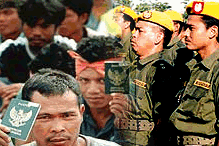 Many tie the migrant worker to one employer, leaving open the door to serious human rights violations as the migrant feels unable to confront the abusive employer for fear of deportation, or feels finally compelled to leave that employer and enter the irregular economy as an undocumented worker.
Many such temporary programmes also place disproportionate power in the hands of recruitment agencies, who charge excessive fees of migrants before they even get to the country of employment, misinform them about the conditions under which they will be working, and oblige them to sign misleading or fraudulent contracts.
Fourteeen Thai workers are currently demanding justice from a Taiwanese company that forced them to live in a severely overcrowded dormitory and restricted their movement out of their living quarters.
An Asianews report last November stated: "Payday is often late and salaries are paid to the workers' 'agents' and not to the workers themselves. What is more, people have to pay to get a job."
Term Laiyarat, who comes from Umnardcharoen province, was quoted as saying: "I had to pay US$4,500 instead of the $1,500 the government demanded."
Samarn Duongsithong, from the province of Sakonnakorn, said he was sent away without even a penny as compensation after suffering a disabling accident in the factory.
Right policy response
We do not deny the government of a country the right to 'manage' its borders, or to control who enters and leaves it's territory, but note that migration management policies must be developed and implemented with due regard for the human rights obligations voluntarily assumed by states. This includes the right to family unity as recognised within the Universal Declaration of Human Rights and other standards.
The policy response to migration needs a firm hand on the tiller if we are not to continue the drift towards unilaterally devised and arbitrarily applied policies which benefit no one, save perhaps abusive employers, traffickers and corrupt government officials.
The call from civil society in Asia is to premise migration policy on the following principles:
1. Migration policies in Asia must be based on common standards that respect human rights and fundamental freedoms, and take account of the root causes of migration. In accordance with the UN secretary-general, all governments should ratify and implement the provisions of international human rights treaties, particularly the International Convention on the Protection of the Rights of All Migrant Workers and Members of their Families and the 1951 Convention relating to the Status of Refugees.
2. Using the international human rights architecture as the benchmark, policies on migration and development should ensure that they aim explicitly to promote and protect the human rights of all migrants, regardless of their status, and pay particular attention to ensuring that discrimination against and abuse of vulnerable migrants, including women, children and irregular or undocumented migrants, is not perpetuated.
3. Migration policy-making should be accountable, transparent and joined up; including through ensuring that the different branches of government actually talk to each other, and avoid incoherence in policy-making. And most importantly, any rush to the bottom - i.e. to make migration policy in contravention of human rights standards - should be avoided, as should pressure from more developed countries to use poorer countries as their policemen and border guards, using development aid as leverage in this regard.
 4. In accordance with the basic principle that duty-bearers of human rights have obligations, all policies on migration must ensure that there is effective access to remedies and redress for individual migrants and migrant communities that have had their rights violated as a result of policy or practice. Governments should ensure that recruitment agencies, employers of migrant workers (including private individuals who employ domestic workers), and human traffickers are brought to justice for violating the human rights of migrants.
5. Migrant communities and civil society should be properly consulted in the making of policy. It has long been understood that migrants and other civil society actors are central to the migration debate and excluding them results in decisions and conclusions that are at best partial and distorted and at worst discredited and ineffective.
In order to be able to make better policy on migration, we need to start being honest about the issues and the solutions, and we need to realise that no one government, institution or organisation has the answer.
It is only through long and painstaking dialogue between the different actors at many different levels - local, national, regional and international dialogue that is firmly anchored in human rights norms - that we will begin to achieve the goal of benefitting economically and socially from migration, while ensuring that vulnerable migrants and refugees are protected from human rights abuses and are able to migrate with dignity.
PIA OBEROI is attached to the Asian Forum for Human Rights and Development, a membership-based human rights organisation based in Bangkok.


