




COMMENT | How much testing is enough? It’s complicated
COMMENT | One of the key measures of a country’s Covid-19 response is how much testing is done. The more cases in the community, the greater the need to expand testing to keep pace with the outbreak.
But just how much testing is enough?
At a press conference on Tuesday, Health Ministry director-general Dr Noor Hisham Abdullah said the benchmark set by the World Health Organisation (WHO) is to have at least ten negative tests for every person found to be positive.
In other words, the test positivity rate should be no higher than about 10 percent. Any higher, it suggests many cases are being missed.
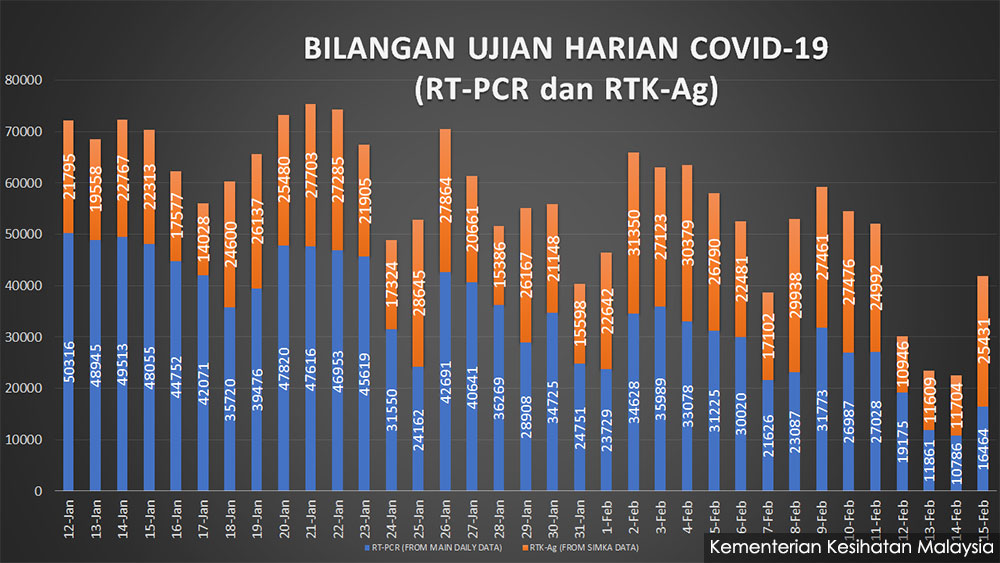
Noor Hisham then went on to say that Malaysia had far exceeded that standard. On Monday, the country detected 2,176 cases against 41,895 RT-PCR and RTK-Ag tests performed.
This corresponds to a positivity rate of 5.19 percent.
However, several sources including health experts quoted in previous Malaysiakini reports had instead cited a five percent figure as the benchmark to meet. One source, the website "Our World in Data", even cited WHO for setting it as the benchmark.
So, who is right? And how did ...
COMMENT | One of the key measures of a country’s Covid-19 response is how much testing is done. The more cases in the community, the greater the need to expand testing to keep pace with the outbreak.
But just how much testing is enough?
At a press conference on Tuesday, Health Ministry director-general Dr Noor Hisham Abdullah said the benchmark set by the World Health Organisation (WHO) is to have at least ten negative tests for every person found to be positive.
In other words, the test positivity rate should be no higher than about 10 percent. Any higher, it suggests many cases are being missed.
Noor Hisham then went on to say that Malaysia had far exceeded that standard. On Monday, the country detected 2,176 cases against 41,895 RT-PCR and RTK-Ag tests performed.
This corresponds to a positivity rate of 5.19 percent.
However, several sources including health experts quoted in previous Malaysiakini reports had instead cited a five percent figure as the benchmark to meet. One source, the website "Our World in Data", even cited WHO for setting it as the benchmark.
So, who is right? And how did different sources attribute different numbers to WHO?
Evolving answer, evolving situation
As it turns out, WHO has been constantly revising its guidelines as the Covid-19 pandemic plays out across the world.
The agency regularly publishes and updates its technical guidance to help policymakers assess the situation in their respective countries and find ways to respond.
One of the earliest instances where the 10 percent figure was mentioned appears to be in March last year, just weeks after it started describing the Covid-19 outbreak as a “pandemic”.
At a press conference at WHO's Geneva headquarters, its health emergencies programme executive director Dr Michael Ryan said: “We would certainly like to see countries testing at the level of 10 negative tests to one positive, as a general benchmark of a system that's doing enough testing to pick up all cases.”
In the same breath, however, Ryan also emphasised that this is not a hard-and-fast rule, nor is the 10-to-1 ratio “an objective”.
Later, on May 12, 2020, WHO published guidelines on when policymakers should consider adjusting their public health and social measures for controlling the pandemic.
This is where the five percent figure made its appearance.
In the document, WHO told policymakers that one of three issues to consider is: Has the outbreak been brought under control?
The best indication of this, it said, is if the effective reproduction number (Rt) is kept below 1.00 for at least two weeks. This would show that the outbreak is “controlled and declining”.
But if a country lacks the capacity to come up with a reliable estimate for Rt, WHO also proposes several criteria that policymakers might use to assess their situation.
One of the seven criteria proposed as alternatives is: “Less than five percent of samples positive for Covid-19, at least for the last two weeks, assuming that surveillance for suspected cases is comprehensive.
“The percentage of positive samples can be interpreted only with comprehensive surveillance and testing of suspect cases, in the order of one test per 1,000 population per week.”
Nuance is the new norm
However, those May 2020 guidelines have since been superseded by the latest guidelines issued on Nov 4, 2020, following a review of the available data.
It recommends that countries monitor the number of tests being conducted as a measure of its disease surveillance and says there should be at least be one person tested per 1,000 population per week and not only limited to a specific population (such as city dwellers who might have easier access to testing).
For comparison, this is equivalent to testing 4,571 people in Malaysia per day. Malaysia had tested nine times that number on Monday, even as it recovers from a lull in testing over the Chinese New Year holidays.
However, the guidelines also go on to propose indicators for the level of Covid-19 transmission in the community and the healthcare system’s preparedness to handle those cases.
It provides guidance for policymakers to gauge and compare those indicators and also suggests public health and social measures that should be taken in various situations.
Rather than just one main indicator for the level of Covid-19 transmission as with the earlier guideline, the current guideline stipulates four main indicators that should be taken into account jointly.
One of these indicators is the test positivity rate at “sentinel sites”.
For example, if the test positivity rate at these sites is five percent or more, but less than 20 percent, that corresponds to “high incidence” of Covid-19 transmission in the community. However, it said these thresholds should be adjusted based on local conditions.
Sentinel sites are hospitals and clinics that routinely collect laboratory samples and conduct epidemiological investigations into infectious respiratory diseases as part of a global disease surveillance network. As of 2015, over 20 government healthcare facilities have been designated as such.
It said policymakers should also monitor trends in the overall test positivity rate from non-sentinel sites. This is described as an “additional” indicator.
“This may be useful if there are limited sentinel sites. It may capture atypical cases better than sentinel surveillance. This is heavily influenced by testing strategy and capacity,” it said.

However, the guidelines do not prescribe a target for the overall test positivity rate, or even what a given number might mean.
Rt, which was the one main indicators in the previous guideline, is now relegated to just being among several suggested additional indicators together with the overall positivity rate.
The Rt was 0.91 as of yesterday.
This means that for every 100 infected people, they would spread the disease to 91 other people over the course of their illness.
In other words, the outbreak is shrinking. Moreover, the Rt at the national level is below what is needed to sustain an outbreak for 13 days straight and counting.
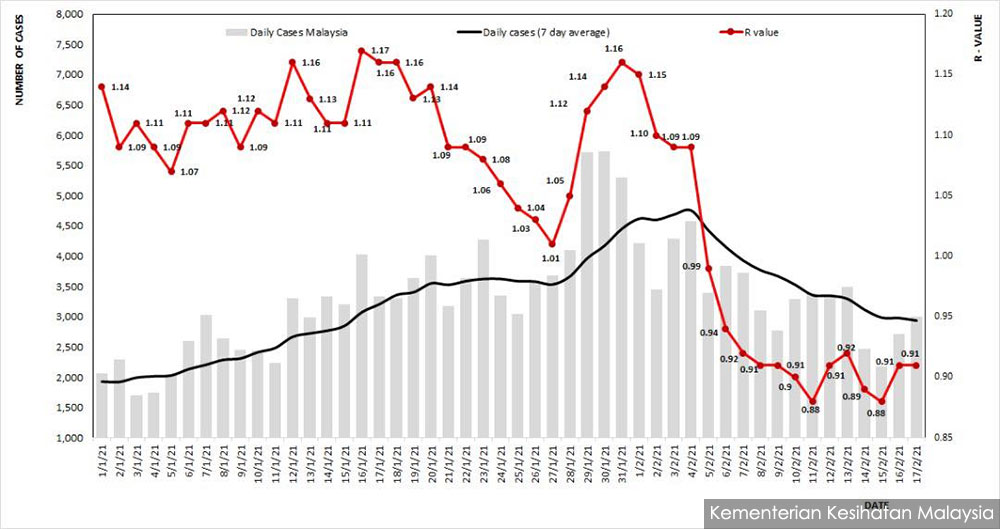
However, the 45,251 new cases recorded over the past 14 days shows that we are not out of the woods yet.
Other reasons for optimism
Notwithstanding doubts that members of the public might have regarding testing, there are still reasons to believe that the current downtrend in the number of Covid-19 cases is genuine and not solely an artefact of reduced testing.
For example, severe Covid-19 cases and deaths are hard to miss, even though they will take several weeks to manifest after the initial infections.
In trying to keep its daily Covid-19 reports relevant, Malaysiakini has changed its reporting format several times since the beginning of the pandemic.
The most recent changes highlight trends in the number of patients receiving intensive care as well as the number of deaths.
At least for now, the numbers show that the number of Covid-19 patients in ICUs has fallen from its peak of 327 cases on Feb 2 to 231 cases yesterday.
And despite a spike in Covid-19 deaths yesterday, the overall trend shows the number of deaths is reaching a plateau.
For the record, fatal Covid-19 cases typically take two to eight weeks to reach their conclusion after the onset of symptoms so the impact of the movement control order on deaths probably hasn’t fully kicked in yet.
At his most recent press conference, Noor Hisham concluded by saying that the Health Ministry expects new Covid-19 cases to fall below 1,000 cases per day in April and below 100 cases per day in May.
That is if people still take the coronavirus seriously and continue to take precautions.
Let us strive to make this happen, so we may move on with our lives.
KOH JUN LIN is a member of the Malaysiakini team.






Report this comment
Are you sure you want to delete this comment?
This action cannot be undone.