



COMMENT | From Russia with love: Living amongst the Semai
COMMENT | The right teacher inspires and motivates; the wrong teacher will dampen the child's desire to learn and possibly deny him many opportunities in life.
The right teacher gives the child a head-start in life. He is eager to open a book, learn a language and ask questions. He is thirsty for knowledge.
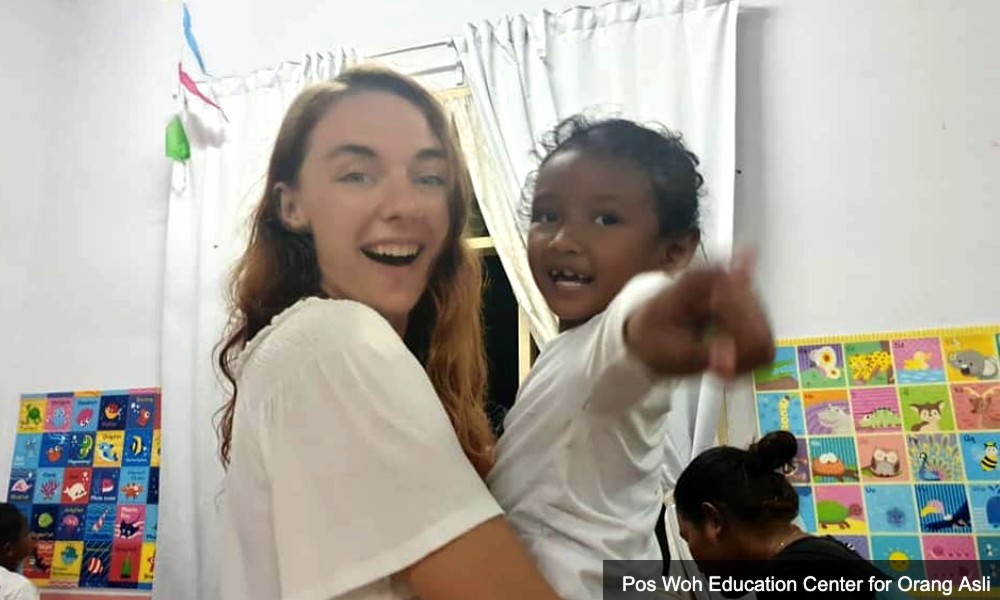
One teacher, who did just that in Pos Woh, an Orang Asli hamlet near Tapah, is 31-year-old Russian Valeriya 'Valerie' Astashova.
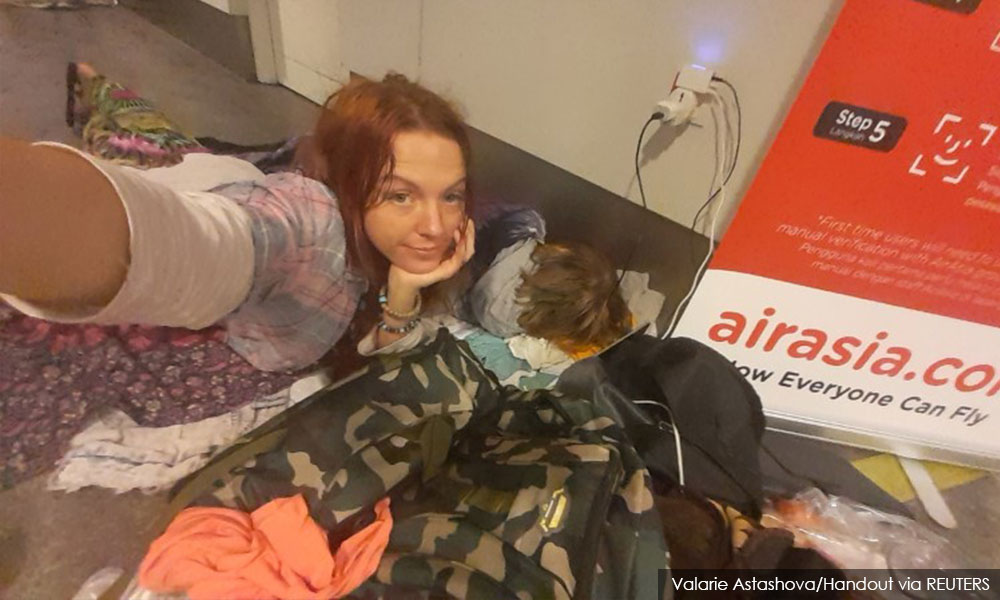
Most readers will recognise her from this report of March 2020 about air travellers stranded at KLIA2.
Almost a year later, Valerie was again in the news when it was reported that the Department of Orang Asli Development (Jakoa) had told her to leave the village which she had called home for the past six months.
Apart from the children of Pos Woh, their parents and Valerie's close friends, few will know of the depth of gratitude and affection that the villagers have for her. With limited resources, she introduced them to a new world of learning, not just for the children but also their parents.
Pos Woh has around 300 residents, with 87 children whose ages range from babies to 17. Soon after her nightmare at KLIA2, Valerie went on a mission to deliver food aid to the Orang Asli. She noticed that the village lacked a school, so she volunteered to be the teacher-on-site...
COMMENT | The right teacher inspires and motivates; the wrong teacher will dampen the child's desire to learn and possibly deny him many opportunities in life.
The right teacher gives the child a head-start in life. He is eager to open a book, learn a language and ask questions. He is thirsty for knowledge.
One teacher, who did just that in Pos Woh, an Orang Asli hamlet near Tapah, is 31-year-old Russian Valeriya 'Valerie' Astashova.
Most readers will recognise her from this report of March 2020 about air travellers stranded at KLIA2.
Almost a year later, Valerie was again in the news when it was reported that the Department of Orang Asli Development (Jakoa) had told her to leave the village which she had called home for the past six months.
Apart from the children of Pos Woh, their parents and Valerie's close friends, few will know of the depth of gratitude and affection that the villagers have for her. With limited resources, she introduced them to a new world of learning, not just for the children but also their parents.
Pos Woh has around 300 residents, with 87 children whose ages range from babies to 17. Soon after her nightmare at KLIA2, Valerie went on a mission to deliver food aid to the Orang Asli. She noticed that the village lacked a school, so she volunteered to be the teacher-on-site.
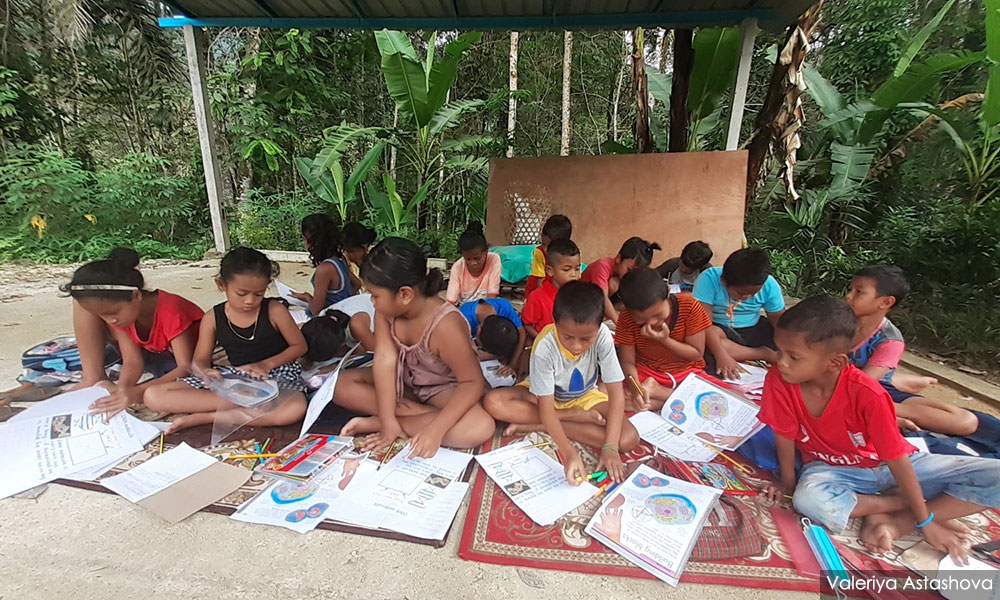
Where previous teachers had failed, the children of Pos Woh found learning to be a joy with Valerie, and under her tutelage, they became relatively fluent in English. They were inquisitive, they wanted to know more about the world around them.
With a shortage of reading material, Valerie contacted her network of friends in Kuala Lumpur, and books, teaching aids, furniture, colour pencils, crayons and paper were delivered.
Such was the enthusiasm of the children for learning that early in the morning, some of the children were already waiting outside the building waiting for her class to begin.
Incredibly, parents, who must have noticed the change in their children, also started to enrol at her school to learn English. The adult classes had 14 people, and were open three times a week, for sessions of three hours. One pupil was a 90-year-old woman.
Valerie, having volunteered and sought the necessary permits from the authorities to teach and live in Pos Woh, plunged into her new post with relish.
When asked how she secured her new responsibility, she said, "I asked the village head if the villagers would be interested to have an eight-week English programme for their children, and maybe adults. I had English study materials and plenty of experience teaching English to children of different cultural backgrounds.
"With 100 percent support from the villagers of Pos Woh, I applied for the permit to conduct a humanitarian programme for Jakoa. I wrote a proposal, attached my diplomas, CV with the list of humanitarian projects in which I had been involved, references and recommendation letters.
"The head of Jakoa in Tapah gave me permission to move to Pos Woh and start setting up the learning centre.
"Jakoa took three months to grant me the permit, and after a request from my students and their parents, the original eight-week term was changed to one year.
"Jakoa approved our request and on 14 December 2020, they granted me a permit to conduct the educational programme until 31 October 2021."
Basic facilities
Valerie said that the first fortnight of settling in was the most challenging.
"When I arrived at Pos Woh, no one spoke English. There was no mobile network, so I couldn't use Google Translate. Fortunately, the driver Mr Gopal, translated for me. When he left, I used a Malay-English dictionary and hand gestures to communicate.
"After a few weeks, I learned a lot of Semai words and phrases, but Kyri, my 10-year-old son, was fluent in Semai after three months."
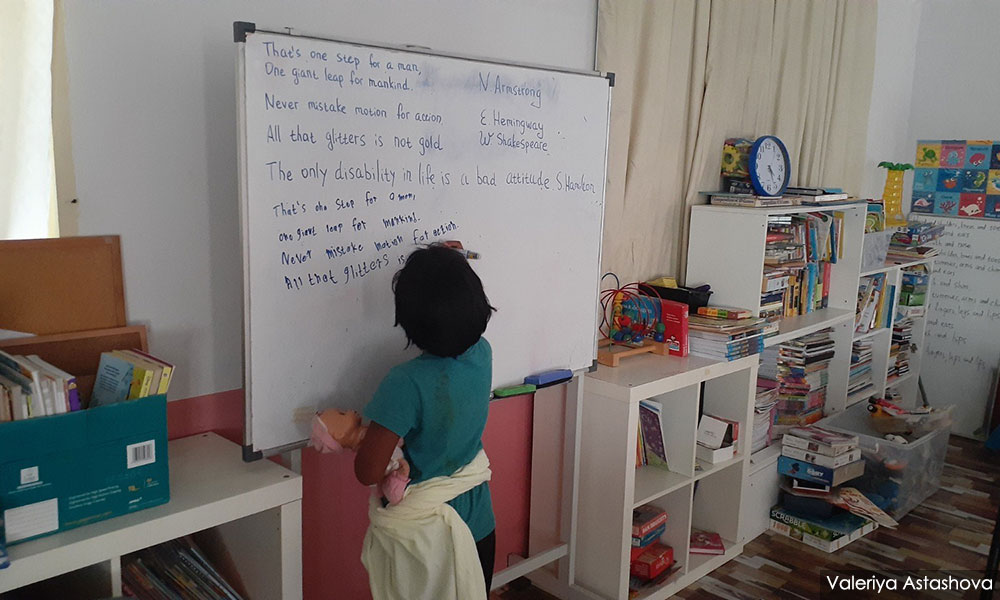
A few families in Pos Woh live in concrete homes, but most villagers live in traditional Semai huts, most of them without running water, some without electricity.
Valerie had not experienced life without modern facilities and had to make do with basic facilities. She found the local women very supportive and welcoming.
"They were very patient when teaching me daily survival basics, and we all laughed at my clumsiness in simple things, like doing laundry at the river. I've never had to wash anything by hand before."
Valerie said that she had learnt more from the Semai than they from her, and said that it was an amazing experience to be shown the beauty of the jungle, living in harmony with nature, survival in the wild, going barefoot, washing in the river, climbing boulders and learning about the different plants.
"The students of Pos Woh were the most enthusiastic, curious and motivated that I have ever had. We focussed on English but after a few weeks we explored other academic subjects, like physics, chemistry, biology, astronomy and geography."
The students were keen to know more, so she taught them everything she knew. They talked about the continents and oceans, the structure of the atom, the solar system, human anatomy, entomology, ancient civilisations, Isaac Newton, Galileo, the composition of the Earth, the history of the civil rights movement, cells and DNA, the standard model of elementary particles, Magna Carta and Emancipation Proclamation, climate change, Nikola Tesla and Albert Einstein.
After school, Valerie found more opportunities to bond with the community. Being vegetarian, she found it quite challenging in the beginning as most Semai dishes contain chicken or wild boar. In an exchange of cultures, they organised weekly cooking lessons. She taught them vegetable curries and borsch. They showed her the various dishes containing petai, jungle greens and tapioca.
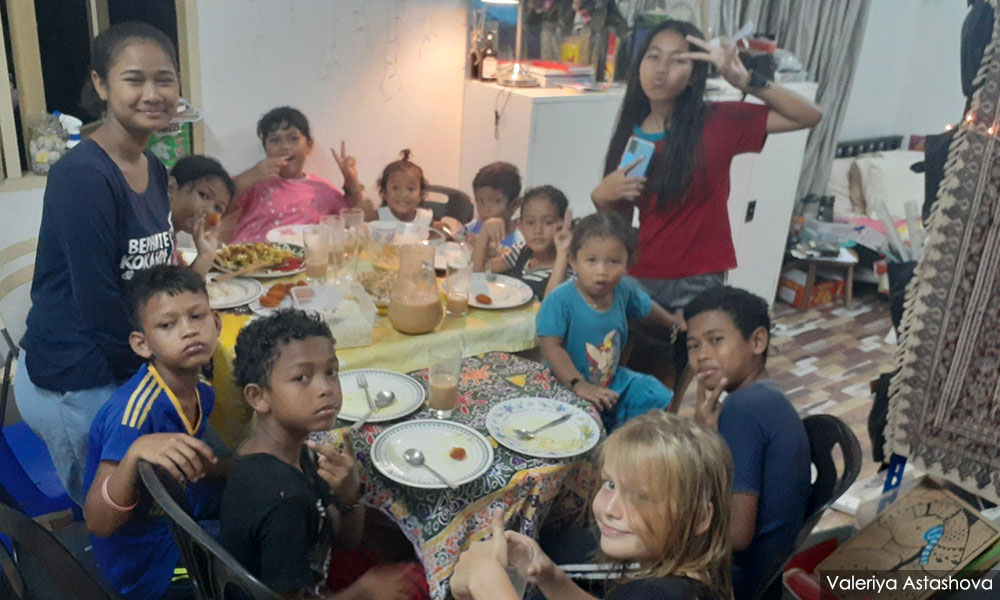
When she fell ill two months after her arrival, the women in the community rallied round to take care of her and nursed her back to health with a local medicinal herbal brew.
Valerie is sad that she has been asked to leave the village but hopes the students will continue learning with the help of two of her most promising students.
She had this message for the Semai at Pos Woh,
"I love you with all my heart. I love my students so much, and nothing will change that, ever.
"We spent six months living together, spending every minute together, eating and sleeping under the same roof, overcoming challenges and supporting each other in very difficult times.
"You are my family. The indestructible bond we have will not be affected by distance."
Both Valerie and the Semai of Pos Woh enriched one another's lives. She opened their eyes to a world of science, invention, art and philosophy. She made learning fun.
They showed her the secret of happiness. She treasures the Semai definition of "punan", which is to value the other person's comfort above one's own.
She said, "They are completely, sincerely happy, content with the gifts provided by the bounty of the tropical rainforest. Greed and envy are rare among the Semai."
More importantly, Valerie has shown the children of Pos Woh that they are achievers. Given the right tools and encouragement, they can make a difference and change the world.
(Update: Valerie's permit was terminated on 8 March 2021. No reason nor warning was given.)
MARIAM MOKHTAR is a defender of the truth, the admiral-general of the Green Bean Army and president of the Perak Liberation Organisation (PLO). Blog, Twitter.
The views expressed here are those of the author/contributor and do not necessarily represent the views of Malaysiakini.


Report this comment
Are you sure you want to delete this comment?
This action cannot be undone.