


COMMENT | Postcards, nostalgia and the reimagining of M'sia
COMMENT | The past, in hindsight, is always more comforting, especially in the context of the fractious present. Yet nostalgia is never a simple operation, especially not in our longing and fascination for Malaysiana – for the old photographs and kopitiams, bicycling past the estates and paddy fields, Sudirman’s vocals and above all things, a less divided society.
But to echo Show Ying Xin’s thoughts in Revisiting Malaya, this view overlooks the messiness of the past: colonial exploitation, warfare and resistance all through the Cold War and the attendant paranoia, riots and multiple declarations of emergency. Yet this notion of the idyllic past, sepia-tinted and wistful, can be subverted by the same media that operationalises it.
The postcard has been a staple format of packaging nostalgia, hopes and dreams for a long time, an innocuous piece of stiff paper cycling through the postal network, from one hand to another. Evolving alongside the postal service, eventually coming into vogue in the second half of the nineteenth century, particularly pioneered by the Germans, and eventually, the Straits Settlements issued their first postcard in 1879.
As Alan Teh writes in the New Straits Times, postcards took on a greater life, capturing scenes of Malaya for the curious and circulating through the postal network, printed by both foreigners and locals alike. They have become historical documents in their own regard, and have gathered more than a passing interest – for instance, Lin Yangchen has curated a brief but informative exhibition on the stories associated with them.
But the postcard does not necessarily need to buttress the existing historical narrative, and a new experiment, decisively counter-hegemonic in its ambitions, although playfully irreverent on the surface is the...
COMMENT | The past, in hindsight, is always more comforting, especially in the context of the fractious present. Yet nostalgia is never a simple operation, especially not in our longing and fascination for Malaysiana – for the old photographs and kopitiams, bicycling past the estates and paddy fields, Sudirman’s vocals and above all things, a less divided society.
But to echo Show Ying Xin’s thoughts in Revisiting Malaya, this view overlooks the messiness of the past: colonial exploitation, warfare and resistance all through the Cold War and the attendant paranoia, riots and multiple declarations of emergency. Yet this notion of the idyllic past, sepia-tinted and wistful, can be subverted by the same media that operationalises it.
The postcard has been a staple format of packaging nostalgia, hopes and dreams for a long time, an innocuous piece of stiff paper cycling through the postal network, from one hand to another. Evolving alongside the postal service, eventually coming into vogue in the second half of the nineteenth century, particularly pioneered by the Germans, and eventually, the Straits Settlements issued their first postcard in 1879.
As Alan Teh writes in the New Straits Times, postcards took on a greater life, capturing scenes of Malaya for the curious and circulating through the postal network, printed by both foreigners and locals alike. They have become historical documents in their own regard, and have gathered more than a passing interest – for instance, Lin Yangchen has curated a brief but informative exhibition on the stories associated with them.
But the postcard does not necessarily need to buttress the existing historical narrative, and a new experiment, decisively counter-hegemonic in its ambitions, although playfully irreverent on the surface is the first book by the Kuala Lumpur-based cloud projects. Each page is perforated, allowing the reader to tear out postcards featuring scenes from the past all the way to the present, ready to be dropped into the mail with a message scribbled on it.
But a closer look shows a different sort of project is at work – one where the reader/postcard-sender becomes part of the construction and consolidation of a collective memory, working as a counterpoint to the hegemony of Malaysia’s official history.
The bilingual Banned in KL, Astro Boy Rides the Wave to Sky Kingdom on A Grasshopper is virtually impossible to categorise into any one genre. It takes as its point of inspiration the works of the artist Mohamed Hossein Enas, which were collected into a book called Malaysians, a grand project commissioned by Shell.
He was sent out in order to paint portraits of the new nation-to-be, and the book was released in 1963, that hopeful year whose promises soon unravelled as the geopolitics and dynamics of the postcolonial and Cold War period stayed their course.
Buried at its core was an older need to catalogue, collect and organise – the same vision that could trace its genealogy back to the more unsavoury compulsion to control and document one’s surroundings, such as the magisterial The History of Java by Thomas Stamford Raffles, who briefly lorded over Java following its conquest by the British.
But in an alternative vein, Banned in KL sets out to grapple with the implications of such projects, curating a selection of telling images to retell other stories and possibilities of Malaysia.
Cloud projects is deliberately nonconformist. A new publishing collective consisting of Sheau Yun Lim, Ong Kar Jin and designer Amanda Gayle, this is their first foray into publication, hoping to specialise in critical books which straddle the balance between beautiful design and critical analysis.
Their collection of images came from various sources, some reproduced from the collections of the Malaysia Design Archives. The Archive, inspired by a visit to Cuba and currently housed in the Zhongshan Building at Kampung Attap, has assembled a collection of wonderful, serendipitous collection of works, visual records from the collection of states and colonies that eventually coalesced into the artificial creation that was Malaysia.
While nation-building requires a founding myth, a coherent narrative, any number of stories can emerge from a collection of images. What story emerges from vintage grasshopper swatters and Astro Boy ice cream wrappers?
These images became a departure point for telling an alternative history of Malaysia, while remaining cognisant of the arbitrariness of their images and the inherent artifice of the project Here. There are no founding myths, no illustrious grand past, no arcs of redemption and pride, rather there is a motley collection of images – a Malay woman refusing to humour a colonial photographer, a listless staged Boria performance for RTM, and an underground punk poster for the since-demolished Voodoo Lounge.
“The choice of images and material was an attempt to fly in the face of official narratives and official histories – how do we stop doing history and start writing non-hegemonic histories?” the collective notes. Yet there was no shortage of links that could be drawn between different periods and Images.
A similar spirit of irreverence and experimentation could be found in the zines of KL’s punk scene during the “globalised”, Tiger Economy years, the same way that found photographs and illustrations of Western provenance came to adorn the books produced in Riau, that grand seat of Malay print-culture, becoming exotic ornament for the syair and hikayat produced for a curious readership.
Ultimately such a collection can only be an introduction, an unlocked door to other hidden stories. Do they tie in with the nation-building project? Perhaps not, but they offer a more human side to the artificiality that is often produced, where the high notions of diversity and multiculturalism veer more closely towards apathy and a resigned coexistence.
This is where the power of found objects is expressed, one where the on-the-ground reality is freer from the carefully constructed visages of the imagined nation. They form a counterpoint of diffuse, collective memory in contrast to the hegemonic impulses of official history.
The French historian Pierre Nora, in his article Between Memory and History: Les Lieux de Mémoire, has written about the contestation between memory and history, declaring that “far from being synonymous, (they) appear now to be in fundamental opposition”.
Where history stamps its reconstruction of the past in place, Nora’s conception of memory is as a living and vital creature, a dynamic phenomenon in its own right. And while Nora appears unconvinced about modern memory, reducing it to an evermore burdensome process of archival and recording for posterity, determined to hold on to whatever we can of a past that has been lost to us by the disruptions of the modern world, the archives do contain the possibility of reinterpretations and reincarnations of memories of other places and possibilities, rather than simply being compulsive, uncritical repositories.
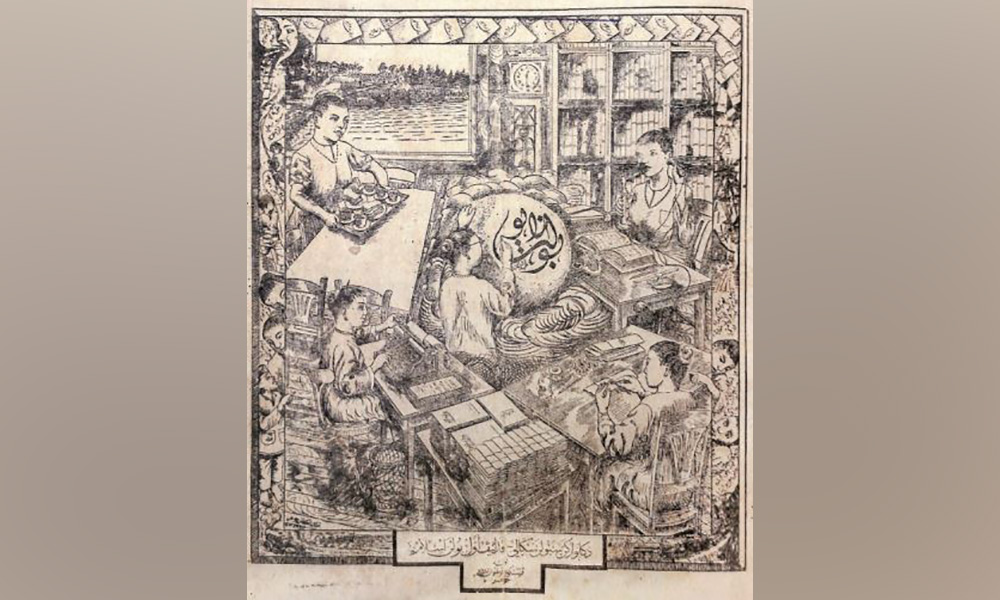
From the Malaysia Design Archive’s collection, one of the images that came most prominently to mind was an illustration from the magazine Bulan Melayu. Featured in Banned in KL, it allows for a richer heritage of the process of nationalism and modernisation.
The original, along with other historical magazines and print material, is currently in the voluminous, temperature-controlled collections of the National Archive, allow for fresh storytelling possibilities. USM's Mahani Musa has written more about the politics of this group of women from Johor who worked for a feminist cause, despite the domination of male intelligentsia.
Even though they worked within the context of their time, and did not demand full emancipation, their ethos is clear from an excerpt of an explanation of their aims in the first issue of the magazine.
It is useful to reproduce it at length: Perbuatan mengeluarkan majalah perempuan oleh perempuan seperti yang telah kita jadikan ini nyatalah suatu perbuatan yang cantik dan luarbiasa dalam alam semenanjung Tanah Melayu ini: oleh sebab ia itu menggambarkan cita-cita yang baik daripada pihak perempuan dan angan2nya hendak membuat jasa, dan juga oleh sebab sepanjang pengetahuan kita inilah mula pertama majalah perempuan keluar dalam semenanjung ini.
For us, it is immediately important to recognise this little-known aspect of the past. Although easily overlooked, it tells a different, richer story of the past that can be otherwise gathered through the official narrative.
Past meets present: It is easy to detach the postcard from the book displaying the women of Bulan Melayu, to drop in a mailbox to be sent out, a fusion of theory and content, form and narrative, generating awareness beyond the ordinary channels of historical knowledge.
Mailing a postcard means being part of the circulation of ideas. Like Mohamed Hossein Enas’s paintings, cloud’s project alludes to a nation under construction. Here, nostalgia, for all its ups and downs, its connotations and denotations, is key to understanding the “very palpable sense of loss of what could have been”, but it “also forecloses new horizons: history is not linear, and narrative possibilities open with each perceived loss. We want to do the work of history: to tell stories that present a world of could-bes, not should-have-beens.”
WILLIAM THAM WAI LIANG is an editor at Gerakbudaya and the author of two novels. His new novel, The Last Days, is set in 1981 and covers the continuing legacy of the Emergency. His first book, Kings of Petaling Street, was shortlisted for the Penang Monthly Book Prize in 2017.
The views expressed here are those of the author/contributor and do not necessarily represent the views of Malaysiakini.



Report this comment
Are you sure you want to delete this comment?
This action cannot be undone.