




Shortsighted over transportation woes
When it comes to the country's transportation problems, the government gets pretty shortsighted, with its vision beginning and ending with the transport problems in Kuala Lumpur alone.
No doubt improving Kuala Lumpur's transport system is necessary more so because it is the nation's capital and also the city with all the 'action'. Still, the government must not neglect and turn a blind eye to the transport woes that exist in other states.
And this was exactly what happened when Deputy Prime Minister Najib Abdul Razak recently announced that the government will take on a multi billion-ringgit plan to solve Kuala Lumpur's chronic traffic problems by upgrading public transport in and around the capital.
When it comes to the country's transportation problems, the government gets pretty shortsighted, with its vision beginning and ending with the transport problems in Kuala Lumpur alone.
No doubt improving Kuala Lumpur's transport system is necessary more so because it is the nation's capital and also the city with all the 'action'. Still, the government must not neglect and turn a blind eye to the transport woes that exist in other states.
And this was exactly what happened when Deputy Prime Minister Najib Abdul Razak recently announced that the government will take on a multi billion-ringgit plan to solve Kuala Lumpur's chronic traffic problems by upgrading public transport in and around the capital.
Among others, a new light rail transit line will be built and other rail networks extended under the RM10 billion (US$2.72 billion) project which will run until 2010. And bus services in the Klang Valley which includes the ever congested Kuala Lumpur, will be enhanced with 1,130 new buses while the upgrade work of 600 is already taking place.
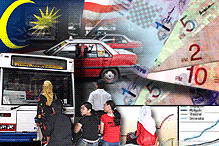 This multi-billion dollar plan is aimed at establishing an efficient and cost-effective public transport system, the hope being that people will opt for it rather than drive cars to move about. Najib said only about 11 percent of people in the Klang Valley use public transport and through the mega expensive project it was hoped that the improvements will see the 11 percent rising to between 40-50 percent as seen in other cities around the world.
Obviously, the multi-billion ringgit plan is not going to solve the perennial traffic jam problems faced especially in Kuala Lumpur and in other states like Penang and Johor Baru. The mega bucks project is not the answer to the problem of traffic congestion.
The answer lies in the efficiency of the public transportation system. The government can increase the fleet of public buses but the scenario will be no different if the public buses are notorious for breaking down midway so often, as is the case at present.
Also, being selective about the number of buses servicing a particular route is another issue. New townships are so often deprived of bus services and the more distant the township from the city, the less frequent it will be serviced by the public buses.
Understand the problem
Our government is so quick to give the public the impression that it is rich through its announcement of mega billion ringgit projects, as half-baked as the projects might be. Yet, the government is ready to lavish money on projects simply to portray to the public that it is concerned with the problems faced by the community at the grass root level. The government's concern while appreciated must come after it has understood the problem at hand thoroughly.
When it comes to public buses, states like Malacca, Ipoh and Penang can do with new, user friendly fleets. The town buses provided in Malacca come with steps so high that it has a pregnant woman or a senior citizen literally crawling their way up the bus. And the bell buttons are placed so high that a person of average height will have to stand on his or her toes to reach it. Now, the buses are there but using them is inconvenient and a hassle. Therefore, do not blame the public if they opt to drive their way around.
Spending big money on public transportation is not going to solve the problem if the buses are not punctual, like present where bus users are forced to wait for hours on end simply because the bus has broken down or the driver concerned decided to skip the designated route to look for a short cut.
The government must not be haste in taking on a project so expensive prior to studying the nature of the problem and the ways and means to solve it efficiently. It must engage in discussions with the respective authorities within Malaysia and outside before deciding on the best solution.
Truth is out there
Rangkaian Pengangkutan Deras Sdn Bhd chief operating officer (operations) Mohamad Ali Mohamad Nor disclosed last year that only 50 percent of the Rapid KL buses are operational on any given day, with the rest sitting in workshops.
(Rapid KL was set up in Nov last year with the merging of Star LRT, Putra LRT, Intrakota bus and Cityliner bus firms and is tasked with providing an integrated public transport system in the Klang Valley, acting as a feeder for the rail and bus services).
As the Transport Workers Union has so well said, the transport sector needs a total overhaul. The union said the core problems facing the transport industry include:
a) multiplicity of operating permits and licenses issued to operators having more 'know who' than 'know how' in the industry.
b) marked absence of cohesiveness and consistency in policy formulation, implementation and enforcement by the authorities.
c) overlapping of jurisdictions over licensing, certification, vehicle testing and enforcement.
d) escalating operating costs.
e) low passenger loads, particularly on rural and over-serviced urban routes.
The transport consortium conceived by the government in the late 90s failed to deliver. Several
Klang Valley bus companies were brought under Intrakota Consolidated and managed by Diversified Resources Berhad. This was followed by Park May Berhad. Truly said, Intrakota was anything but 'consolidated'.
Expensive foreign-manufactured buses, expensive spare parts and rising vehicle maintenance costs, inadequate buses to service the various routes, ineffective 'one-man operator' system resulting in trip delays and road safety concerns, insufficient drivers and hiring of 'irresponsible' individuals as drivers.
Public transport system a mess
All the above resulted in the once admired Intrakota service turning into a mess. Ask any bus commuter and the reply will be unanimous that the buses are in deplorable condition, with faulty or leaky air conditioning units and dirty interior. Punctuality is a concept not known to Intrakota. And mind you, bus fares have been raised, but not the quality of the buses provided.
The situation is no better in the case of feeder buses which ply the LRT stations. They too have no notion of punctuality.
Then comes the problem with the city's taxis. It is no secret that the Road Transport Department has miles to go before city folks and tourists can offer a thumbs-up for the taxi services provided. Every other day we read or hear of a taxi passenger who has been overcharged or the taxi driver refusing to use the meter. And in spite of this daily problems, enforcement and checks by RTD officers on areas where errant cabbies wait for passengers has not improved, but instead worsened.
The KTM service, albeit a little better, too needs an overhaul. The trains never arrive on time and notification of delay in schedule is never prompt.
The only saving grace is the Light Rapid Transit (LRT) service which helps city folks commute efficiently from point A to B. As LRT's use has been tremendously welcomed, it is only wise that the government extend the line of service to the suburbs or destinations not served by the buses and taxis.
The disabled left out?
There is no need to rush into making changes just to show to the rakyat just how concerned the government is. The country does not need another "Middle Ring Road 2" fiasco where billions after billions is being spent to 'cover' up the mistakes made by some irresponsible government official.
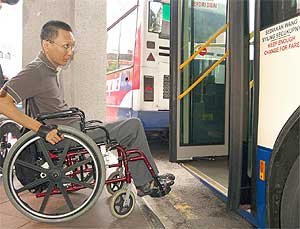 While the government raves and rants about its sincerity in wanting to improve the public transportation system, Abdullah has forgotten to look into the welfare of an equally important group, the disabled. As it is now, the buses and trains, especially the KTM Komuter and Monorail are certainly no blessing for the disabled.
The government has saved RM4.4 billion, no thanks from the fuel subsidies which in turn resulted from the government's decision to increase fuel prices to 30 sen per litre and liquid petroleum gas to 30 sen per kg. And the newly set up Public Transport Trust Fund which has a backing of RM4.4 billion, saved at the rakyat's expense, must deliver.
The people, while having had enough of the government's rhetoric in wanting to make life better for them are still willing to give Abdullah and his team the benefit of the doubt. Hopefully, the rakyat, as the tax payers, will get their money's worth where enjoying an efficient public transportation system is concerned.


Are you sure you want to delete this comment?
This action cannot be undone.