




Flaws in EPU apparent methodology (Part 2)
Based on generally accepted accounting principles and current norms, these are more examples of flaws in EPU's apparent methodology in calculating bumiputera equity.
The fallacies clearly demonstrate that par value methodology cannot be meaningfully used to measure actual progress nor can it be used for target setting.
Based on generally accepted accounting principles and current norms, these are more examples of flaws in EPU's apparent methodology in calculating bumiputera equity.
The fallacies clearly demonstrate that par value methodology cannot be meaningfully used to measure actual progress nor can it be used for target setting.
Example 6: Static and optional defects in par value
The par value capital of Ali Sdn Bhd is RM2 in 2006. It is awarded a long-term contract worth RM100 million up to 2020. It does not want to increase its par value capital for this duration of 14 years.
EPU Apparent Methodology:
The par value is RM2 in 2006 and is still RM2 in 2020. Ali Sdn Bhd has not progressed for this duration. Therefore, Ali Sdn Bhd needs more assistance.
Flaws:
- The par value capital is a static figure. If it is static, how can EPU use it to benchmark actual progress? This example shows that Ali Sdn Bhd has not progressed at all despite receiving generously assistance - which obviously is wrong!
Example 7: Distortion of true picture
Ali started a shipping business called Ali Baba Sdn Bhd five years ago in 2000, with a par value capital of RM2. Shortly after, it was awarded several long-term contracts by major government-linked companies (GLCs) to ship their produce worldwide.
 In the same year, Ali also incorporated a company in Panama called Ali Baba & Sons (Panama) Ltd to provide shipping maintenance, advisory and logistic services to Ali Baba Sdn Bhd. With its political connections, Ali Baba Sdn Bhd secured a RM500 million loan from Bank Islam.
In 2006, Ali Baba Sdn Bhd recorded a loss of RM500 million while Ali Baba & Sons (Panama) Ltd made a profit of RM200 million through deliberate transfer pricing policy. Unable to repay the loan and continue in business, Ali Baba Sdn Bhd folded up in 2006. The loan was written off as bad debt in Bank Islam.
Bank Islam, adversely affected by this and other bad debts, was forced to seek a bailout of RM2 billion from the government to prevent going under.
Ali remained relatively unscathed - his company's bank loan was in effect paid by Malaysians through the bailout of Bank Islam.
EPU Apparent Methodology:
Using a par value methodology, the capital of Ali Baba Sdn Bhd was extinguished to RM0 in 2006. It lost RM2 and was one of many companies adversely affected by the Asian financial crisis. Therefore, the company should be given special assistance to help it stand up on its feet again.
After Ali Baba Sdn Bhd folded, Ali set up another company called Ali Nominees Sdn Bhd (using part of the monies from Ali Baba & Sons (Panama) Ltd). It was awarded several long-term contracts under a special scheme for companies affected by the financial crisis. It employed the same modus operandi except that, this time, it obtained a RM500 million loan from Bank Rakyat...
Flaws:
- Par value methodology distorts the situation of the company and the nation. As this example clearly shows, the loss in regard to Ali Baba Sdn is only RM2!
In fact, the true situation is more dire than the RM2 par value loss. It conceals a RM500 million loss by Ali Baba Sdn Bhd and another RM2 billion bailout of Bank Islam using tax monies.
By ignoring the true situation, EPU methodology provides fertile ground for cover-ups and mismanagement without accountability. If there are any lessons to be learnt or any remedial actions to be taken, it can only be done by seeing the true picture.
Example 8: Flawed sampling methodology
The wealth of all Malaysians can be categorised as:
A) Wealth of entities or persons skewed towards bumiputeras
- A large number of GLCs with a majority of bumiputera employees and awarding the majority of contracts to bumiputeras, e.g. Telekom, Tenaga, Proton, MAS, UEM, Bumiputra Commerce, Affin, Bank Islam
B) Wealth of entities or persons not skewed towards any particular race
- Partnerships, sole proprietorships, co-peratives, societies and other entities open to all races
C) Wealth of entities or persons skewed towards non-bumiputeras
- Small, medium and large companies
EPU Apparent Methodology:
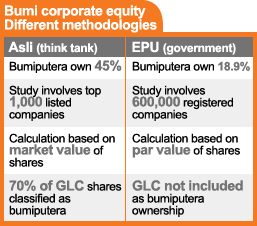
Of this spectrum of entities and persons, EPU only studies a sample of 600,000 companies in category C1. For unexplained reasons, it excludes the wealth of all those entities in categories A, B and C2.
Flaws:
- The laws recognise that businesses can be operated not only through limited companies but also through partnerships, sole proprietorships, co-operatives, societies and other business entities. These generate wealth.
In addition, wealth from properties, shares, bank savings, etc, can also be owned by private individuals through acquisition or inheritance. Wealth can be located inside and outside the country.
Therefore, EPU's study of only category C1 is seriously flawed as it does not represent the whole spectrum of wealth of the entire population. Concentration of wealth in the categories of A, B and C2 are very substantial and collectively may even exceed the wealth of category C1. But why are they excluded?
Yet ridiculously enough, the wealth of Felda and bumiputera-controlled plantation GLCs such as Guthrie, Boustead and Sime Darby is left out in the methodology.
 Instead, smaller non-bumiputera plantation companies such as Unico, Tanamas, Harn Len, Far East and many others may have been included in EPU calculation.
If this is not selective manipulation of statistical data for an agenda, then what is?
Part 1: Flaws in EPU's apparent methodology
LJ WONG is a chartered accountant by profession. He worked in a tax consultancy firm and a public listed company before he retired. He is now involved in an Internet-based business.


