




The equity problem will just not vanish
Deepavali and Hari Raya celebrations have brought some reprieve from recent tensions on the equity distribution. But, as the relentless wrath of Dr Mahathir Mohamad towards Abdullah Ahmad Badawi shows, some things just don't depart. The equity problem too will not vanish, even if we quash it or spook it away.
It is good that the dialogue has been going for quite a while. History will record few phases in which 'methodology' was used in engrossed and animated tones. But we are falling into the familiar habit of 'moving on' before resolving where we were.
Moreover, I fear that, after much debate and exchange, there is still a grave ignorance towards the actual CPPS paper and confusion on the issues of methodology and asset distribution.
I would collate responses to the CPPS paper into two main categories. First, the debate on market value versus par value and related discussion on stock versus wealth ownership. Second, the smashing of dialogue by the government and civil denunciation of such a tyrannical and immature measure.
I will comment on the question of methodology and the first set of issues, with more direct reference to the CPPS paper and some attention to questions of methodology. On the cancer of anti-democratic rule and regressive leadership enough has been said.
Deepavali and Hari Raya celebrations have brought some reprieve from recent tensions on the equity distribution. But, as the relentless wrath of Dr Mahathir Mohamad towards Abdullah Ahmad Badawi shows, some things just don't depart. The equity problem too will not vanish, even if we quash it or spook it away.
It is good that the dialogue has been going for quite a while. History will record few phases in which 'methodology' was used in engrossed and animated tones. But we are falling into the familiar habit of 'moving on' before resolving where we were.
Moreover, I fear that, after much debate and exchange, there is still a grave ignorance towards the actual CPPS paper and confusion on the issues of methodology and asset distribution.
I would collate responses to the CPPS paper into two main categories. First, the debate on market value versus par value and related discussion on stock versus wealth ownership. Second, the smashing of dialogue by the government and civil denunciation of such a tyrannical and immature measure.
I will comment on the question of methodology and the first set of issues, with more direct reference to the CPPS paper and some attention to questions of methodology. On the cancer of anti-democratic rule and regressive leadership enough has been said.
Before delving into the report, but before that, a note on methodology. We have been embroiled in a debate on methodology but what is this concept, this thing? The word has been used in reckless and loose ways, it's time we try to pin it down.
A methodology may be defined as a set of methods, based on certain premises and postulates, that are employed to investigate a question. Any research project adopts a methodology, then collects data, analyses the information and reports some finding.
The importance of a clear definition is demonstrated by a negative example. Mirzan Mahathir, Asli's President, in the Oct 10 statement rubbishing the research of his subsidiary CPPS, pleaded: "All methodologies are at best good estimates". He erroneously equated a methodology with an estimate, the method with the outcome.
Nothing controversial here
A researcher has to choose a methodology to use, but he or she does not necessarily exercise choice over the outcome of the research. In this light, 45 percent and 18.9 percent are not elements of a methodology; these are the findings of a study. 1,000 versus 600,000 companies are also not parts of the methodology; these are the sample sizes.
 CPPS did not choose to study 1,000 companies; it had to because access to relevant data of the other 599,000 was denied by government authorities.
Let us avoid creating an impression that the CPPS chose a figure of 45 percent or focused on the 1,000 publicly listed companies by choice. That is the way of those who callously pre-judged, baselessly dismissed the report, and cynically insinuated that the research was designed to a certain conclusion.
The CPPS paper's primary concern is not to dispute the 18.9 percent official figure for Bumiputera equity ownership, but to discuss the achievements and shortcomings of corporate development and distribution. The CPPS affirms the need for Bumiputera enterprise to be developed, but seeks out which is the better avenue to achieve that goal.
Our shortcomings are well known, not so much because the official Bumiputera equity ownership falls below the 30 percent mark, but more in terms of under-developing a vibrant and broad-based Bumiputera business class.
Mechanisms for redistributing equity in the early stages of the NEP, primarily through legal requirement that 30 percent of shares be allocated to Bumiputera, have not been effective either because the Bumiputera shareholder sells his stake for profit or does not get involved in the business and so does not learn.
Other means for increasing Bumiputera holdings, such as through Permodalan Nasional Berhad, or widening participation through the Amanah Saham schemes, have resulted in concentrations of ownership and wealth. Privatisation, as widely known, gave birth to iconic capitalists and a hyper-rich elite, the biggest of which had to be bailed out after the financial crisis.
The government holds major stakes in GLCs, which in turn comprise a large chunk of the Bursa Malaysia.
There is nothing controversial here; Malaysians are aware of these realities and trends surveyed by the CPPS.
The paper ventured to estimate the distribution of equity ownership. Its methodology differs from the official in two basic areas (again, number of companies sampled, estimates or findings are NOT the part of the methodology): it focused on wealth ownership, not stock ownership as done by the EPU, and it accounted for ownership within the GLCs, which are excluded from the government figures.
Simple procedure
The procedure is simple. GLCs (Tenaga, Telekom, etc.) comprise 36 percent of market capitalisation, according to the Securities Commission, the statutory body created by the Malaysian government to oversee the Bursa Malaysia.
Of this ocean of stock, an estimated 70 percent is held by Bumiputera, largely through government investment arms like Khazanah (assuming that government ownership represents Bumiputera interests).
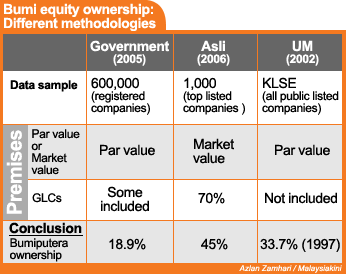 Seventy percent of 36 percent amounts to 25 percent. This measure of what is excluded from the official statistics is added to the official figure of 20 percent (not questioning that), adding up to 45percent.
The CPPS emphasise that 45percent is an approximation of Bumiputera distribution at the national level, being limited to publicly listed shares and being based on the estimated 70percent Bumiputera ownership of GLCs. The steps are basic and mathematically straightforward.
But of course, 45 percent is staggering compared to 19 percent. Inevitably, once that number went public, the public was stunned and those with vested interests went berserk. Most just blustered it cannot be possible, without giving any reason (and then lambasted the 'methodology').
Well, try different numbers. We do not question the official figure of 19 percent Bumiputera ownership, nor the Security Commission's calculation that GLCs constitute 36 percent of market capitalization.
One might differ with the CPPS' estimate of 70 percent Bumiputera ownership of GLCs. But if we reduce that number for argument's sake, to 50 percent or 35 percent, we will still get estimates above 30 percent Bumiputera equity ownership. It is mathematically conceivable.
But the CPPS estimate was reached through a considered process, not random number crunching. We should note also that, according to the Eighth Malaysia Plan (p. 191), ownership of privatized government entities in 2000 (at par value) was broken down thus: 50 percent government, 25 percent Bumiputera, 14 percent non-Bumiputera, 11 percent foreign.
This implies that about half of the stock of Telekom, Tenaga and other privatized corporations were excluded in the official statistics in 2000. Assuming these corporations in 2000 comprised 35 percent of the stock market, about 18 percent of stock ownership held by the government through GLCs is completely blanked out.
The government has not given a good answer why GLCs are excluded from the equity distribution picture. After all, as the CPPS points out, trust funds and institutions and foreigners are included why not GLCs?
Widening rich-poor divide
Another contention against the report is that government shareholdings cannot be said to represent any particular group. The case was clearer when they were public utilities or state-owned enterprises, before they were privatised. One cannot simplistically say they represent all Malaysians simply because they are called government-linked.
The CPPS highlights the fact that management of GLCs is overwhelmingly Bumiputera. That is a clear demonstration of priorities. We can also refer to government policy in terms of interventions in equity ownership is clear: to expand the Bumiputera Commercial and Industrial Community (BCIC).
The report makes an astute point, that NEP does not stipulate any objectives regarding the distribution of share ownership within the Bumiputera community. However, the fact that equitable distribution within ethnic communities is not explicitly commissioned in the NEP does not mean that we must not think and act on widening inequality.
Indeed, the Ninth Malaysia Plan stressed the growing problem of rural-urban and intra-ethnic inequality widening rich-poor divide within all communities.
This brings us to the par value versus market value showdown. Some insist that par value is more relevant, because the government is more concerned with stock ownership, not wealth, ownership.
Par value reflects the proportion of stock ownership, which this is the main objective of the NEP. Thus the CPPS' usage of market value is incongruous with official policy.
In terms of policy formulation, the Ninth Malaysia Plan, in Chapter 16 on "Growth with Distribution" uses the heading Wealth Ownership in the section outlining the distribution agenda. The government apparently - and appropriately - considers wealth ownership the relevant policy framework, 35 years after the advent of the NEP.
In terms of policy implementation, it is obvious that the government has pursued wealth ownership, with the concentration on large, blue-chip corporations and relative neglect of small and medium scale enterprises.
In terms of temporal relevance, whatever the motivations for using par value in the initial calculations in 1970, note that it was at a time before the privatisation of state assets, before the KL and Singapore stock exchanges split in 1990, before the stock market boom of the 1990s, before the concentration of wealth in the hands of a multi-ethnic elite.
Shouldn't our measurement of equity ownership keep up with these tectonic shifts?
Comfortable with privileges
Interestingly, the CPPS finds evidence for real and meaningful inter-ethnic partnerships based on mutual competence, not patron directorship or shareholding by politically connected people. The report classifies 2.4 percent of listed companies in 2000 as inter-ethnic partnerships.
This is a small proportion, but a noteworthy one because it suggests that partnerships forged without government patronage are few but thriving. Some people seem to be upset that this is happening.
I wonder what those who insist on keeping a methodology from the 1970s just because it's always been that way would say about poverty line measurement. Will they maintain that the poverty line cannot be re-measured?
Actually, that has already been done. The poverty line, the level below which households cannot afford basic needs and are classified as poor, was first formulated in 1977.
One cannot deny that the components of 'basic needs' and typical household budget allocation between food, rent and consumer items changes over thirty years. Measurement of poverty needs to be updated to be relevant and realistic.
The EPU made substantial modifications to poverty line determination in 2005 in preparing the Ninth Malaysia Plan (pages 327-328). We do not have details on the amendments, since the process as usual lacks transparency, but the willingness to modify the measurement to keep up with should be acknowledged.
Why can't we do the same for our measurement of equity ownership? Why can't we release more data so that we can find out the true picture of equity and wealth distribution, and so that different methodologies can be tested on even terms?
Times have changed, people have moved on, ready to face up to new realities. Trouble is, many have moved up, too comfortable with their privileges. And for them, change is oh so difficult.
H LEE is a concerned Malaysian student currently pursuing his doctorate abroad.


