




A bridge too far
Since the days of the National Economic Consultative Council, I have been involved with issues related to urban poverty especially on aspects impacting the Indian Malaysian community.
Although I have done some work in relation to poverty among the Orang Asli communities, and visited poverty-stricken areas in Perak and Pahang, it is only recently that I have begun to seriously look into this problem among the bumiputeras.
Often one thinks that the government machinery responds quickly and decisively to address poverty concerns of the bumiputeras. However, my recent experiences showed otherwise. The poor are not only economically disadvantaged but also seldom have a voice in how public resources are allocated and spent.
The plight of the Orang Asli in the Peninsular and that of the Penan in interior Sarawak clearly illustrate such dilemmas and struggles.
Since the days of the National Economic Consultative Council, I have been involved with issues related to urban poverty especially on aspects impacting the Indian Malaysian community.
Although I have done some work in relation to poverty among the Orang Asli communities, and visited poverty-stricken areas in Perak and Pahang, it is only recently that I have begun to seriously look into this problem among the bumiputeras.
Often one thinks that the government machinery responds quickly and decisively to address poverty concerns of the bumiputeras. However, my recent experiences showed otherwise. The poor are not only economically disadvantaged but also seldom have a voice in how public resources are allocated and spent.
The plight of the Orang Asli in the Peninsular and that of the Penan in interior Sarawak clearly illustrate such dilemmas and struggles.
Hard to believe
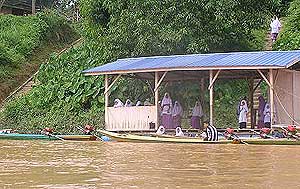 On Nov 5, I visited a Malay village which has no road access and the only way to get to this community is via a 45-minute boat ride from Kuala Krai in Kelantan. When I first read about this village called Kampong Bahagia, I could not believe that such a community existed after 49 years of Independence.
Wanting to see the place and meet the people myself, I left Kuala Lumpur early that Sunday morning together with Mr K A Guna of Yayasan Sosial Strategik (YSS). It was a pleasant drive through the rural roads and we passed numerous small towns.
When we stopped for a cup of coffee in Raub, Guna and I were surprised when a gentlemen at a stall there recognised me from one of the talk shows on television and came to greet us.
After we reached Kuala Krai, we went to a jetty area called Tangka Bradely where we met local resident Mr Kuppusamy and three journalists. We hired a boat for RM80 for the round trip. With some difficulty, I got on to the boat as the seats were for people of a smaller size.
Nevertheless, it was a nice ride. Upon arrival at the village, we saw children waiting for the boat to return home after school. We met the headmaster and a teacher of the primary school. We chatted by the jetty about the students and their performance. Of the 33 students who sat for the UPSR in 2005, only two passed all the subjects. The result was poor but the headmaster said this year they have more teachers and he is hopeful that their performance will be better. There are 192 students and a hostel in the village especially for students from nearby areas.
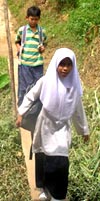 From the jetty one has to carefully walk across a plank to get to the other side. For the locals, the task was easy but for city folks like myself, it was daunting and required much concentration. Thankfully, I made it across without falling into the water. Each time that I experience something like this, I make a small commitment to reduce weight.
We sat at the coffee shop located near the entrance to the village and some of the people there began to share their concerns and problems with us.
After a drink, we began to walk to the primary school about 1km away. Along the way, we noticed that some of the houses were new brick buildings while others were old and made of wood.
Transportation woes
The school looked like any other primary school while the hostel building was new. By this time, some of the local leaders got wind of our presence and came to meet us. We chatted at the school canteen. Among those present was the interesting Tok Imam, a well-respected elder in the village.
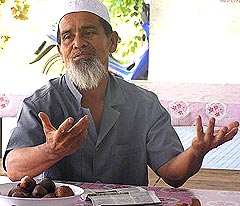 Tok Iman (
photo
) and the rest shared their concerns about Kampong Bahagia and eight other surrounding villages.
Tok Iman (
photo
) and the rest shared their concerns about Kampong Bahagia and eight other surrounding villages.
Kampong Bahagia is the largest with about 150 families. The others are Kg Mabong (50), Kg Sg Rimau (13), Kg Sg Pigang (15), Kg Raba (20), Kg Batuan (5), Kg Joha (20), Kg Sri Tanjong (20) and Kg Bunga Raya (20).
We were told that the villagers settled in the area in 1960. Each family was given 8 acres (six acres for rubber small holding, two for fruit and vegetable growing and for the homestead).
Only a few families are on welfare or zakat provisions. All of them are working hard to cultivate their land but transportation has become a major financial burden.
In the case of rubber, they have to sell it in its dry form. They are faced with the mammoth task of transporting the rubber, first from the tapping area to the jetty and from here into the ferry, then from ferry back to the jetty at the other end and finally from jetty to the lorry.
Their complaint is that at the end of the day, whatever simple profit they make is spent on transportation cost.
Rubber tapping is supplemented by the growing of durian and dukung fruit trees. Here too, transportation proves to be the major problem and if delayed, the quality of the fruits are affected.
Fishing is also not a lucrative option as the villagers cannot transport their catch to the market on time.
Monitoring team
In view of this, the villagers are hoping that the government will build a bridge linking their villages to the main land. The locals said they are promised a new bridged whenever the general election comes around but this has yet to materialise.
According to them, another option is to construct a road which will connect the kampong to the logging tract through Tanah Merah. One of the local leaders requested that I convey their woes to Works Minister S Samy Vellu.
As we drove back to Kuala Lumpur, Guna and I reflected on the plight of the community and how a bridge or road would enhance their socio-economic well-being. Why the delay then?
I believe that the prime minister should appoint an independent monitoring team whose main role will be to travel around the country as troubleshooters to highlight the gaps in the delivery system and facilitate a speedy solution.
The Human Rights Commission of Malaysia (Suhakam) is undertaking this process to check on the gaps not only within the civil and political dimensions but also in the economic, social and cultural dimensions.
Dr Denison Jayasooria, YSS executive director, visited Kampong Bahagia on Nov 5, 2006 in his capacity as a Suhakam commissioner.


Are you sure you want to delete this comment?
This action cannot be undone.