




Hold the media accountable
It was only 'yesterday' that journalists wrote from the security of the newsroom and perceived authority of the profession. 'I report, you accept'. Readers were somewhat invisible.
However, with easy access to diverse online news sites and journalists' email addresses, readers today are increasingly saying: 'You write, we react'. And so it should be if we are to see better standards of reporting in our mainstream papers.
Journalists' arrogance is now old-fashioned. Disconnection from their readers in the digital medium is, professionally, unwise. Critical online readers, who choose to be part of the news- making process, will dismiss uncritical reporting. Biased commentaries will most likely attract equally biased reactions.
It was only 'yesterday' that journalists wrote from the security of the newsroom and perceived authority of the profession. 'I report, you accept'. Readers were somewhat invisible.
However, with easy access to diverse online news sites and journalists' email addresses, readers today are increasingly saying: 'You write, we react'. And so it should be if we are to see better standards of reporting in our mainstream papers.
Journalists' arrogance is now old-fashioned. Disconnection from their readers in the digital medium is, professionally, unwise. Critical online readers, who choose to be part of the news- making process, will dismiss uncritical reporting. Biased commentaries will most likely attract equally biased reactions.
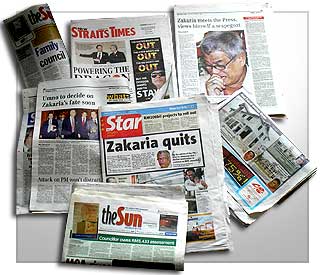 Journalistic standards, once defined by fraternal recognition, are now significantly framed by online interactivity and collaboration between the storytellers, their sources and readers alike. What is read online is easily compared and contrasted with other credible news outlets. The power of journalists and their editors to filter information is diminished, while readers are becoming influential players in media discourse. Which means standards of journalism are only as good as readers apart from journalists - wish it to be.
Thus, in the midst of lacklustre mainstream media reportage of public affairs, independent online news websites are in a unique position to set the benchmarks for best practices. By extension, this means more intelligent media reportage of, for example, the usual divisive Malay threats and abrogation of non-Malay rights bandied at each Umno general assembly. Racist rhetoric and theatrical thrusts of the keris invoking the spirit of the Malay warrior reinforces the ugliness of fear politics among Umno delegates.
What are the skills?
But journalists do have choices in what they choose to write and how they frame their stories. Just as sensible citizens would denounce the utterances of small-minded demagogues, the journalist fraternity could if they choose question the preposterous speeches by Umno sycophants jostling for a place nearer to the power center. Intelligent Malaysian readers and journalists - can surely see through the absurd and destructive antics of Umno delegates who often pop out from the woodwork at each annual assembly.
Apart from straight 'reporting' of the delegates' vilification of non-Malays, journalists could hold these figures up to scrutiny and expose to readers their political motivation. That's a journalism of choice. Conventional journalism practice, however, cannot resist showcasing the mad and absurd. That sells newspapers. Thus, the usual media headlining of Umno's warning to non-Malays: 'If you mess with our rights, we will mess with yours'. A colleague mockingly remarked, 'It's Malaysia, not Chinasia or Indiasia". That's how outsiders see Malaysia not that our politicians give a hoot about what foreigners say.
 I was asked at a lecture with a group of Antara news agency journalists in Jakarta last week what 'new' skills should journalists acquire in reporting for societies ruled by communal politics? How can journalists give readers value-added information they need to make the choices in their lives as responsible citizens?
Journalistic skills that would never go out of fashion, I said, were (are): critical thinking and clear, succinct writing. Habitually asking 'why' and 'why not'; 'so what' and 'what now', when one examines issues would be a good starting point, I said. Applying these simple mental checks to the coverage of the Umno general assembly could have led to more insightful angles.
Lest we forget, journalists are their readers' eyes and ears. Journalists should be asking the hard questions, understanding the issues, and seeking out the right answers. Good journalism essentially relies on one's capacity for critical observations, reasoning, and the ability to write for an audience towards helping them understand the complexities of their environment. As Endy Bayuni, editor of The Jakarta Post said to me, good journalism happens when journalists give people a voice, 'particularly the weak and marginalised'.
Don't shoot him (or her)
Which reminds me of my conversation with Palagummi Sainath, rural affairs editor of The Hindu in Mumbai, who used the phrase 'service of power' to explain the traditional journalists' habit of giving the last word to those in power. He said, "There have always been journalists who did not and do not believe in the service of power - those who cut through the hypocrisy of pomp and stated the uncomfortable.
I've always thought that the boy who said: 'The Emperor has no clothes!' and who pointed to a pathetic but powerful moron who was simply starkers was one of the finest early journalists. He dragged into the public domain what others knew but would not say. Once he put it there, it made life simpler for everyone except the Emperor".
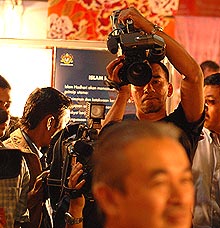 And there's a lot that Malaysians know including the journalist - but would not say in public, unless you're an Umno delegate.
Journalists used to be the traditional source that citizens consulted for an explanation of the past and guidance on what would or could happen given the reported checks on reality. Essentially, journalists were a source of 'wise' authoritative accounts of the interplay between shifting social, economic and political forces. They were highly regarded for their close watch on those who govern, boldly investigating and questioning those in public office. That was how the media kept the politicians honest.
Who keeps the media honest? You, the reader. Better standards and integrity in journalism are a consequence of readers' vigilance in monitoring the media and keeping journalists on their toes. Keep the media accountable. Suggest new angles to the stories. Question the contents. But don't shoot the messenger.


