/file/publisher-c1a3f893382d2b2f8a9aa22a654d9c97/2019/04/a552c9ae0210a44366079cb8f6760f9e.jpg)

COMMENT | Raising minimum wage will lead to unemployment?
COMMENT | When David Card got the phone call that he won the Nobel Peace Prize, he was in his pajamas. He came home from a late flight, showered and was ready for bed, but a man from Sweden, named Adam Smith (similar to the pioneering economist who died 232 years ago), left him a message. This must be a joke, he thought to himself.
Card won the Nobel for revolutionising how economics was done. In the past, economists “prove” a theory by observations rather than experiments. If a government reduced spending and increased taxes and the economy prospered, was it because of any of the two policies or a dozen others or just plain luck?
But Card thought an evidence-based approach was possible for some theories, and one of them was minimum wage. Economists have long held onto the gospel truth that raising the minimum wage will lead to unemployment. This is founded on the highly simplistic theory of supply and...
COMMENT | When David Card got the phone call that he won the Nobel Peace Prize, he was in his pajamas. He came home from a late flight, showered and was ready for bed, but a man from Sweden, named Adam Smith (similar to the pioneering economist who died 232 years ago), left him a message. This must be a joke, he thought to himself.
Card won the Nobel for revolutionising how economics was done. In the past, economists “prove” a theory by observations rather than experiments. If a government reduced spending and increased taxes and the economy prospered, was it because of any of the two policies or a dozen others or just plain luck?
But Card thought an evidence-based approach was possible for some theories, and one of them was minimum wage. Economists have long held onto the gospel truth that raising the minimum wage will lead to unemployment. This is founded on the highly simplistic theory of supply and demand.
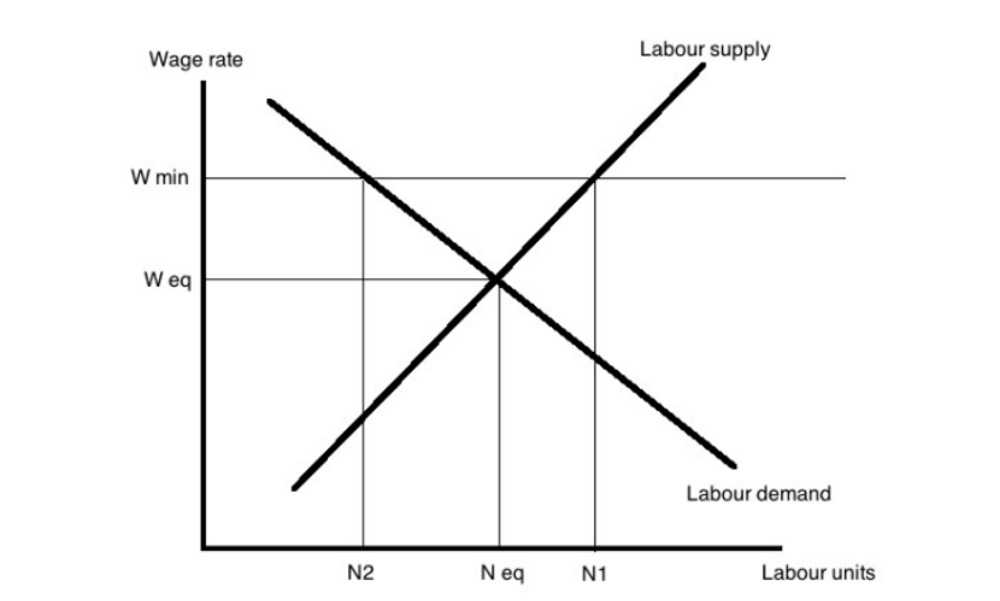
The higher the wage rate, the lower the demand for labour. While this makes sense on a simplistic level, Card and his partner, Al Krueger, sought to test this with real-world data. Since minimum wage legislations were implemented differently across different states in the US, Card was able to create a “natural experiment” to see if increasing the minimum wage does indeed lead to higher unemployment.
They chose 410 fast-food restaurants like Burger King, KFC, and Wendy’s – minimum wage affects this industry the most – in New Jersey (raised minimum wage) and Pennsylvania (did not raise minimum wage). What they found was shocking.
Our long-held assumptions were proven wrong: Raising the minimum wage have no effect on unemployment numbers.
Since then, multiple studies of different states and countries have confirmed the finding. Many economists, including Nobel-winning economists Paul Krugman and Joseph Stiglitz, have changed their positions on minimum wage. In 1978, almost all economists agreed that minimum wages will reduce employment among low-wage workers. But in 2015, this number has declined to 26 percent.
That means it is no longer acceptable for any resistance to minimum wage to rely on unproven claims that are more theoretical than real.
The Malaysian Employers Federation (MEF) and other employer organisations could not say, at every turn including the first-ever minimum wage implementation, that the minimum wage will destroy businesses, increase unemployment, and derail economic recovery as though it is an open-and-shut case.
Burden of proof
The burden of proof is especially high when more and more evidence points to the positive effects of minimum wage hikes.
Workers are not a commodity like rice, sugar or corn. They are people. That means there are other important benefits that are not normally present in commodities when we pay them more. This includes better morale, low turnover, and higher productivity. These were proven true from large-scale experiments around the world.
Even if we assume the employment effects were completely invalid, other positive effects to businesses could still be present.
First, increasing the minimum wage puts more cash in the hands of low-wage workers, who are more likely to spend in their local communities, which in turn strengthen local and small businesses. Second, higher wages would attract better candidates who are more motivated to apply for jobs, especially during the current worker shortage. Third, technology adoption would increase if a company decides to replace workers with machines, and this would make companies more efficient in the long run.
Let’s assume, however, that everything written here is not true. Economist Geoffrey Williams suggested that any debate of minimum wage could not ignore the elephant in the room: Government’s data on the poverty line income and living wage.
The current food poverty line income limit is RM1,169. The Statistics Department has revised its poverty line income to RM2,208. This means that to get fish, poultry, meat, cereal, vegetable, and clothes, shoes, rent, and transport, besides education, of an optimal level is out of reach for many Malaysians.

Of course, we are not even discussing the “living wage” target of RM2,700 for individuals, RM4,500 for couples, and RM6,500 for couples with two children for Kuala Lumpur. The idea behind the living wage is that to live a life, you do not just need food on your table, you also want some social participation (hobby, volunteering, community events), opportunity for personal and family development, and freedom from financial pressure in order to be motivated and productive.
A minimum wage debate, therefore, is not simply about awaiting the employer’s approval – whose profit-driven interest would always be opposite to a workers’ – but also about ensuring everyone in society is given a fair shot to live decently.
Some have argued that the minimum wage is unimportant because that would mostly affect foreign labour and not locals. Besides the fact that this should not change the debate for any egalitarian society, the huge portion of fresh graduates who earn only between RM1,001 to RM1,500 would still benefit, even marginally.
The saddest part about the minimum wage debate is the recognition that this is only a small step to improve the lives of workers. Cost of living, fresh graduates’ pay, union strength, and labour rights are pressing matters that continue to make it hard for workers to keep their heads above water.
Even then, stepping forward always seems impossible.
JAMES CHAI is a political analyst. He also blogs at www.jameschai.com.my and he can be reached at jameschai.mpuk@gmail.com.
The views expressed here are those of the author/contributor and do not necessarily represent the views of Malaysiakini.