




An invitation to rethink nations modern history
Author Dr Collin Abraham must be commended and congratulated for succinctly narrating and discoursing the long process of British colonization of Malaya and the struggles for independence with a theoretical framework of modern political economy informed and supported by in-depth knowledge of empirical history. Allow me to make several personal observations as my share of contributing to the rational discourse:
 It has succeeded to a high degree in organizing a mass of facts and figures in the modern history of Malaya, which has always been known for its diversity not only in terms of race, religion, language and culture but also social class and ideology, into an analytical framework that is intelligible.
In particular, the restoration of the class and ideological analysis of the forces, groupings and personalities that participated in the making of modern Malaya has, I believe, made the understanding of the Malayan history even more insightful.
For example, like it or not, the Chinese Malayan community has never been politically and ideologically monolithic. As Abraham observes with deep insights, there was, first and foremost, a deep division between the nationalists (Kuomintang) which was generally supported by the wealthier segment of the community on one hand and Left on the other which was predominated by the lower-middle and working classes.
Author Dr Collin Abraham must be commended and congratulated for succinctly narrating and discoursing the long process of British colonization of Malaya and the struggles for independence with a theoretical framework of modern political economy informed and supported by in-depth knowledge of empirical history. Allow me to make several personal observations as my share of contributing to the rational discourse:
 It has succeeded to a high degree in organizing a mass of facts and figures in the modern history of Malaya, which has always been known for its diversity not only in terms of race, religion, language and culture but also social class and ideology, into an analytical framework that is intelligible.
In particular, the restoration of the class and ideological analysis of the forces, groupings and personalities that participated in the making of modern Malaya has, I believe, made the understanding of the Malayan history even more insightful.
For example, like it or not, the Chinese Malayan community has never been politically and ideologically monolithic. As Abraham observes with deep insights, there was, first and foremost, a deep division between the nationalists (Kuomintang) which was generally supported by the wealthier segment of the community on one hand and Left on the other which was predominated by the lower-middle and working classes.
However, the Chinese Left was not exclusively communist either. In fact, there was a subtler but real enough distinction between the more pro-Western and anti-communist Kuomintang rightwing on one hand and the Kuomintang leftwing (the Kuomintang Revolutionary Committee) which was more sympathetic to the Soviet Union, friendlier to the Communist Party of China and more anti-imperialist. Generally, while the Communists enjoyed the support of the working classes and radical students in the Chinese community, the base of the Kuomintang leftwing was rooted in lower-middle classes such as petty traders and small businessmen.
Very often, the Communists and the Kuomintang leftwing were united on their hostility towards the Kuomintang rightwing led by Chiang Kai Sek and its pro-Western and seemingly Japan-appeasing positions in the 1930s before the outbreak of the anti-Japanese war on 7 July 1937.
It must also be noted that, a very tiny minority of the Chinese, both in China and British Malaya, became Japanese collaborators as the result of the influence by Wang Jing Wei, an ex-leader of the Kuomintang leftwing and former protg of Dr Sun Yat Sen, who set up a quisling regime in Nanjing after the Massacre from 1940 to 1944. Wang's supporters and operatives in British Malaya became the targets of surveillance of the Special Branch as potential enemy agents. (see Ban Kah Choon, Absent History: The Untold Story of Special Branch Operations in Singapore 1915 to 1942 , Singapore, SNP Media, 2001).
Rediscovery of critical roles
Abraham has also very convincingly demonstrated, the left-right division also occurred in the Malay as well as Indian communities and at one point in the immediate postwar period, the anti-colonial leftwing Malay forces were so influential that it was perceived as the paramount threat by British colonialists to their rule. Schemes of cooption and repression were devised to neutralize and turn over the threat.
Of course, the Communist Party of Malaya (CPM) also spotted the revolutionary potential of the anti-colonial Malay Left and devised strategies accordingly, especially in the forms of its Malay Works Department and Kem Se Malaya coordinated by Chen Kwang Chang @ Chen Nan @ Haji Hashim, in anticipation of a decisive show of force with its principal enemy, British colonialism. (see Suriani Abdullah, Rejimen Ke-10 Dan Kemerdekaan , Hong Kong, Nan Dao, 1999; pp. 14-17)
Moreover, Abraham has further correctly pointed out that the Malay Left was strongly inspired by the anti-British resistance mounted by Malay aristocrats and peasant leaders in the 19th century. All the veterans of the Communist Party of Malaya who now live in southern Thailand like Abdullah CD, the late Rashid Maidin (1917-2006), Abu Samah and Siti Norkiah I met and interviewed told me that their political consciousnesses and outlooks were first formed by legends about anti-British resistance movements in Perak and Pahang respectively when they were children.
As a matter of fact, the Communist Party of Malaya itself acknowledges in its official history the progressive role played by the anti-British Malay aristocrats and peasant leaders although the party also asserts that it, being a modern and worldwide anti-colonial and anti-imperialist movement, had transcended or superseded them after they had failed.
Indeed, one of the distinguishing features of Abraham's book is the rediscovery of the critical and crucial roles played by the leftwings of the Malay, Chinese and Indian communities, including the Communist Party of Malaya, in the struggle for Merdeka.
In fact, the very slogan of Merdeka originates from the Malay Left organized in the Parti Kebangsaan Melayu Malaya (PKMM) which was founded on Oct 17, 1945 in Ipoh. From its inauguration on May 11, 1946 in Johor Baru to the resignation of its first president Dato' Onn Jaafar, the original Umno used the racially more exclusive slogan of Hidup Melayu and charged those who called for Merdeka as "extremists". (see Rashid Maidin, Daripada Perjuangan Bersenjata Kepada Perdamaian , Kuala Lumpur, SIRD, 2005; p. 35)
However, it seems that this aspect of narrative and discourse in Abraham's book could be further strengthened if and when it also incorporates new facts and perspectives offered by the recently released Malay-language memoirs of Abdullah C.D. and Rashid Maidin as well as the 1996 autobiography of Abu Samah who was an Umno Youth leader in Pahang before joining the Communist Party of Malaya not long before the proclamation of the "Emergency".
Critical evaluation of CPM
A final point I must make is on Abraham's treatment on the subject of the Communist Party of Malaya which is, like it or not, an important theme in the modern history of Malaya.
On the whole, I think Abraham is fair-minded and balanced in his critical evaluations of the party that has been maligned and demonized with partisan zeal on the parts of its enemies or former enemies for so many years, especially during the Cold War and the "Emergency".
As Chin Peng himself has admitted in his memoirs, the party did commit some errors and mistakes but those errors and mistakes should not, in my personal opinion, negate nor vitiate altogether the contribution made by the party since its inception in April 1930 to the anti-colonial, anti-fascist and anti-imperialist cause of the Malayan people of all ethnic communities.
As a matter of fact, although it mainly originated from the Nanyang Provisional Committee (NPC) of the Communist Party of China, the Communist Party of Malaya inaugurated in April 1930 was also the first modern political party in our history that aspired to be ethnically inclusive and Malaya-oriented.
Many Chinese-language documents and publications have shown that there were many efforts within the party to ideologically battle 'Chinese chauvinism' or what Mao Zedong called "Great Han Chauvinism". For example, in a Chinese-language circular dated 15 May 1952 and issued by the Politburo of the Central Committee to the party's ranks and files as well as its armed units, the use of racist terms like "keling" (refers to Indians) and "fan" (refers to Malays and Orang Asli) was forbidden in party documents and publications, and the notion and attitude of Chinese being racially more "superior" to the Malays, Indians and Orang Asli was criticized for being incompatible with Marxism-Leninism and Internationalism.
Indeed, in an ironical or paradoxical twist, many Malayan Chinese who joined CPM's Malayan People's Anti-Japanese Army (MPAJA) to originally heed the community's call for Chinese self-defence had, through the new experiences of moving and operating outside Chinese-concentrated areas during the Occupation, developed a deeper sense of love for the rivers, hills, jungles and people of non-Chinese origins in Malaya.
Many writings and memors of those ex-MPAJA veterans who were banished to China by the colonial authorities after the proclamation of the "Emergency" reflect that powerful shift of sentiment and consciousness. Many of them in their 70s and 80s have made it a point to regularly visit Peninsular Malaysia as ordinary tourists to see for themselves the towns and villages they were born, the graves of their parents or places they once risked their lives or shed their bloods to defend as homeland.
Chin Peng's decision to publish his massive memoirs and insistence of his right to return and settle down in Malaysia is a reflection of that Malayan sentiment.
This book, I believe, is going to be very useful for younger generations of Malaysians in their 30s or below to learn and think about the history of the nation in a rational and critical manner so as to enhance a sense of true patriotism in this age of unbridled globalization which contains elements of cultural imperialisms from all directions and dimensions.
It is also useful for the reflection and introspection among the elderly generations because the book has incorporated new facts, perspectives and viewpoints offered by, for example, veteran of the Communist Party of Malaya (CPM), Chin Peng whose side of story or history had long been blacked out or distorted during the Cold War and the "Emergency".
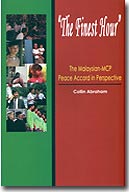
JAMES WONG WING ON is a former member of parliament and newspaper columnist. The above is one of the four prefaces for the recently launched book authored by social scientist Dr Collin Abraham entitled The Finest Hour The Malaysian-CPM Peace Accord in Historical Perspective .


Are you sure you want to delete this comment?
This action cannot be undone.