




COMMENT | Shaking it up with a switch in solicitors
COMMENT | The requirements – legal or otherwise – in seeking justice in a court of law are aplenty. If rules and regulations have to be complied to the letter, there have been occasions when an obscure requirement would surface, raised by one party.
When there’re none in written form, the courts sometimes fall back on precedents and in some cases, the Hansard is referred to understand what the lawmakers had intended.
But litigation lawyers will tell you about the unexpected perils in the course of their work. Key witnesses could turn hostile, others may claim that they were coerced into making certain statements or admissions and in many instances, witnesses’ oral testimony does not commensurate with their written statements.
Then there are postponements and adjournments for an assortment of reasons. Counsel involved in another court is one of the reasons. In many instances, especially in criminal cases, the reports from the Chemistry Department are not ready.
Litigants or accused persons and even counsel being indisposed is another reason. Hence, a case can go on for...
COMMENT | The requirements – legal or otherwise – in seeking justice in a court of law are aplenty. If rules and regulations have to be complied to the letter, there have been occasions when an obscure requirement would surface, raised by one party.
When there’re none in written form, the courts sometimes fall back on precedents and in some cases, the Hansard is referred to understand what the lawmakers had intended.
But litigation lawyers will tell you about the unexpected perils in the course of their work. Key witnesses could turn hostile, others may claim that they were coerced into making certain statements or admissions and in many instances, witnesses’ oral testimony does not commensurate with their written statements.
Then there are postponements and adjournments for an assortment of reasons. Counsel involved in another court is one of the reasons. In many instances, especially in criminal cases, the reports from the Chemistry Department are not ready.
Litigants or accused persons and even counsel being indisposed is yet another reason. Hence, a case can go on for years. Interestingly, the famous agar-agar (jelly seaweed) case at the Klang Sessions Court in the 70s went on for a good 13 years before the case was disposed of.
(The case involved a businessperson who was charged with smuggling a large quantity of jelly seaweed.)
Delay tactic?
But often, accused persons have mistakenly been accused of delaying the inevitable.
Whatever the consequences, the right of an accused person to be represented is enshrined in our law books.
The constitutional protection of the right to be represented by legal counsel is provided under Article 5 (3) (3) of the Federal Constitution which reads: “Where a person is arrested, he shall be informed as soon as may be of the grounds of his arrest and shall be allowed to consult and be defended by a legal practitioner of his choice.”
Section 255 of the Criminal Procedure Code states that “every person accused before any criminal court may of right be defended by an advocate.”
There have been many instances where accused persons have discharged their counsel for various reasons. There have also been instances when lawyers have discharged themselves from representing their clients.
The recent application to the court of Valen, Oh & Partners discharging themselves is a case in point. The firm had acted for fugitive financier Low Taek Jho, better known as Jho Low, and his father Low Hock Peng, in the 1MDB suit against them.
The firm said its appointment has been terminated by Kobre & Kim LLP as the instructing solicitors on the matter. So, the change of solicitors or counsel is nothing new.
New lawyers for Najib
Yesterday, former prime minister Najib Abdul Razak discharged his lawyers who had represented him in the High Court and the Court of Appeal in the SRC case. In their place, he appointed a new team to hear his appeal at the Federal Court.
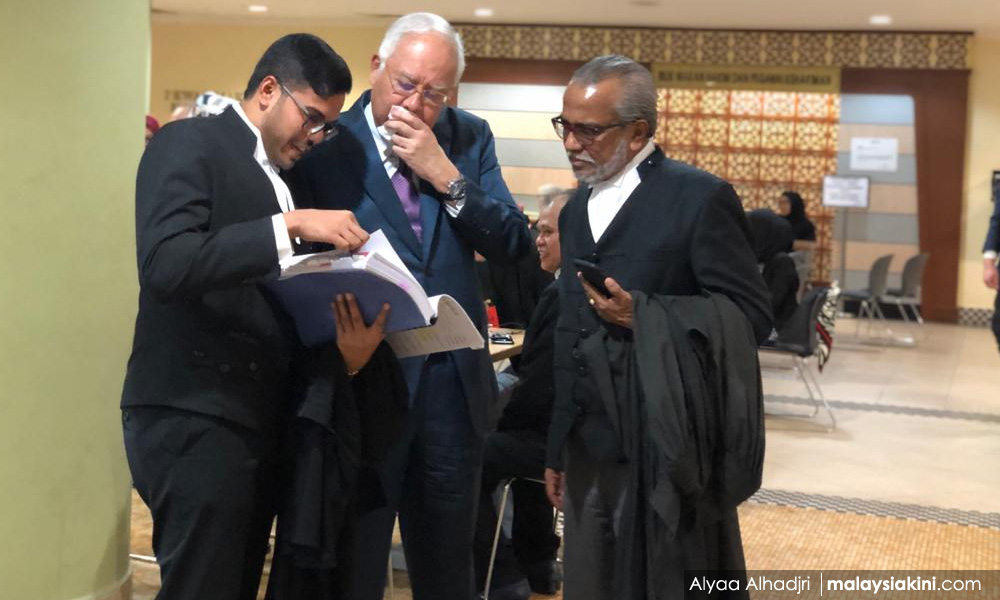
For purposes of clarity, Najib discharged the firm of Shafee & Co and not Muhammed Shafee Abdullah as counsel in his appeal to the Federal Court.
Similarly, Najib appointed the firm of Zaid Ibrahim Suflan TH Liew & Partners and not Zaid the individual per se.
But that application to change solicitors got tongues wagging with all kinds of allusions and insinuations when news filtered in on Tuesday morning. It reached a crescendo in the afternoon.
This was after various news portals reported that the new firm of solicitors had applied to the apex court to adjourn the scheduled 10-day hearing next month.
According to a letter from Zaid Ibrahim Suflan TH Liew & Partners to the Federal Court dated July 26, the legal team said this is because they were just appointed to represent Najib in the appeal.
The letter, signed by the firm’s senior partner Liew Teck Huat, states that Najib instructed them to seek adjournment of the SRC appeal hearing scheduled from Aug 15 to 26.
Is the Federal Court obliged to grant the application? Or can it order the proceedings to proceed as scheduled?
Rule 6 of the Bar Council’s Legal Profession (Practice and Etiquette) Rules 1978 states: (a) An advocate and solicitor shall not accept any brief unless he is reasonably certain of being able to appear and represent the client on the required day.
The Federal Court can be expected to take cognisance of these rubrics before it makes a ruling.
R NADESWARAN is a veteran journalist who writes on bread-and-butter issues. Comments: citizen.nades22@gmail.com.
The views expressed here are those of the author/contributor and do not necessarily represent the views of Malaysiakini.





Report this comment
Are you sure you want to delete this comment?
This action cannot be undone.