


/file/publisher-c1a3f893382d2b2f8a9aa22a654d9c97/2020/09/054232f0840c381e3d5c62ba7d4ede03.jpg)

COMMENT | Pamu - the non-voters all parties should fear
COMMENT | The largest party in the upcoming 15th general election (GE15) may not be BN or Pakatan Harapan but the non-voters or what I call ‘Parti Aku Malas Undi’ (I’m Lazy To Vote Party) or Pamu.
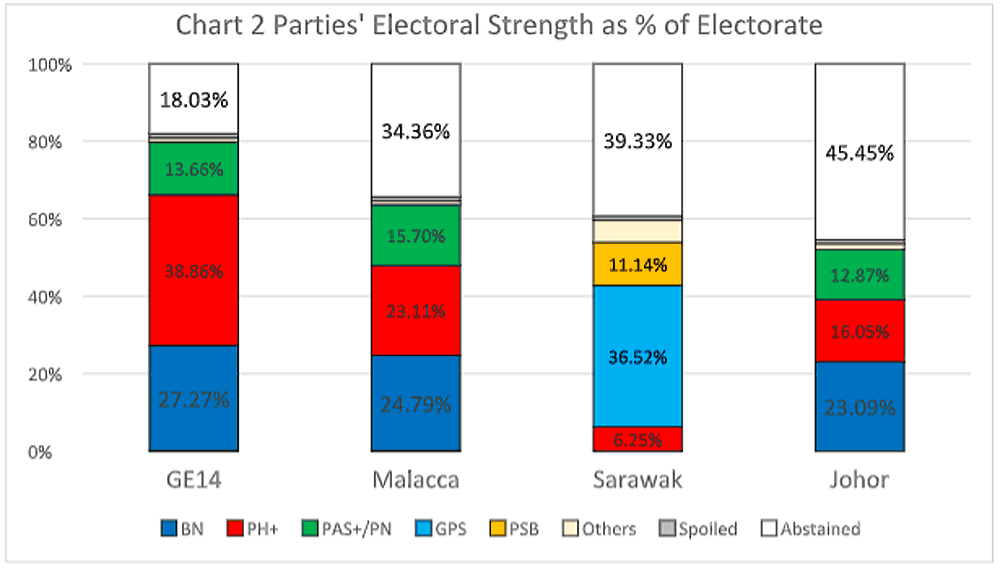
As in the Johor (March 12, 2022) and Malacca (Nov 20, 2021) state elections, Pamu constituted a respective 45 percent and 34 percent of the voters there.
More than ‘lazy’, ‘malas’ in Malay can mean ‘reluctant’ or ‘disinterested’. Their reluctance and disinterest should be recognised and addressed.
To be accurate, non-voters are larger than Pamu, as some abstentions may be caused by circumstantial reasons, and may even be the outcome of vote suppression.
Instead of scientifically separating the disinterested and involuntary non-voters, here I conveniently lump them together to draw public attention to address both political apathy and vote suppression.
So, no, this is not a derogatory term as some moralists might unwittingly or intentionally misinterpret. Recognising voters’ right to not vote and reducing abstention can be complementary, and not at all contradicting...
COMMENT | The largest party in the upcoming 15th general election (GE15) may not be BN or Pakatan Harapan but the non-voters or what I call ‘Parti Aku Malas Undi’ (I’m Lazy To Vote Party) or Pamu.
As in the Johor (March 12, 2022) and Malacca (Nov 20, 2021) state elections, Pamu constituted a respective 45 percent and 34 percent of the voters there.
More than ‘lazy’, ‘malas’ in Malay can mean ‘reluctant’ or ‘disinterested’. Their reluctance and disinterest should be recognised and addressed.
To be accurate, non-voters are larger than Pamu, as some abstentions may be caused by circumstantial reasons, and may even be the outcome of vote suppression.
Instead of scientifically separating the disinterested and involuntary non-voters, here I conveniently lump them together to draw public attention to address both political apathy and vote suppression.
So, no, this is not a derogatory term as some moralists might unwittingly or intentionally misinterpret. Recognising voters’ right to not vote and reducing abstention can be complementary, and not at all contradicting.
How prevalent is non-voting?
Non-voting is prevalent, not just in Malaysia but in other countries too. For example, one in every three UK voters did not vote in the last election in 2019. When non-voters are added in, the Conservatives’ winning vote share of 43.6 percent becomes only 28.5 percent of the electorate.
The reason why most of us do not notice Pamu is because we are looking at only total valid votes instead of the electorate.
Why? One reason is such a simple story helps to make the winner look stronger.
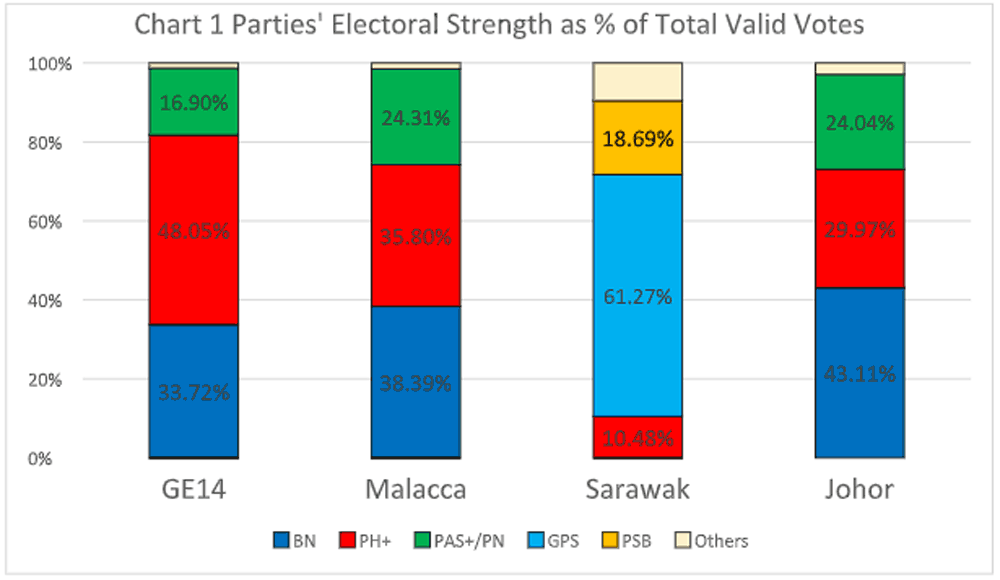
Take Johor for example. BN’s seat gain from 16 out of 56 (28.57 percent) to 40 (71.43 percent) sounds more justified when we compare its vote share of 43.11 percent to Harapan’s 29.97 percent and Perikatan Nasional (PN)’s 24.04 percent.
If we add in the non-voters (45.45 percent), BN’s victory (now at only 23.09 percent) looks questionable to enjoy a two-third dominance in the state legislative assembly.
The big tent narrative
Ignoring the Pamu also helps the ‘big tent’ narrative. The easiest way to explain the opposition’s debacle in Johor is that Harapan and PN could not put up a common candidate against BN in every constituency.
Now, let’s consider these two numbers: BN gained 17,222 votes between 2018 and 2022, while the main opposition parties – Harapan and PAS in 2018; Harapan, PN, and Muda in 2022 – collectively lost 170,595 votes in the same period.
Notice that 170,595 is nearly 10 times of 17,222. Hence, for the gap of every 11 votes between BN and the main opposition combined, BN only won one vote, the opposition lost the remaining 10.
The reduction in turnout was so obvious that while 721,607 new voters had joined the electoral roll, as many as 1,122,491 eligible voters abstained, forcing the turnout to drop by 112,847.
Assuming voters would blindly follow parties, the ‘big tent’ narrative ignores the alienation and abstention of voters caused by realignment. Had Harapan and PN realigned to put up a big tent, would the opposition not lose more disillusioned voters to Pamu if not also to BN?
Vote suppression
Overcoming vote suppression – obstacles that cause some voters, normally disproportionally over-represented in certain segments, to not come out to vote – can have mixed impacts on turnout.
Automatic Voter Registration (AVR) reduced vote suppression on those who live in remote areas, who work all the time during office hours, and those who were newly enfranchised or politically activated.
In the infamous case after the Reformasi wave, around 680,000 new voters who registered themselves during April-May 1999 were left out of the electoral roll published in November. Many believed such an unusual delay might have conveniently saved BN in many marginal constituencies.
However, this also reduces turnout rate as many who are never interested to vote are now part of the electorate. To offset this reduction, more measures are needed to reduce vote suppression in other aspects.
While we do not have voting data by ethno-religious category, socio-economic class, age group, and gender to identify any vote suppression, we do have the figure by states.
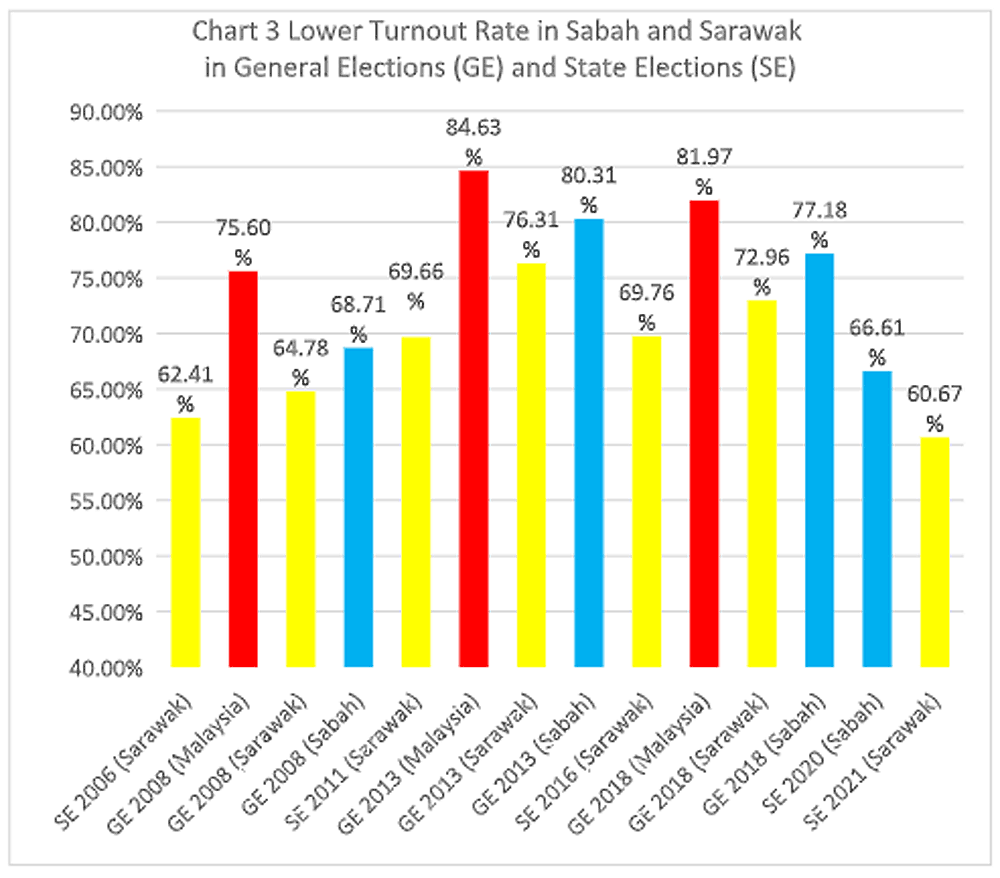
Here is the troubling fact: Sabah and Sarawak always had significantly lower turnout than the entire Malaysia from 2006 to 2021.
For parliamentary elections, Sarawak was lower by 8-12 percent while Sabah by 4-7 percent. For state elections held separately from general elections, Sarawak registered a turnout of 60.67 to 69.76 percent while Sabah’s last state election in 2020 had only 66.61 percent.
Notwithstanding state-specific factors which may lead to lower political interest, Sabah and Sarawak’s lower turnout may be due to having a large number of voters who work and live outside their constituencies.
This problem is actually common to most states in Malaysia but most acute in the Borneo states due to the lack of jobs and education opportunities. A pre-AVR estimate put Sabah and Sarawak voters in the peninsula at 300,000 and 230,000, as compared to 80,000 peninsula voters in Sabah and Sarawak.
Consider that Sabah and Sarawak are geographically vast, it may be inhibiting for a voter earning minimum wage to go home to vote if she is from Kapit but lives in Kuching (500km), or from Pensiangan but lives in Putatan (250km).
The standard suggestion for voters to transfer their voter registration to their current residence is either ignorant or evasive of the unintended consequence: depletion of voters in Sabah and Sarawak, especially in their hinterland of those two states.
We would then have to choose between two undesirable outcomes: worse underrepresentation of urban and Peninsular voters (including diasporic Sabahans and Sarawakians) if malapportionment is not curbed, or, reduced electoral weight for the hinterlands and the Borneo states if equal apportionment is applied.
There are now two easier solutions with the non-dissolution of six state assemblies under Harapan and PAS, which can eventually benefit the entire Malaysia including Sabah and Sarawak.
The first is an early announcement of election dates. Since five states except Penang will have their legislature automatically dissolved between June 25 (Selangor) and July 3, 2023 (Kedah), these five states should formally inform the Election Commission (EC) that their legislatures would serve a full term, with Penang also announcing an intended early dissolution date (before its legislature’s due date on Aug 1) in this period.
The EC should then plan and announce, as early as January, the nomination and polling dates for the joint state elections, which is likely to be in August. This would allow voters as well as civil servants and parties to plan their 2023 schedules ahead of time.
The second is absentee voting facilities. Voters who are out of their states (out of their divisions for Sabahans and Sarawakians) should be allowed to vote early – say, three consecutive days before polling day - at distant voting centres in state capitals and major cities, and their votes can be sent home.
This is logistically possible but neither the federal, Sabah, nor Sarawak governments have the political will, nor does the EC have the dedication to get it done.
If Harapan and PN want to see a decent turnout in the joint state elections next August, they must include absentee voting in their manifesto, that they would impose this on the EC if they form or join the next federal government.
World Toilet Day
If voting is a rational decision, then it involves comparison of benefits and costs. No one should condemn abstention when the costs outweigh the benefits, or the benefits are seemingly non-existent.
At the same time, I will speak bluntly about the consequence of abstention: you are letting strangers make decisions that may affect you. Can you trust strangers so much?
There are 222 parliamentary and 116 state legislative offices, and about 100 federal and state executive offices to be filled. These jobs will be filled, regardless whether you go out to vote or not.
If you want to be seen and heard by politicians, you must come out to vote, even just vote for an unelectable candidate or even cast a spoiled vote.
Trust me, it is nightmare for many politicians, not knowing how many of the Pamu voters would come out to vote. Why? Apolitical voters, when they do come out, vote only to punish, not to reward.
Yes, please come out to vote, even just to flush away the waste. Remember, Nov 19 is also World Toilet Day.
WONG CHIN HUAT is an Essex-trained political scientist at Sunway University working on political institutions and group conflicts. Mindful of humans’ self-interest motivation while pursuing a better world, he is a principled opportunist.
The views expressed here are those of the author/contributor and do not necessarily represent the views of Malaysiakini.
/file/publisher-c1a3f893382d2b2f8a9aa22a654d9c97/2022/10/f5f1c1a3cf009731f1fb6a6c3c403733.jpg)
/file/publisher-c1a3f893382d2b2f8a9aa22a654d9c97/2022/03/d9b28cdcaae249a45daf1b92d98faed9.jpg)
/file/publisher-c1a3f893382d2b2f8a9aa22a654d9c97/2022/03/044747ea9d8da7a54317e9806726ffa0.jpg)
/file/publisher-c1a3f893382d2b2f8a9aa22a654d9c97/2021/12/51bea106ed7a9d853d136eb466d25ab3.jpg)
/file/publisher-c1a3f893382d2b2f8a9aa22a654d9c97/2022/03/3f8deefa784ec66d4c160233e2776569.jpg)
/file/publisher-c1a3f893382d2b2f8a9aa22a654d9c97/2022/10/5489aaa2d919d6f2bd7f6e5bf046af64.jpg)


Are you sure you want to delete this comment?
This action cannot be undone.