


/file/publisher-c1a3f893382d2b2f8a9aa22a654d9c97/2022/11/c1651547ada4ce0fa1803af9f48bab6d.jpg)

COMMENT | Stop demonisation, continue democratic consolidation
I, like many other Malaysians, have had trouble sleeping over the past week as we imagine the formation of a government comprised of politicians who are not representative of our “own” group.
Non-Malays and non-Muslims fear the formation of an almost 100 percent Malay Muslim government by Perikatan Nasional (PN). Many Malay Muslims fear the formation of a government dominated by non-Malays from Pakatan Harapan.
In the lead-up to the 15th general election (GE15) and amid the recent uncertainty of who will be the 10th prime minister of Malaysia, many racial and religious sentiments were played up by all sides.
While I was hoping that a coalition led by Harapan would be part of the next government of Malaysia, I was willing to accept a PN-led government as part and parcel of the process of democracy and democratic consolidation in Malaysia.
While the policy direction of the country would...
COMMENT | First, let me congratulate Anwar Ibrahim for being named the 10th prime minister of Malaysia.
I, like many other Malaysians, have had trouble sleeping over the past week as we imagine the formation of a government comprised of politicians who are not representative of our “own” group.
Non-Malays and non-Muslims fear the formation of an almost 100 percent Malay Muslim government by Perikatan Nasional (PN). Many Malay Muslims fear the formation of a government dominated by non-Malays from Pakatan Harapan.
In the lead-up to the 15th general election (GE15) and amid the recent uncertainty of who will be the 10th prime minister of Malaysia, many racial and religious sentiments were played up by all sides.
While I was hoping that a coalition led by Harapan would be part of the next government of Malaysia, I was willing to accept a PN-led government as part and parcel of the process of democracy and democratic consolidation in Malaysia.
While the policy direction of the country would have taken a turn towards religious and racial conservatism under a PN government, it would be wrong to say that it would have made Malaysia into a Taliban country.
Women would not be denied the right to work or to go to schools in a PN-led Malaysia. And the politicians in Sarawak and Sabah would not agree to the implementation of hudud if they were part of a PN-led government.
Voters would have the opportunity to evaluate the performance of a PN-led government after four to five years and decide their fate at GE16.
Similarly, those who were stoking fears that a Harapan-led government would be detrimental to the rights and well-being of Malays and Muslims in Malaysia were equally irresponsible.
No such evidence can be produced in Penang and Selangor where Harapan has been in power for three terms. Accusations that the post-GE14 Harapan government was anti-Malay and anti-Muslim were unproven and based on distorted evidence, if not downright lies.
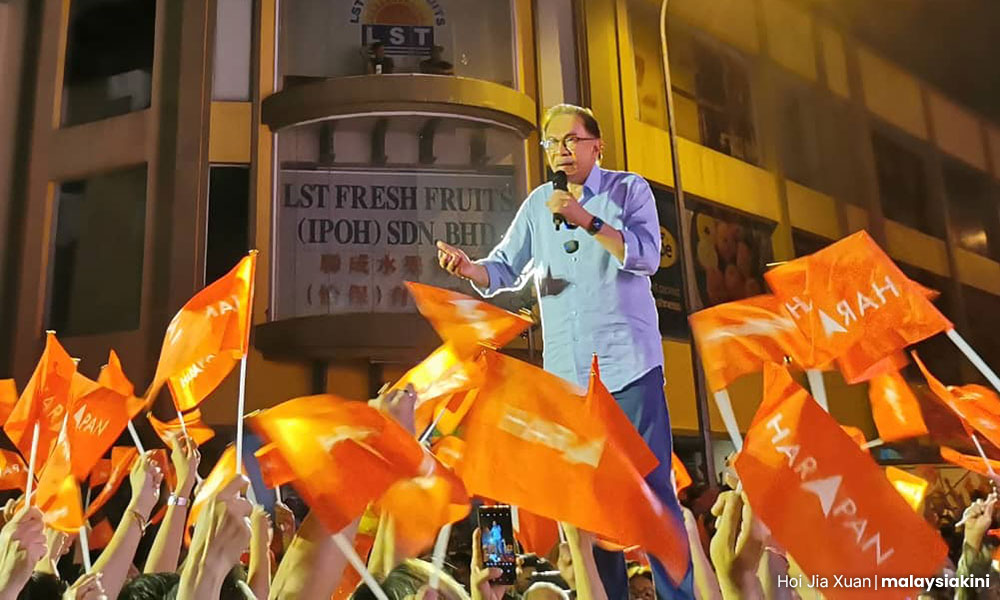
Having a peaceful transfer of power was what we experienced in GE14 and it is something that we should continue to uphold, especially if “we” are not part of the winning side.
Whether Anwar or Muhyiddin Yassin was named the 10th prime minister, it should be seen as part and parcel of democratic consolidation and maturing of the young democracy that is Malaysia.
But now that Anwar has been named the 10th prime minister, the challenges facing him as the prime minister of a unity government are many. It will take much consensus building and give-and-take to establish a government that will be able to last for five years and which can deliver sufficient results to the rakyat.
Here are some of my humble suggestions:
(i) Offer “New Deals” in writing as part of a process to bring BN, GPS, and GRS into the governing coalition.
While it is expected that BN, GPS, and GRS will be part of the new unity government, it is important that the basis of being part of the federal government be established quickly and in writing.
MOUs should be signed by Anwar with the leaders of BN, GPS, and GRS respectively to set out the broad terms of agreement on policy issues that will be addressed by the new unity government.
A commitment towards greater decentralisation of powers and finances for Sarawak (GPS) and Sabah (GRS) and veto powers on certain policy issues and government appointments for BN are some examples.
This is a necessary strategy to set the parameters of cooperation and to minimise the probability of the reoccurrence of another Sheraton Move. Recall that Bersatu did not have any agreement with BN post-Sheraton move. Their only agreement was to form a government together that did not include Harapan.
(ii) Offer an olive branch to PN including being part of the federal government
This will not be a popular proposal among Harapan supporters but an offer to be part of the unity government should be extended to PN. This perhaps can be done after Anwar has obtained support from BN, GPS, and GRS.
The reality that many Malay voters chose PN candidates as their alternative to Umno candidates rather than Harapan candidates should not be ignored. The choice to accept or reject this offer is up to the PN leadership but such an offer should be made in the interest of political and social stability.
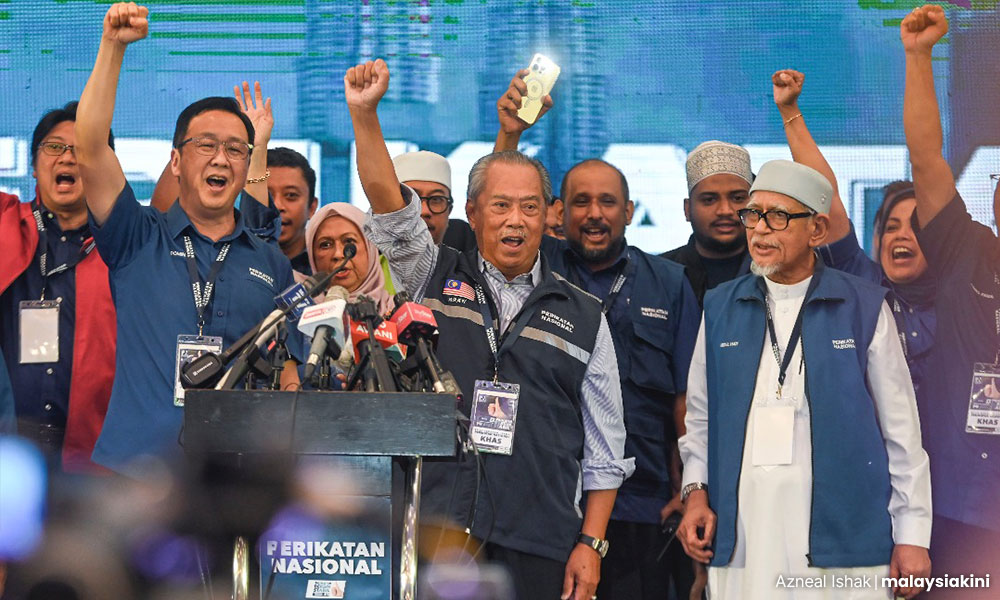
Even if PN chooses not to be in the unity government, full parliamentary privileges including equal constituency allocation should be given to PN MPs.
One-third or half of the heads of the parliamentary select committees should also be from the ranks of PN MPs. An MOU 2.0 should be signed with PN and other opposition MPs that will outline the responsibilities and privileges of a “loyal” opposition.
(iii) Offer a political realignment with BN/Umno
This is perhaps the most difficult proposal to put forward but some sort of realignment between Harapan and BN is needed. BN will position itself as being “forced” to join the Harapan-led unity government. But individual Umno leaders are already looking towards their own party elections and how they will campaign for their respective positions.
If an overt realignment that has something positive to offer to BN/Umno is not forthcoming, the possibility that a newly elected Umno president will pull BN out of the unity government and work together with PN to form a new government cannot be discounted.
Hence, Anwar needs to strengthen the hand of the BN leaders who will likely play key roles in the new government by offering some sort of political realignment. This may include having an electoral arrangement not to field any Harapan candidates in states like Kelantan and Terengganu in the state polls next year.
A more thorough analysis of the election results will show that Harapan needs a Malay-based party like Umno to gain more support in Malay-majority areas and to decrease the fear that Malays have against Harapan, particularly DAP.
At the same time, Umno also needs time to undergo its own internal reformation process that will allow it to win back some of the support it has lost to PN, especially among young and first-time Malay voters.
A Harapan-BN/Umno electoral arrangement may provide the most stable electoral configuration in Malaysian politics, for the next few electoral cycles at least.
(iv) Control the “extremists” from within the ranks
One of the main reasons why the Sheraton Move could take place was because “extremist” voices from within the ranks of Harapan openly attacked their own government, especially the then-prime minister Dr Mahathir Mohamad.
Such voices will likely undermine the unity government, especially if their voices put internal pressure on leaders from the respective parties in government to pivot towards their “extremist” positions. If such voices from within each party are not properly dealt with, the new unity government may prove to be a short-lived one.
(v) Strengthen institutions and governance structures
Finally, a firm agenda to strengthen institutional capabilities and governance structures within the federal government should be continued.
Governments will come and go, as the past two GEs have shown. Institutions which are properly governed and independently managed such as Bank Negara, EPF, and Petronas, will outlive politicians and be able to better serve the long-term interest of the rakyat. The independence of the civil service to serve the government of the day should also be strengthened.
We should celebrate the peaceful handover of power and the appointment of a new prime minister to lead a new government. But, make no mistake, the hard work of forming and maintaining a stable federal government post-GE15 has just started.
ONG KIAN MING is a former DAP MP for Bangi and a former deputy minister of international trade and industry.
The views expressed here are those of the author/contributor and do not necessarily represent the views of Malaysiakini.
/file/publisher-c1a3f893382d2b2f8a9aa22a654d9c97/2022/11/48a3600407b6e581879c52662642a251.jpg)
/file/publisher-c1a3f893382d2b2f8a9aa22a654d9c97/2022/11/92bb7b754a615e21bd7c1f4478fdb197.jpg)
/file/1265/66c2b7d40807f64088a38fa7bbed6df8.jpeg)
/file/publisher-c1a3f893382d2b2f8a9aa22a654d9c97/2022/09/4eb0ffaf392891f9781f5b2006c419d9.jpg)
/file/publisher-c1a3f893382d2b2f8a9aa22a654d9c97/2022/11/0037c34629b116e3c0a28b63feec787c.jpg)


Are you sure you want to delete this comment?
This action cannot be undone.