




Najib runaway train or Pak Lah Express changes route?
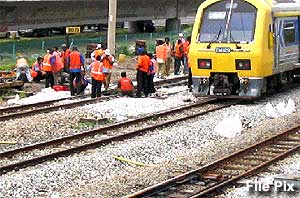
Deputy Prime Minister Najib Abdul Razak's announcement of the award of the shelved double tracking project on March 16 invoked the nightmarish abuse of power by former premier Dr Mahathir Mohamad in the lingering days of his reign on this massive project.
On Oct 22, 2003, only nine days before Mahathir stepped down, the project was abruptly and clandestinely awarded to the MMC Corp Bhd-Gamuda Bhd consortium at the price of RM14.5 billion, despite the existence then of un-revoked letters of intent, issued earlier to state-owned Indian Railway Construction Co (Ircon) and state owned China Railway Engineering
Corp (CREC). Both having worked on the investigations and design of this project for years under a government-to-government agreement.
The circumstances under which this 2003 award was made were most dubious.
Deputy Prime Minister Najib Abdul Razak's announcement of the award of the shelved double tracking project on March 16 invoked the nightmarish abuse of power by former premier Dr Mahathir Mohamad in the lingering days of his reign on this massive project.
On Oct 22, 2003, only nine days before Mahathir stepped down, the project was abruptly and clandestinely awarded to the MMC Corp Bhd-Gamuda Bhd consortium at the price of RM14.5 billion, despite the existence then of un-revoked letters of intent, issued earlier to state-owned Indian Railway Construction Co (Ircon) and state owned China Railway Engineering
Corp (CREC). Both having worked on the investigations and design of this project for years under a government-to-government agreement.
The circumstances under which this 2003 award was made were most dubious.
First, the announcement was strangely not made by the government but by the contractor who claimed that it received the letter of award on the night of Oct 21, 2003.
Second, the incumbent contractor Ircon-CREC consortium was reported to have submitted a price of RM14.3 billion in the morning of Oct 22, 2003 (which perhaps explained why MMC-Gamuda had to claim it received the letter of award on the night of Oct 21).
 Third, the contract was awarded in such a hurry that both India and China were not notified of this abrupt award to a third party while negotiations were still on-going, and neither were the letters of intent revoked, thus breaching diplomatic norms and professional ethics.
Fourth, Mahathir had apparently never submitted this project for proper discussions, not to mention approval, by the cabinet, judging from the reportedly heated Dec 10, 2003 cabinet meeting during which there was a flurry of attempts to call for technical and financial inputs from the ministries of transport and finance as well as technical details from MMC-Gamuda so as to enable the cabinet to make the final decision.
Fifth, no body in the government dared to answer critical questions on this most improper award such as: who made the decision, when was it made, who issued the letter of award, and when.
Deplorable announcement
It is a testimony of the strict clamp-down on media freedom in the Mahathir era and a demonstration of the non-transparency of the Barisan Nasional government that, to this day, these critical questions have not been answered by either the press or the government.
Ironically, the mystery was unveiled by a foreign newspaper the Asian Wall Street Journal (AWSJ) which reported on Nov 13, 2003 and again on Dec 11, 2003 that it was Mahathir who directed the ministry of transport to make this award on Oct 22, 2003. To date, these AWSJ reports have not be corrected or denied.
To the credit of the new Abdullah administration, the cabinet decided to shelve this project in December 2003, on the commendable ground that this project must give way to other sectors of higher priority, namely, health, education and agriculture.
(Fuller details of this double tracking episode including analysis on the project viability are described in article 71 in my book Where to, Malaysia , and also in another article titled ' Double tracking: Cabinet back on track ' posted in malaysiakini on Dec 17, 2003).
Now, three years later, Najib tells us that this project will be resumed immediately.
Quite apart from the project's miserable economic and financial viability, which will be dealt with later in this article, Najib's announcement is most deplorable on multiple grounds.
First, according to local media, the decision to go ahead was made by the Cabinet Committee on Public Transport, in a meeting chaired by Najib on March 16. Najib announced that the northern portion will go to MMC-Gamuda which will start work upon finalising the price, while the southern portion to an Indian company to be nominated by the Indian government.
Shouldn't such an important decision, labelled as the single biggest project in the country, be made by the full cabinet rather than by a cabinet committee? Has the cabinet fully deliberated and approved? If so, why didn't the cabinet announce the decision? If not, it must be the height of irresponsibility to entrust such an important function to a committee. Or has Najib usurped the authority of the prime minister?
Second, Najib justified the resumption of the project on the ground that completing the whole project "will optimise government expenditure" already spent on completing the Ipoh-Rawang stretch. This rationale is totally unacceptable. The project must first be assessed for its viability in its entirety covering all aspects: economic, financial, social and political.
Only when this full assessment yields a net positive benefit to the country should this project be embarked upon. This process of project scrutiny was obviously not carried out in Mahathir's time, neither is it known to have been carried out in Abdullah's administration.
Just because part of the project was completed is no good reason to resume a shelved project, unless the entire project is proven to be viable. To do so would be to throw good money to chase after bad money, and compound the losses.
Grand betrayal
 Third, Najib said he did not know the cost of the project yet, adding that it will be determined only after negotiating the prices with the contractor. How irresponsible can a leader be - embarking on a project costing tens of billions without first knowing its total costs? This is the clearest admission that a serious cost/benefit analysis has not been carried out for this project. Besides, how could the government bargain effectively with the contractor in a negotiated contract as in this case, if the government has not in the first place done its own homework of completing a realistic calculation of the costs?
Fourth, why was there no open tender for this massive project? We have already seen the folly of not calling tender for this project in the last episode in 2003, when the quoted price of the invited consortium of Ircon-CREC tumbled all the way from RM42 billion to RM24 billion to RM20
billion to a reported RM 14 billion, when a competitor appeared on the scene to bid for the project.
Awarding such huge contracts without tender is another serious breach of promise by Prime Minister Abdullah Ahmad Badawi (who has repeatedly pledged to re-instate open tenders for all government contracts), coming so soon after the RM3 billion Second Penang Bridge contract was granted to the Umno-linked UEM group, also without tender. Needless to say, this will lead to incalculable leakages of public funds and inevitable corruption.
Practicing such cronyism through open violation of standard government procurement procedure (which stipulates competitive tenders) on such a massive scale is a grand betrayal of the people's trust and a criminal breach of government regulations.
Simple arithmetic will show that the entire project is outright unviable, economically and financially.
The total project cost of this electrified double tracking railway when completed from north (Padang Besar) to south (Johor Bahru), traversing some 900 km, is likely to exceed RM25 billion. This estimate is based on the last quoted price of RM14.5 billion for the proposed Padang Besar-Ipoh and Seremban-Johor Bahru sectors (totaling 636 km) and the costs on the
completed sector of Ipoh-Seremban plus land acquisition and other costs.
But the total revenue received by the state-owned railway monopoly KTM Berhad at present is only around RM500 million per year (it was reported in 2003 to be RM400 million).
It is not difficult to see that the present total revenue is only equivalent to a small fraction of the financing cost or opportunity cost of the total capital outlay of RM25 billion, which should be in the vicinity RM1.7 billion or RM 1,700 million. Given that the completion of the project will boost revenue, say optimistically by 100% or even 200%, the total revenue will still be well short of the financing or opportunity costs. And when the hefty operating costs and depreciation of assets are counted, the losse could run into billions, just like the infamous Perwaja Steel project.
Full circle
The simplest test of the project's financial feasibility is to throw open the project for self-financed private investment. Investors will surely scoff at such an offer as totally unrealistic.
In fact, common sense tells us that given the geography of peninsular Malaysia - a small land mass well served by strategically located ports and efficient highways - there is little chance that the railway company can compete and prosper against other means of transportation such as vehicles and coastal vessels. Unlike other countries with vast landlocked hinterlands, where the railway serves as an important economic lifeline, Malaysia is simply not cut out for high-scale development of railway transportation.
 Some may argue that this is a social project that brings convenience to the people. True, but at what price? Keeping in mind that Malaysia already enjoys excellent vehicular and marine transportation, can that bit of extra convenience in transportation brought by this project outweigh the immense benefit that could otherwise accrue to the people if these huge sums of
money are spent to improve the livelihood of millions of people who live in poverty, many residing in infrastructure-starved areas?
The Abdullah administration already made the wise decision to shelve this project in favour of others of higher priority at the outset, so what prompted Abdullah to change his mind now? Or has he lost his direction as well as control of the government?
This project has all the characteristics of a classical Mahathir era mega project huge scale, high costs, irrational, crony-driven, non-transparent and uncompetitive.
With its re-launching, the self-proclaimed reformist leader Abdullah seems to have signaled that he has traveled one full circle, starting out as a crusader to wipe out the vices of the Mahathir era, dithering and stumbling on the way, evading and retracting when challenged, and finally back to the comfort zone crafted out by Mahathir the world of cronyism, corruption and nepotism.
KIM QUEK is a retired accountant with an interest in current affairs.


