




Malaysia-US FTA: Whats at stake? (Part 2)
Two examples serve to illustrate both the politics at play and the potential damage to Malaysia's economic and human security if the Free Trade Agreement (FTA) with the US goes ahead.
The all-encompassing nature of the FTA rules can be especially seen in relation to agriculture and intellectual property rights as they apply to medicines.
They impact equally on 'traditional' sectors of the economy sustaining rural livelihoods and the modern, knowledge-driven industries that are said to hold the key to future well-being and competitiveness.
Two examples serve to illustrate both the politics at play and the potential damage to Malaysia's economic and human security if the Free Trade Agreement (FTA) with the US goes ahead.
The all-encompassing nature of the FTA rules can be especially seen in relation to agriculture and intellectual property rights as they apply to medicines.
They impact equally on 'traditional' sectors of the economy sustaining rural livelihoods and the modern, knowledge-driven industries that are said to hold the key to future well-being and competitiveness.
For many years the trade liberalisation agenda in agriculture has been set by and for the corporate agribusinesses of the US, EU and Japan. What this means is that the terms of trade in agricultural production - an area where developing countries should have their strongest comparative advantage, according to free trade theory - are firmly weighed against them. In fact, nowhere are the double standards of so-called free trade more apparent than in the agricultural sector.
A major lynchpin of the first Bush administration was the 2002 Farm Bill. This allocated the astronomical sum of $248 billion to farmers, mainly in the form of subsidies for growing eight crops (including rice) in a number of mid-western states which form the bedrock of Republican Party support. Smaller farmers have barely benefitted at all.
Aruradha Mittal of Food First has called this scheme "welfare for corporate agribusiness" and it is difficult not to agree. Discussion of the 2007 Farm Bill is running parallel to the Malaysia-US FTA negotiations.
 The consensus is that US farmers may accept a modest reduction in subsidies but only in exchange for greater export opportunities and market access abroad of the kind guaranteed in the FTA.
Meanwhile, it is clear that smallholder farmers in Malaysia would suffer untold hardship if tariffs are slashed and their subsidies are cut. Not only would this scenario would devastate rural livelihoods but it would also call into question food sovereignty which was highlighted as a key goal in the Ninth Malaysia Plan.
Trips-plus standards
The second example focuses on the implications of bilateral free trade on access to affordable medicines. Medicines (like other products) can be protected by intellectual property rights (IPRs). These are artificial monopoly rights to intangible goods and services, including copyright, patents, trademarks, industrial designs, integrated circuit designs and trade secrets. Major corporations have long pressed for such rights which, they say, encourage innovation and protect their R&D.
The adoption of the Agreement on Trade-Related Aspects of Intellectual Property Rights (Trips Agreement) at the World Trade Organisation (WTO) was fundamentally about transforming IPRs into internationally tradable commodities.
 The Agreement extended protection for branded drugs and limited parallel imports, impeding the availability of affordable generic medicines. But in partial recognition of the struggle of many developing countries and NGOs against what they saw as "patent hegemony", the Doha Declaration on the Trips Agreement and Public Health does recognise countries' rights "to protect public health and, in particular, to promote access to medicines for all".
This flawed compromise - agreed to in 2001- at least partly addressed the problem of allowing the export of low-cost generics to developing countries that do not have the capacity to produce these medicines.
However, the US government has consistently used its FTA negotiations to extract ever higher levels of intellectual property protection than those mandated by the Agreement. They include so-called Trips-plus standards which, in some instances, even exceed US domestic law. This has hugely important implications for people's access to medicines and the right to promote public health provision.
A recent report by a highly respected umbrella group of NGOs (including Health GAP, Mdicins Sans Frontires, Oxfam and Third World Network) concluded that Trip-plus deals are bad for public health for these reasons:
- they expand the scope of pharmaceutical patents to include new indications and new formulations;
- they limit grounds for issuing compulsory licences to emergencies, government non-commercial use and competition cases only;
- they bar parallel trade on non-patent drugs sold more cheaply elsewhere;
- they extend patent monopolies;
- they enhance protection for clinical trial data, thereby preventing registration and sale of generics; and
- they enforce patent violations and grant drug companies investor rights to sue.
The empirical evidence from other US-sponsored FTAs is also pretty damning. According to Jakkrit Kuanpoth, the Trips-plus terms of the Thailand-US FTA deepens Thailand's technological dependence on foreign interests, engenders loss of trade balance in the pharmaceutical sector to the US, and hinders local R&D. He says that "patents will continue to be used by foreign drug companies as a mechanism for overpricing, transfer pricing and insertion of restrictive clauses in technology transfer agreements".
At the same time, the FTA threatens the existence of the Thai generic companies. Exactly the same findings can be found in a similar study of the impact of an FTA on the Colombian generic drug industry. The net effect is that Colombians will have to spend an extra US$1.5 billion on medicines every year by 2030.
A World Health Organisation review of the implications of bilateral FTAs on access to medicines suggests in no uncertain terms that accepting Trips-plus terms "negates the letter and spirit of the Doha Declaration, and will limit the capacity of States to progressively realise the human right to health".
 At least some voices in Malaysia appear to acknowledge the gravity of the situation. Last month, Attorney-General Abdul Gani Patail argued that generic medicines should not be restricted in any manner. It is a view endorsed by the Malaysian Organisation of Pharmaceutical Industries which sees any FTA giving US drug companies a hugely unfair advantage over local competitors and undermining public health safeguards. Whether the public criticism will be sufficient to halt the juggernaut that is the US pharmaceutical industry must be open to doubt.
Worst excesses
The lessons from both case studies - agriculture and the Trips-plus provisions as they apply to medicines - are wholly indicative of what a Malaysia-US FTA would look like. There are many more equally controversial issues on the table. To suggest, as some Malaysian politicians have done, that they can simply be laid to one side during the negotiation process is deceitful.
Certainly the US government is not under any illusions. Its trade strategy is first and foremost about the pursuit of market access initiatives on the basis of models "that can be used throughout all negotiations". For the US, then, there are core provisions that are not open to compromise. Rather there are core business interests to protect, with agribusiness and pharmaceuticals to the forefront.
 President George W Bush himself understands this logic. As he made clear at the opening of negotiations, "a US-Malaysia Free Trade Agreement will advance our commitment to opening markets around the world and expanding opportunities for America's farmers, ranchers, workers, and businesses". Can the same be said for Malaysia's farmers, workers and businesses?
Nor is it good enough to summarily dismiss the very real concerns of informed citizens who oppose the deal in principle and in practice. To do so is both bad politics and bad policymaking.
One unintended consequence of the government's premature flirtation with the FTA is that it has provoked some serious and radical rethinking of the terms on which Malaysia should engage with the processes of globalisation. For many years Malaysia had a deserved reputation for successfully pursuing the unorthodox, often in the face of mainstream criticism. The imposition of capital controls as a way of stemming capital flight in the wake of the 1997-98 financial crisis is the best known example.
It is deeply ironic, then, that just as the international trade regime, and its attendant free trade manifestation, has come under intense critical attack the government should see fit to tie itself to a deal that locks in the worst excesses of rapid liberalisation. How much more bewildering that it does so in harness with a US administration that provokes widespread outrage because of its unfettered unilateralism.
Review deal
The removal of the US-imposed time constraint should be now used as an opportunity for reflection and a much more frank debate than has hitherto been the case. In fact it is beyond comprehension that such a debate has not yet taken place. If our politicians and public are confused then they require the range and quality of information that might help them make better decisions.
A minimum requirement surely would be a thorough evaluation of the FTA's assumed costs and benefits. Even in its own terms - the claims about creating investment, exports and jobs - the FTA does not bear close examination. Malaysian exporters want market access. But the fact is that the allure of the US market may be grossly overstated.
The US has been burdened by years of budget and trade deficits as well as excessive consumption. There are telling signs that these imbalances are chipping away at what is still a phenomenally powerful economy. The American consumer is starting to run out of road. As a result, there is mounting pressure to reduce deficits to sustainable levels.
 One scenario is a decrease in US imports, perhaps by as much as $300 billion in the next decade, with an attendant surge of US goods and services entering Malaysia. Put this way, the much-vaunted benefits of access to the US market actually look quite marginal.
By contrast, the downside costs to Malaysia look daunting. The threats to economic sovereignty and policy autonomy are not the fevered nightmares of those with "inferiority complexes". The risks are real. Even in a globalising world, economic sovereignty and policy autonomy are the prerequisites of any coherent national development policy.
As the Harvard economist, Dani Rodrick, puts it: "The exchange of reduced policy autonomy in the South for improved market access in the North is a bad bargain where development is concerned".
Deeper trade liberalisation - such as that embodied in the FTA - will not deliver poverty reduction, equitable distribution, sustainable development or many of the other goals outlined so recently in the 9MP. It will simply compel the disciplines of the global marketplace and the rights of investors.
What the past year has demonstrated above all else is that globalisation and trade liberalisation are not taken-for-granted processes. In some senses it is actually very healthy that competing social and economic forces are struggling over who sets the rules of the game. Different national constituencies are pushing for and against different degrees of global integration.
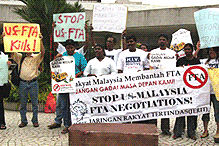 For their part, the business communities in both Malaysia and the US are pressing for the short-term gains that an FTA may or may not deliver. But opponents worry for the longer-term developmental sustainability of any deal in its current format. More than this, they appreciate the mismatch between the rights that business actors have acquired through bilateral trade arrangements and the lack of corresponding responsibilities that they are expected to exercise.
In this context, the fight over free trade is symptomatic of critical new thinking about how best to control the forces of globalisation that increasingly structure the country's development choices. The FTA would leave these choices to the most powerful market actors.
But the foundations of a durable development project requires vision, values, leadership, purpose and accountability - the very antithesis of the market ethos. Hard choices will have to be made in the coming months. Those who make these choices must also listen to those voices who offer another vision of the future.
Part 1: Malaysia-US FTA: What's at stake?
CHARLES SANTIAGO is an economist.


