




The emperor cometh
Global mergers, acquisitions and equities have been rising over the last year; some will say exponentially. The sell-off of Qantas, Australia's national airline, although mostly privately-owned, fell through early this month when a consortium of investors couldn't meet the bid deadline. By then the game wasn't dead yet. And as that attempted buy-out was being played out, or unravelling, a couple more suddenly flew into the world's media spotlight.
Global mergers, acquisitions and equities have been rising over the last year; some will say exponentially. The sell-off of Qantas, Australia's national airline, although mostly privately-owned, fell through early this month when a consortium of investors couldn't meet the bid deadline. By then the game wasn't dead yet. And as that attempted buy-out was being played out, or unravelling, a couple more suddenly flew into the world's media spotlight.
Former Australian and now American citizen, the billionaire media mogul Rupert Murdoch, made an 'uninvited' bid for one of the world's, if not the world's most authoritative newspaper pre-eminent The Wall Street Journal . He offered US$5 billion to the Bancroft family, who owns Dow Jones, which publishers a stable of globally prominent publications, including The Wall Street Journal-Asia and the now revamped Far Eastern Economic Review.
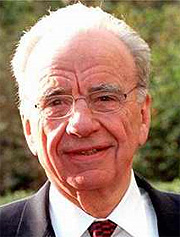 Insiders say the Bancroft family scoffed at Murdoch's bald-faced arrogance. But in fact they sneered at the mere US$5 billion on offer just as Qantas's board of directors and major shareholders had laughed at the A$11.1 billion bid by Alliance Partners Australia, led by Australia's Macquarie Investment Bank. Scurrying to revive the bid, Qantas is now hanging out for a better number. Last week, APA killed off the venture, saying it wasn't prepared to pay more than what it had offered for Qantas. And Qantas staff are mighty relieved the game's over for now.
Wall Street insiders say the Bancrofts could be holding out also for more even though they've been telling those who'd listen that they would never sell. 'Never' is not a word in Murdoch's vocabulary. Murdoch says it's a fair and generous offer, and in the rough and tumble of global business, if Rupert wants WSJ badly, he'll cough up more for the doyen of American and international journalism. And if the Bancrofts still won't play ball, the next step is likely to be a hostile takeover.
Plan not insignificant
The last time the WSJ's share price lit up like Christmas lights on Wall Street indices was back in the halcyon days of the bubble economy in 2000 before it pricked into recession. Since then WSJ's share price has languished around US$65 a pop. That's hardly crumbs. The question is: can Murdoch shore up its share value assuming the Bancrofts will succumb to an offer they can not refuse?
That depends on what Murdoch plans for the spreadsheet, but odds-on that his plans wouldn't be insignificant. Here's the irony, though. In 1988 Murdoch told a journalist from WSJ : "There is room at the top of the market to attack The Wall Street Journal ." Prescient or what? Because the cycle says the market is now at its top. So Murdoch's making his move, taking out a big stake in Pearson, owner of London's The Times . The plan was to use The Times to take on the Journal on its own turf. But Murdoch's strategy didn't work. Now he's taking the direct route the one that has worked the best in building his global media empire.
The bigger the prize, and the harder they are to acquire, the more determined Murdoch becomes in pulling out all stops. That's why he's called 'emperor' in certain media circles. When he prised Hong Kong's South China Morning Post , he made enemies among star-studded journalists and reporters who thought they're jobs were as good as gone. After all, trimming the flab of organizations like these is one way of immediately paying for his acquisitions. It's ruthless but every business does this.
In other areas, where acquisitions fail, Murdoch launches direct competition, like Fox News to undercut CNN's global thrust, and BSkyB to show the UK's BBC that he can do what they've been doing. But whether Murdoch's media business does it better than these long-entrenched networks is possibly what worried SCMP's journos and no doubt those in the Wall Street Journal today. Yet ratings and revenues show that Murdoch's BSkyB and Fox News have broken the stranglehold that the BBC and CNN have enjoyed for yonks.
While the Bancrofts quietly mull over the Murdoch move, and major shareholders think the offer is as good as it's going to get and they'll start to agitate the Bancroft family to sell the business, senior editors at The Journal may be reluctant to cave in, if push comes to shove.
Global benchmark
There's no question that WSJ's reporting has been a global benchmark of good journalism. The most prized asset of the journalism business isn't The Journal's printing machines. On the one hand it's its editorial content. On the other hand, it's The Journal's financial reporting, especially its financial analyses, in real time, given that Dow Jones, the parent company, controls the bulk of Wall Street's indices coverage also in real time.
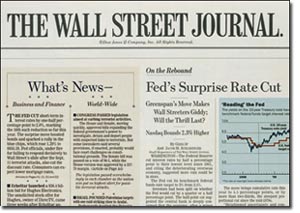 That's what Murdoch's media businesses have lacked so far: real-time, first-class financial reporting and analyses the way London's superb
Financial Times
has been showing the way in Britain and Europe. There's more. Both newspapers' online news business is doing a roaring trade. It's probably more profitable than print. It's been clear that the increasingly internet-driven PC savvy young professionals are making print media not only less financially lucrative and increasingly outdated. More, these professionals, young and old, are prepared to pay premium subscriptions for
FT's
and
WSJ's
online, real-time content.
That's what Murdoch's media businesses have lacked so far: real-time, first-class financial reporting and analyses the way London's superb
Financial Times
has been showing the way in Britain and Europe. There's more. Both newspapers' online news business is doing a roaring trade. It's probably more profitable than print. It's been clear that the increasingly internet-driven PC savvy young professionals are making print media not only less financially lucrative and increasingly outdated. More, these professionals, young and old, are prepared to pay premium subscriptions for
FT's
and
WSJ's
online, real-time content.
It's this that Murdoch wants not so much to use in his hard-print media businesses but delivery of real-time financial news and analyses on Fox News and BSkyB , which will then become the vehicles by which to expand his financial news coverage globally whilst encircling rivals in Europe and Asia. Such moves are some way off. For Murdoch, the main game now is in the American media market.
Clearly there's room at the top of the market. Murdoch is already drawing up plans for a start-up that'll rival the conglomerate CNBC Network. And if you haven't yet noticed, CNBC has been featuring financial and economic news and analyses from The Wall Street Journal. Which can only mean one thing for the wily old Murdoch: If The Journal is worth US$5 billion, CNBC could also be worth the same, more or less.
MANJIT BHATIA, an Australian, is a university lecturer and writer who specializes in international economics and politics, with a focus on the Asia-Pacific. He has been published in The Wall Street Journal .


