


/file/publisher-c1a3f893382d2b2f8a9aa22a654d9c97/2023/09/89b78b7e43c580d2175e324d8fb536dc.jpg)

COMMENT | Abolish Sedition Act, restore freedom of expression
COMMENT | There is growing concern when Prime Minister Anwar Ibrahim and his Pakatan Harapan-BN Plus government seems to be moving towards something like ‘lese majeste’ in Malaysia that will criminalise actions and speech about royalty.
In June, the government warned it would take “appropriate action” against any insults or threats towards the nation’s royal institution.
Within three years (2020-2022), 255 persons were investigated under the draconian Sedition Act 1948 (a law enacted by the British colonial government), but only four were charged. In 2023, the Act is still being used.
On Sept 25, 41-year-old Wan Ji Wan Hussin the Court of Appeal upheld his conviction for making seditious remarks against the Selangor sultan but reduced his sentence to nine months imprisonment.
In July, the Kedah menteri besar was charged under the Sedition Act for two offences in two different courts - one with regard to comments concerning the Selangor sultan, and another over a statement about the coalition government.
In March 2019, the police also investigated organisers and participants of the Women's March in Kuala Lumpur under the Sedition Act. This year, some...
COMMENT | There is growing concern when Prime Minister Anwar Ibrahim and his Pakatan Harapan-BN Plus government seems to be moving towards something like ‘lese majeste’ in Malaysia that will criminalise actions and speech about royalty.
In June, the government warned it would take “appropriate action” against any insults or threats towards the nation’s royal institution.
Within three years (2020-2022), 255 persons were investigated under the draconian Sedition Act 1948 (a law enacted by the British colonial government), but only four were charged. In 2023, the Act is still being used.
On Sept 25, 41-year-old Wan Ji Wan Hussin the Court of Appeal upheld his conviction for making seditious remarks against the Selangor sultan but reduced his sentence to nine months imprisonment.
In July, the Kedah menteri besar was charged under the Sedition Act for two offences in two different courts - one with regard to comments concerning the Selangor sultan, and another over a statement about the coalition government.
In March 2019, the police also investigated organisers and participants of the Women's March in Kuala Lumpur under the Sedition Act. This year, some participants were investigated for offences under the draconian Peaceful Assembly Act 2012 and another law.
Malaysians expected the repeal of the Sedition Act when Anwar’s Harapan won the election but this did not happen even after about 11 months in power.
No need to review, just totally repeal
The Malaysians Against Death Penalty and Torture (Madpet) reiterates the call for the total abolition of the Sedition Act and cannot agree with the cabinet’s position to keep it under claims of only using it to protect the king, sultans and state rulers.
“The cabinet has agreed in principle for the Sedition Act to be reviewed to ensure this law is used only to protect the institution of rulers from any provocation,” Minister in the Prime Minister’s Department (Law and Institutional Reform) Azalina Othman Minister was reported as saying on July 25.
On Oct 16, 2014, the Malaysian Bar held the “Walk for Peace and Freedom”, seeing the participation of about 1,500 lawyers to condemn the use of the Sedition Act and calling for its immediate repeal.
In June 2020, Suhakam called on the government to repeal the Sedition Act without further delay, followed by many other groups and persons.

The Sedition Act criminalises seditious tendency – intention is irrelevant, truth is no defence, and freedom of expression is sidelined.
It makes it an offence to do or say things that ‘have a seditious tendency to bring into hatred or contempt or to excite disaffection against…’. Hence, it does not matter if what was said was even the truth or a justified opinion, for all that matters is whether it had a seditious tendency or not.
Whether the maker of the statement had the intention of doing this act that caused a seditious tendency is irrelevant.
Section 3(3) of the Act states that ‘for the purpose of proving the commission of any offence against this Act, the intention of the person charged at the time shall be deemed to be irrelevant if in fact the act had, or would if done, have had, or the words, publication or thing had a seditious tendency.
In PP v. Mark Koding (1983) 1 MLJ 111, the court held that even an innocent or noble intention would not provide a defence.
“It is immaterial whether the accused's intention or motive was honourable or evil when making the speech,” the case revealed.
Even if the Sedition Act is repealed, Malaysia has other laws that could be used including the Penal Code offence of criminal defamation that could be used against anyone who committed crimes against the royalty.
‘No one is above the law’
Our Federal Constitution in Article 8(1) states that all persons are equal before the law and entitled to equal protection of the law.
Article 10(1)(a) states that every citizen has the right to freedom of speech and expression, and under the ‘restrictions as it deems necessary or expedient’ with regard to this freedom, there is no mention of the royal institution or the rulers.
Yang di-Pertuan Agong Sultan Abdullah Sultan Ahmad Shah recently reaffirmed the principle of equality of all persons, and that the law must not give special treatment or exception to anyone.
He said that the law has only one language, one principle, one punishment and one application to anyone. Even the king, in his wisdom, did not demand any special treatment for the royalty or the royal institution.
Malaysia is a constitutional parliamentary democracy, not a feudal state.
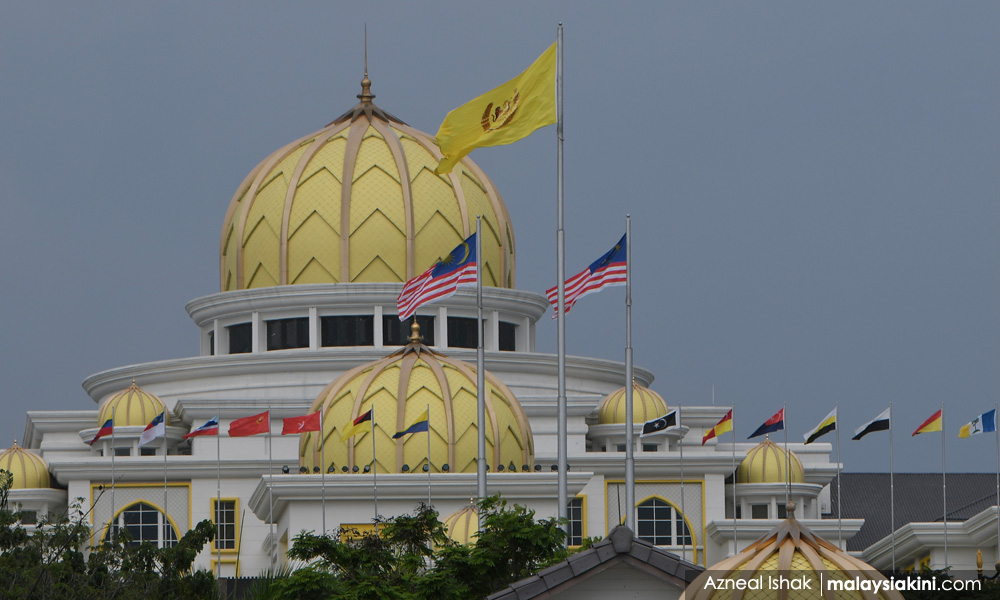
The king and the rulers generally no longer have absolute power. Everything done by the king or rulers is on the advice of the prime minister or chief minister, whereby the king has no choice but to follow the advice of the party as provided in the Constitution, be it the federal or state.
Even for the appointment of the prime minister, the king can only appoint the person who has the confidence of the majority of the MPs.
As such, it is ignorant to personally blame the king or any ruler, for the people he appoints including judges, Suhakam commissioners, attorney-general and members of the cabinet.
Removing royalty’s ‘legal immunity’
It must also be noted that the Constitution (Amendment) Act 1993 introduced Part XV proceedings against the Yang di-Pertuan Agong and the rulers, whereby Article 182(3) states that: “The Special Court shall have exclusive jurisdiction to try all offences committed in the federation by the Yang di-Pertuan Agong or a state ruler and all civil cases by or against the Yang di-Pertuan Agong or state rulers notwithstanding where the cause of action arose.”
Article 33A(1) states that: “Where the Yang di-Pertuan Agong is charged with an offence under any law in the Special Court established under Part XV, he shall cease to exercise the functions of the Yang di-Pertuan Agong.”
This constitutional amendment that made clear that there was no immunity for royalty and/or rulers was made when Anwar was a minister of the then-BN government.
‘Feudal mentality’
A problem in Malaysia is the definition of royalty and the preferential treatment accorded by the state, public officers and some to royalty primarily because of a prevalent ‘feudal mentality’.
Would that affect tenders, contracts, logging permits and mining licences when royalty is involved in the business or application? Even when it comes to law enforcement, there seems to be disinclination when royalty is involved and this is seen by the number of cases filed in the Special Court.
Should the people not have the freedom to highlight the wrongdoings of royalty or the companies/businesses they are involved in?
If the king appoints a prime minister who no longer enjoys the confidence of the majority, will it be an offence under the Sedition Act to highlight this failing of the institution?
If the royal institution or the rulers do or say something that is unacceptable or wrong, can’t concerned Malaysians highlight this?
In the past, royalties have been involved in companies taking part in logging, mining, and other matters.
Hence, to maintain the Sedition Act for the protection of royalty or even royal institutions cannot be justified.
Are we to be forbidden by law to be a good citizen in a democracy to highlight wrongs or suspected wrongs, or to publicly disagree with a statement/action?
Therefore, Madpet reiterates the call on the government to immediately repeal the draconian Sedition Act 1948, and no longer come up with excuses for delaying the repeal.
We also call on the government to immediately impose a moratorium on the use of the Sedition Act, so that no one will ever be again investigated, arrested, detained for investigation or charged for any offences under the Sedition Act.
Madpet also reiterates the call for the immediate repeal of bad laws, and/or draconian provisions in law.
MADPET is a movement for the abolition of the death penalty and torture.
The views expressed here are those of the author/contributor and do not necessarily represent the views of Malaysiakini.
/file/publisher-c1a3f893382d2b2f8a9aa22a654d9c97/2023/09/da0cdbf5aef41469fe07b07202e171ea.jpg)
/file/publisher-c1a3f893382d2b2f8a9aa22a654d9c97/2022/11/f528966fdb3d09893f6fd5f7b5601a76.jpg)
/file/publisher-c1a3f893382d2b2f8a9aa22a654d9c97/2023/09/89b78b7e43c580d2175e324d8fb536dc.jpg)
/file/publisher-c1a3f893382d2b2f8a9aa22a654d9c97/2020/01/ab98507586896da22b4aa49ff8bb61df.jpg)
/file/publisher-c1a3f893382d2b2f8a9aa22a654d9c97/2023/03/c6a3b1273ed473e67e38fe98809d86dc.jpg)
/file/publisher-c1a3f893382d2b2f8a9aa22a654d9c97/2023/09/fc981bad3d72602336fb52eb21e6151e.jpg)
/file/publisher-c1a3f893382d2b2f8a9aa22a654d9c97/2022/08/c84daf67aadc8a198fc9fbea392d8399.jpg)
/file/publisher-c1a3f893382d2b2f8a9aa22a654d9c97/2023/01/34aad1074e06b7afae05b76bb6d51376.jpg)
/file/publisher-c1a3f893382d2b2f8a9aa22a654d9c97/2022/10/1636d5fb4b361cea5196b6b0bfc28a9b.jpg)
/file/publisher-c1a3f893382d2b2f8a9aa22a654d9c97/2023/09/053464306b4d4b1bb0469fe102dfa8cc.jpg)


Are you sure you want to delete this comment?
This action cannot be undone.