




The nation's good, bad and ugly
I have always believed that Malaysia is a fortunate country. We are blessed with fertile soils producing (and top producers no less) commercial crops such as rubber and palm oil, a climate with no seasons (even though on the hot side) so we don't have to worry about the elements, no natural disasters such as volcanoes and earthquakes (though we do experience some tremors when a big earthquake occurs near us, and just sometime back, we were hit by a tsunami).
Our former colonial master, the British, actually left us with a set of good roads linking all the major towns, a good rail system that links east and west coast of Peninsular Malaysia. They have also left us with a good administrative system and an English speaking civil service. They have also, by practicing racial policy of divide-and-rule, been partly responsible for some of the problems we are facing today.
Despite some misgivings about certain policies, I consider myself lucky to be a Malaysian. I was born here, bred here and would most probably die here. This is my country and I am always proud to announce to my foreign friends that I am a Malaysian first and foremost.
I have always believed that Malaysia is a fortunate country. We are blessed with fertile soils producing (and top producers no less) commercial crops such as rubber and palm oil, a climate with no seasons (even though on the hot side) so we don't have to worry about the elements, no natural disasters such as volcanoes and earthquakes (though we do experience some tremors when a big earthquake occurs near us, and just sometime back, we were hit by a tsunami).
Our former colonial master, the British, actually left us with a set of good roads linking all the major towns, a good rail system that links east and west coast of Peninsular Malaysia. They have also left us with a good administrative system and an English speaking civil service. They have also, by practicing racial policy of divide-and-rule, been partly responsible for some of the problems we are facing today.
Despite some misgivings about certain policies, I consider myself lucky to be a Malaysian. I was born here, bred here and would most probably die here. This is my country and I am always proud to announce to my foreign friends that I am a Malaysian first and foremost.
In reviewing our progress as a nation, I will talk about the good, the bad and the ugly.
The Good
Until the Asian financial crisis in 1997, Malaysia in fact had a very good run in its economic growth. During Tunku's and Tun Razak's time as prime ministers, we were the top producers of rubber and tin. With the implementation of the Felda scheme, we became top producers of palm oil as well.
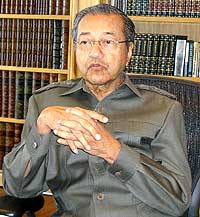 In the eighties, Dr Mahathir Mohamad transformed our economy into a semi-industrialised nation, with the help of inflowing FDI. In the early 1990s, we were No 4 in the ranking for FDI, which is really an achievement considering that we are a small country with a relatively small population at that time.
Compared with countries like Congo, Burma, Philippines, Indonesia, Nigeria, Somalia, Ivory Coast and so on, which achieved Independence about the same time as us, we are much further ahead economically as well as in democratic practices.
We, however, should not be too complacent, because compared with the likes of South Korea, Taiwan, Hong Kong and Singapore, we did not do so well, even though countries like Taiwan and South Korea were behind us in the 1960s.
In sports, as a small nation of a few million, we were the world champions in badminton and we produced many world beaters in the '50s and '60s, when the support from the state was minimal at best. In hockey, we were once placed No 4 in the world (in the 1974 World Cup). In soccer, we were one of the top nations in Asia, and our team did us proud by getting into the final rounds of the Olympics.
Our judiciary used to the the envy of many countries, including some developed nations, because it was fiercely independent and upright. The ordinary people and businessmen felt secure knowing that there was always a legal avenue that they could resort to if they were somehow victimised by government machinery or policies.
Our universities, especially University Malaya and its medical faculty, used to be one of the top in Asia. It was highly regarded, not only in the academic circle, but also by people in other countries.
People of all races used to mix well. During my childhood, it was not uncommon to see people of all races sitting together in a kedai kopi and chatting.
We also have one of the best hardware for a semi developed country. We have the Twin Towers which used to be the tallest buildings in the world, we have a very good airport in KLIA, (even though there was much controversy about whether we really need such buildings - I will not go into this), we have a good road system like the North South Highway (controversy again about the toll agreement of course), we also have good telecommunications coverage, fairly good penetration of IT usage. We have a relatively good administrative system among the third world nations.
Last but not least, we have a fairly open society.
The Bad
1. Deteriorating standard of governance. Corruption is getting more rampant. There is this perception that whenever a project is planned and implemented, someone would gain tremendously from it. Lack of transparency and accountability are the other things that have led to a deteriorating standard of governance.
2. The NEP, which has a very good initial intention of restructuring the society to help the poor irregardless of races, has been abused and misused for personal gain, and has led to the practice of cronyism and nepotism.
In the pretext of the NEP, abuses in interpretation and implementation of many policies occur, and the problems of racial polarisation became more and more acute.
The crutches given under the NEP has also made our people much less competitive. The people became less productive and less diligent, with too much dependence on government assistance. Whereas the implementation of a project should be based on the needs of and the benefits to the people, it is now often implemented based on how much certain individuals can gain from it. Hence, the NEP has made corruption worse.
 3. Loss of excellence. We have lost our urge for excellence. Our universities are no more among the top in the world. Our football team was placed 149th. We have not regained the Thomas Cup, we have ceased to be among the top in Hockey. Our students going overseas, with some exception of course, no longer top foreign universities regularly like before, even though we are producing tonnes and tonnes of all As students in the SPM exams. Even straight As students are not well versed with general knowledge, and cannot even tell you simple historical or geographical facts.
Our police as well as the judiciary are perceived to be not like before. Civil servants especially the younger ones no longer have good command of English, and this will become a handicap in learning new ideas or exchanging views at international conferences.
The loss of excellence has everything to do with our education system which is badly in need of a total overhaul to bring back the urge for excellence in whatever we do. The NEP has also indirectly been responsible for this malaise since it has made the people less dependent on themselves and more dependent on government assistance. The "crutch" mentality has made people less competitive, and without the urge to be competitive, we will never have the urge for excellence again.
The Ugly
Our people as a whole are getting less courteous and ruder. This was revealed by the Readers' Digest research in which it has tagged us as the third rudest country.
Some of us don't have the basic courtesy of standing up and giving our place to the elderly, the pregnant or the disabled. Some of us don't observe traffic rules anymore, except when there is a CCTV or police presence. Some of us U-turn at no U-turn place, and never observe traffic limits, some of us never bother to stop at a traffic light junction when the traffic light is red. Going against traffic in a one way street is no more rare, double and triple parking is now a common occurrence.
This is again a failure of our education system. The rudeness and the 'kiasu'ness have in fact added much stress to our daily lives, which has in turn made us more kiasu and rude. It is a sort of a vicious cycle, and to break this cycle, we need our schools to produce caring and thinking individuals, and not selfish people.
The future
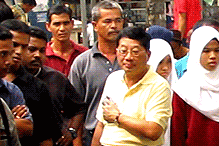 Despite all the misgivings that I have listed above, I am full of optimism for my country. However imperfect our system is, we are still a workable democracy. Despite some of the abuses and misconducts, we are still many steps ahead of others.
Our government, by virtue of being elected, still listens to the people. I am optimistic that the NEP would be reviewed, at least the implementation of it. The police force is showing change for the better, the judiciary, likewise, will regain its former glory.
We have among our younger generation of leaders, people like Raja Nazrin, who I have no doubt will one day be our King, which have given this nation hope. This group of fair minded people will exert their influence on the people around, doing away with the 'crutch' mentality and regain the excellence.


