




A place in the sun for everyone (Pt 1)
Not many countries can boast the cultural diversity that Malaysia has. We are blessed with a diversity of talents, while geology and geography have provided us with great natural resources. We are a lucky country.
Malaysians should be thankful for what we have. Compared to other nations in the region with a similar ethnic configuration, our progress has been relatively peaceful and prosperous.
Our journey as a nation has admittedly not always been smooth. Many times we have quarreled, but we have stuck together through it all. It says much for us that we want to be known as Malaysians - albeit of different races, cultures and religions.
Not many countries can boast the cultural diversity that Malaysia has. We are blessed with a diversity of talents, while geology and geography have provided us with great natural resources. We are a lucky country.
Malaysians should be thankful for what we have. Compared to other nations in the region with a similar ethnic configuration, our progress has been relatively peaceful and prosperous.
Our journey as a nation has admittedly not always been smooth. Many times we have quarreled, but we have stuck together through it all. It says much for us that we want to be known as Malaysians - albeit of different races, cultures and religions.
Once, Malaysians mixed more freely. Racial polarisation and religion-based divisions did not intrude into our daily lives as much as now. Today, many problems are manifested in racial terms. This is a failure for which all Malaysians must bear responsibility.
Will the time come when we have one quarrel too many? A marriage where the partners live largely separate lives and often in polite disdain for one another cannot be a happy one. It doesn't help when we can't talk honestly and openly to one another. We must resolve our differences with sensitivity and fairness. Unless we empathise with the other side - try to understand their fears and hopes - we will not realise fully the great potential of our nation.
The underlying reasons for this separateness are the fears of each race for their place under the Malaysian sun, the lack of trust in one another, and the general distrust that government policies will deliver a just outcome for all. Racial separation is largely a politically induced one. Unscrupulous politicians have exploited distrust and suspicion to deepen the racial divide
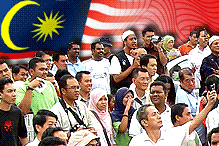 The concept of
Bangsa Malaysia
or a single Malaysian identity is an alluring one, which most Malaysians accept. If national unity is the ultimate goal then the policies must also reflect it. There must be integrity and honesty of purpose. As Gandhi said, to seek a truthful and just end, we must begin with a purity of purpose.
The concept of
Bangsa Malaysia
or a single Malaysian identity is an alluring one, which most Malaysians accept. If national unity is the ultimate goal then the policies must also reflect it. There must be integrity and honesty of purpose. As Gandhi said, to seek a truthful and just end, we must begin with a purity of purpose.
However, 'bumiputera-ism' betrays the integrity and honesty of purpose of building a Bangsa Malaysia . We send out wrong signals when we say we want national unity but then divide the population into 'bumiputeras' and 'non-bumiputeras. The notion that one group is entitled to special privileges automatically excludes all others who do not fall in that category.
What has ethnicity to do with affirmative action? If affirmative action is about giving the marginalised a leg up, then race should not be part of the equation. A poor person is a poor person and should be given assistance. A rich person has no need for assistance. How does one justify extending privileges to those who don't really need it - since they have already leveled up - while neglecting those who need it, but do not get it on account of their race? When race is the criterion, then affirmative action becomes racial discrimination.
Poor justifications
Central to this is the question in many a non-Malay mind: Do I have an equal place here? When newly-arrived 'Malays' from across the straits are accorded bumiputera status, while even third-generation non-Malays are not, it is hard to convince the latter that they have equal status as citizens.
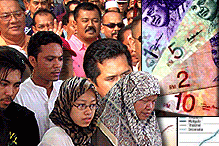 While the NEP has uplifted the socio-economic status of the Malays and narrowed the wealth gap with non-Malays, large sections of the Malay masses remain marginalised. This, despite 36 years of vigorous affirmative action, brings into question the direction the NEP is taking. Has implementation gone awry or, as some would say, has it been hijacked by the elite?
The obsession with creating a Malay capitalist class has meant that the wealth distribution among this ethnic group has become grossly uneven. Cronyism has created a select class of Malay tycoons. Intra-racial wealth disparity is greatest among the Malays, although it has also grown in the non-Malay groups.
One has to question the wisdom of this strategy: how does creating Malay tycoons help other Malays? And how does it contribute to national unity? The general wealth disparity between the Malays and non-Malays may have caused racial tensions in the past but the paucity of Malay capitalists has never been the cause of ethnic strife in Malaysia.
Even the argument that Malay tycoons are needed as role models is a specious one. What kind of role models do they make when they have everything given to them on a platter and have to be bailed out with public money every time they fail?
 On the incubation of Malay capitalists, Syed Hussein Alatas commented, "Entrepreneurs in the history of capitalism, both ancient and modern, have never been the product of official incubation. They emerge from the social and historical process and dominate governments with their interests."
He went on to say that it is the height of absurdity to give to a group of Malay capitalists a thriving business they did not create. It is not only absurd but it is also the height of fiduciary irresponsibility to give what is essentially public property to select groups.
Everything that can be done has been done to for Malay businessmen but there must come a time when they must be made to earn their spurs. Unless they risk their own money, they will never learn fiscal responsibility and unless they compete on a level playing field they will not learn entrepreneurship.
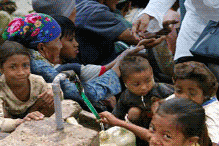 A government that derives its right to rule from the poor masses must not award a disproportionate percentage of benefits to one segment of society.
If alleviating poverty or removing socio-economic disparity between the races is the central argument for ensuring harmony then it is not enough to say that the poor have also benefitted or that all parties are better off. Malaysians must question how benefits are being distributed and whether all parties receive fair gains. Unfair inter- or intra-race distribution is the surest way to racial or social turmoil.
Beyond economics
Distrust and suspicion go beyond economics. If the Malays feel vulnerable economically - that they will be overwhelmed by the non-Malays in an economic free-for-all - the non-Malays feel equally vulnerable on the level of politics.
Non-Malays have accepted that the Malays are politically dominant and with their numerical superiority will remain so indefinitely. What raises problems is how this superiority is wielded. The increasingly strident calls for Ketuanan Melayu has caused much unease, as has the continued berating of 'immigrants' who are told they here on sufferance and should shut up or ship out. Non-Malays are aggrieved that their sacrifices and contributions are not appreciated. Such attitudes do not promote security or inspire confidence that they have a place in this country.
 Religion and culture also cause much angst. While the government touts the virtues of multi-culturalism, its commitment to this is not always clear. Racial chauvinists promote mono-culturalism based on a Malay-Islamic centric culture with the implicit blessing of the authorities. This provokes a similar reaction from the other communities who then fly their cultural flags so to speak.
Racial chauvinists are people who display exceeding pride in their own race and culture yet are blind to the achievements of others. What these chauvinists must understand is that cultures are not monoliths but patchworks of autochthonous and foreign elements. Globalisation brings with it global music, global fashion, global culture: we cannot stop such influences.
As it is globally, so it is within our borders, we cannot stop our different cultures from mixing and melding, nor should we. We should instead embrace the rich and varied cultures we have in Malaysia and encourage cultural mixing. How else do we create Bangsa Malaysia ?
The bigger concern is religion - or to put it plainly, the fear of Islamisation among both non-Muslims and liberal Muslims.
 Non-Muslims are concerned over infringements into their constitutional right to religious freedom. When town planning regulations discriminate against other religions or when places of worship are demolished, or judicial rulings are suspect, non-Muslims have cause for concern. The government must facilitate dialogue to resolve contentious issues and not give in to religious zealots who are intent on imposing their views on everyone else.
Creeping Islamisation is an alarming development in Malaysia. The spread of a particularly pugnacious perspective is a result of the politicisation of Islam. Because race and religion are so intimately intertwined, race can be exploited to incite religious conflicts and vice-versa . This is the danger of Malaysia's race politics.
Part 2 will appear tomorrow
YIN EE KIONG is a Malaysian who has lived in Brunei, Papua New Guines, Australia, the UK, US, Qatar, Sudan). He is the founding president of Ipoh City Watch and wrote the 'Ipoh Watch' column for The Sun prior to his departure to Sudan.


