




Chinese dilemma Pt 2: The schizophrenic Chinese soul
The legitimacy of the MCA in the eyes of the Malay ruling elite from independence until now at least - resides in their role as a crucial partner in representing the voice and the interests of the Chinese in Peninsular Malaysia, within the framework of the mythical "social contract".
In that context, Umno needs MCA, no matter how badly the party does at the poll at any one time, to prop up the faade of multiracial coalition politics based on power sharing between the races. Subscribers to this narrative would point out the importance of the survival of MCA, by observing that in 1969, after MCA had suffered horrendous losses at the hands of the opposition coalition and withdrawn from the Alliance, there was May 13 shortly afterwards.
Against successive onslaught from the DAP in consecutive elections, the MCA has always survived reasonably well by calling for Chinese unity under their banner. The more seats they have, the stronger they are in negotiating for the rights and interests of the Chinese voters. So they say.
The legitimacy of the MCA in the eyes of the Malay ruling elite from independence until now at least - resides in their role as a crucial partner in representing the voice and the interests of the Chinese in Peninsular Malaysia, within the framework of the mythical "social contract".
In that context, Umno needs MCA, no matter how badly the party does at the poll at any one time, to prop up the faade of multiracial coalition politics based on power sharing between the races. Subscribers to this narrative would point out the importance of the survival of MCA, by observing that in 1969, after MCA had suffered horrendous losses at the hands of the opposition coalition and withdrawn from the Alliance, there was May 13 shortly afterwards.
Against successive onslaught from the DAP in consecutive elections, the MCA has always survived reasonably well by calling for Chinese unity under their banner. The more seats they have, the stronger they are in negotiating for the rights and interests of the Chinese voters. So they say.
It is not a position that appeals to me, but it does appeal to a great swathe of the Chinese electorate. An old college mate from my university days in Canada once told me back in Malaysia that as long as there is Umno, there must be a strong MCA. (It did not jeopardise our friendship for him to hold this view.)
Different Chinese groups
To talk about the Chinese community as if it is a single homogeneous entity is to be guilty of stereotyping perhaps.
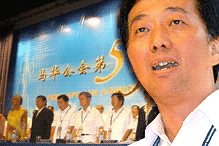 After all, there are many different groups of Chinese. There are the Chinese-educated, English-educated, and multi-lingual-educated Chinese. There are many dialect groups within the same Chinese dominated cities and towns, each belonging to their numerous guilds and associations nationwide.
They are also divided into many socio-economic alliances and classes, and the intra-ethnic chasm in wealth distribution can also be quite amazing. They also embrace many different religious beliefs that migrated with them from China, as well as Christianity, the Baha'i faith, and even Islam.
Then there are the Chinese in the northern, central, and southern regions of Peninsular Malaysia, as well as those from Sarawak and Sabah. Sometimes, they feel like aliens to one-another beneath the faade of common self identification of "we-Chinese".
But every action always has an equal and opposite reaction. The emergence of Umno as the main vehicle for Malay ethnic/racial nationalism since independence has condemned our national discourse to one mainly based on race. With very few exceptions, Chinese ethnic identity is paramount within the multiple parameters of the Chinese political consciousness.
(The crucial question is: can multi-racialism in politics ever work with the Chinese in Malaysia? But that will have to await another moment for a fair treatment.)
As a rule, the Chinese are also very pragmatic and moderate people. Confucian teaching of living a good life in this-worldly concern, as well as the pre-eminence of the value of always following the "middle path" has shaped the Chinese soul for centuries. One of the highest social virtues for a Chinese is to maintain social harmony and avoid direct confrontation at all costs.
Naturally, many Chinese in Malaysia have also inherited the cultural genes of a typically migrant community. They are painfully aware that they are a minority, in a country where the majority indigenous ethnic movement claims dominance over the "homeland"
 The older generations of Chinese can tell you all about their fear and trepidation when they observed from afar the bloody anti-Chinese repression and massacres that happened in Indonesia and other neighbouring countries in the 60s.
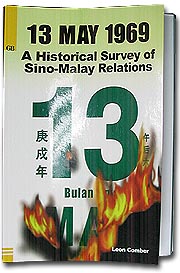
Everywhere in the world, when the great Chinese migration first sent their waves and waves of cheap coolies to far-sway lands a couple of hundred years ago, they were subject to exploitative hostile suspicion, as well as blatant racial discrimination. Then in Malaysia, we have our own home-made May 13 incident.
This cultural chromosome of fear is embedded very deep among the older traditional Chinese families, transmitted from generation to generation through many a family and dinner conversation.
That is why the BN has invoked the terrifying images of the May 13 incident to such great effect in past elections. The first task of any Chinese-based opposition party must be to educate Chinese voters to neutralise this natural fear of the unknown, and hence this resistance to change.
Respect and suspicion
If you examine the history of the Chinese people in China and Malaysia, you can also unravel the uneasy relationship between the people and governments in general. Many candidates for a PhD programme in disciplines like political science, sociology, and social anthropology can find a fertile field of research to explain why the Chinese people everywhere are generally so apathetic in participatory politics, by and large.
By and large, the Malaysian Chinese tend to have a mixed feeling of respect and suspicion against government ministers and public officials at all levels. As any learned Chinese scholar will tell you, the long and turbulent 5000 year history of the Chinese people is packed with perennial tales of massive corruption at all levels of government. That is why the magistrate Pao Kung, the fearless judge who went after corrupt officials, has been elevated to the iconic position of a demigod in Chinese culture.
At the same time, being very pragmatic survivors under all kinds of adverse circumstances, many Chinese people will always respect the authoritative figure. In the family, there is the father. Within any Chinese community, there are the big towkays heading the 7000 or so Chinese guilds and associations. In the new nation-state of Malaysia, there are also the MCA and other ministers and public officials.
To play it safe, the great majority of Chinese people will bend over backwards to get on the good side of any government anywhere. They may have tons of grouses against political authorities, but they know persevering through their unhappiness is a price to pay for personal and family success in life. Often the victim is the spirit of participatory democracy.
In times past in China, whenever nepotism, tyranny, repression, and famine gripped the land, all the suffering Chinese could do was to pray for the emergence of a great warrior-hero to descend from heaven and deliver them from evil. Folklore as well as novels and poetry of Chinese high culture wax lyrical about the noble deeds of these heroes.
In modern pop culture, the kung fu genre in books and films have entrenched this belief that you really have to depend on a hero with superhuman kung fu prowess to knock off the local tyrant and deliver justice to the rakyat.
But ask any Chinese man on the street in Malaysia whether they would allow their children to be such a hero, and they will run like the devil. There is too much risk and too little worldly advantage to be gained from being a tragic hero. All that your Chinese man-on-the-street wants is for their children to become successful businessmen and professionals, to prosper and have many more prosperous children.
When heroes are in short supply, the Chinese person making his livelihood in the world of trade and commerce would prefer the prudence of the umbrella supplied by a patron, the towkay , the protector, the Kapitan, the pivotal intermediary, who would put in a good word on his behalf to the biggest boss.
In pre-independence Malaya, the biggest boss was the British colonial government. After Independence, the biggest boss had to be Umno. For Chinese voters who have inherited the cultural genes described above, MCA indeed must remain as that pivotal intermediary for them to seek protection under an Umno dominated government. As the MCA publicity is so fond of projecting, "Things can be done only if we have connection with the Emperor's Court."
Birth, growth of DAP
While the pragmatic side of the Chinese soul has given MCA their reason to be, the romantic hankering after tragic warriors and heroes has nurtured the birth and growth of the opposition DAP.
 The birth of the DAP in 1967 might have been cradled in the withdrawal of the PAP in Singapore from Malaysian politics in 1965. They might have burst on the political scene to fill the vacuum left by the boycott of the general election in 1969 by the Socialist Front.
Whatever the historical twists and turns that charted their earlier fortune, the arrest of Lim Kit Siang in 1969 under the ISA, and his subsequent domination of the party for nearly four decades, have determined the party as a movement led by tragic heroes after the fashion of Prometheus. Today, Lim Guan Eng has inherited and embodied this very spirit of the Greek hero figure so prominent in the tragedies of Sophocles.
The claim to fame and influence of DAP leaders has been cemented upon the personal price paid by their fearless leaders in the face of repressive persecution. With that moral authority, thy can attack the political integrity of the MCA leaders, and portray the latter as a bunch of corrupt hypocritical self-enriching opportunists, to the applause and admiration of the Chinese electorate.
In short, as long as the pragmatic realism and the romantic impulse of the Chinese soul are in a constant war with each other, the MCA and the DAP will always be engaged in a primordial battle to the death.
They will gain advantage in alternate elections, swinging back and forth according to such contingent variables as the state of the economy, the corresponding swing of nationalist posturing within Umno, as well as the dramatic changes going on in neighbouring countries and the world at large. It is what Lim Kit Siang coined as "the pendulum".
For some younger, more radical Chinese youths, the choice between the MCA and the DAP seems like a Hobson's choice. You are damned if you do, and you are damned if you don't. At the end of half a century of independence, the greatest beneficiary of this perennial rivalry between the MCA and the DAP has been Umno.
( Postscript: This writer is grateful for the informed and intelligent analysis on the Bukit Bintang constituency by reader Ong Kian Ming whose piece entitled Election Jitters in the MCA appeared in the Malaysiakini opinion section on Aug 8)


