


/file/1327/3eba9c86c93a6479beb0c3f191fbc89a.jpeg)

COMMENT | Mandatory death penalty ends, what's changed?
Getting right down to it, what has the abolition of the mandatory death penalty meant for us as a society?
The good news is, contrary to commentaries and beliefs by some extreme critics, the abolition of the mandatory death penalty has not resulted in mass hysteria and violence.
We do not have to walk the streets in perpetual fear that we will be the next murder victim and our roads are not littered with illicit drugs.
If anything at all, the inspector-general of police’s comments on murder rates is an indication that nothing substantive has changed since the abolition of the mandatory death penalty.
While the numbers have increased, we should not forget that...
COMMENT | It has been a little over a year since the abolition of the mandatory death penalty in Malaysia, and it is a good time to take stock of the developments since then and what remains ahead.
Getting right down to it, what has the abolition of the mandatory death penalty meant for us as a society?
The good news is, contrary to commentaries and beliefs by some extreme critics, the abolition of the mandatory death penalty has not resulted in mass hysteria and violence.
We do not have to walk the streets in perpetual fear that we will be the next murder victim and our roads are not littered with illicit drugs.
If anything at all, the inspector-general of police’s comments on murder rates is an indication that nothing substantive has changed since the abolition of the mandatory death penalty.
While the numbers have increased, we should not forget that our population has grown naturally, with new additions from migration returning to normal post-Covid rates.
The bad news is that despite all the fanfare, aspiration, fear, and concerns, nothing has changed following the abolition of the mandatory death penalty.
Are we getting there?
In contrast to reform in other areas, the death penalty was one of those issues that the government moved swiftly and delivered on its promises.
It provided a significant and substantive change to the law that promised to give more than 900 people respite from the death penalty - subjected to the offence they have committed, a more fair and equal process in criminal justice, and bringing Malaysia closer in line with international standards on the death penalty.
Implementation was always going to be more difficult and time-consuming than the initial projected optimism.
Even now, there is still a significant number of cases awaiting resentencing, and cases that were put on hold following the abolition of the mandatory death penalty are just catching up with the changes.
The verdict is still out on whether the goals and objectives of the abolition of the mandatory death penalty were achieved.
As of May 31, 2024, Parliament was informed that 474 cases for resentencing were heard at the Federal Court with 19 death sentences maintained.
Of those resentenced, no one who was convicted of drug trafficking under Section 39B of the Dangerous Drugs Act 1952 had the death penalty maintained and some murder-related cases were resentenced to 30 to 40 years, when appropriate mitigating factors were present.
In terms of concern, two cases stood out. First, the case of Junaidi Bambang who was convicted for the murder of his three daughters in 2002.
Junaidi was under the impression that they would be sold to a brothel and in an attempt to prevent that, he decided to take their lives and his own. He survived the attempt and was later sentenced to death.
There were also indications that he was suicidal and was refusing medicine, and despite the circumstances, his death sentence was maintained.
Next, in the case of a Singaporean who refused his appeal on July 17, 2024, it was reported that he informed the court, “I don’t want to ask for clemency, I only ask for the death sentence. Thank you.”
The case was then dismissed with the death penalty maintained.
Some would baulk at the crimes they committed and there is very little doubt they are heinous and likely meet the threshold. Then again, which murder case isn’t heinous?
My concerns are that these individuals are suicidal and it just takes some degree of curiosity to look up the facts of their case and their conduct in prison.
It does not absolve them of the crime, but it certainly bears merit for us to consider the appropriate punishment as a society.
The resentencing process has not fully or extensively examined and evaluated the mental competency of persons being resentenced and the impact of their mental health conditions on their culpability and sentencing.
Are we expecting too much too soon?
Maybe I would have been much less concerned and much more willing to sit back and observe the development longer if it were not for the concerning trends that the Hayat organisation has observed.
We have seen that the overall number of persons on death row has decreased sharply by 225 persons between Nov 7, 2023, to Dec 31, 2023.
Initially, we attributed the decrease to resentenced cases, but the number does not add up.
Within that period, we observed no more than 29 cases resentenced at Putrajaya with no other resentencing case known to have taken place elsewhere.
This would suggest that the majority of those released from death row were those still in the appeal stage and not waiting for resentencing.
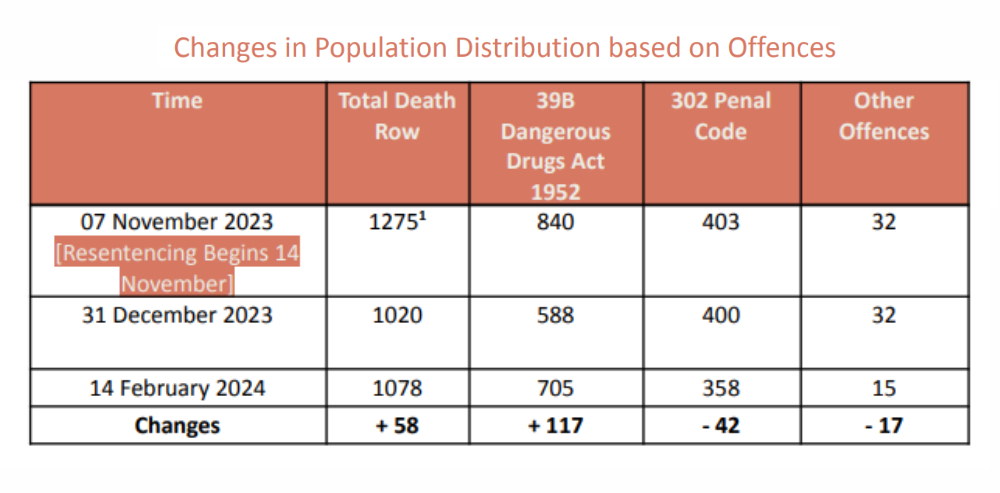
This curiosity turned into concern when the number of persons on death row for drug offences trended upwards to 705 while the overall death row population plateaued with a mere addition of 58 persons.
The significant increase of persons on death row for drug trafficking meant they were all newly convicted or convicted on appeal as resentencing cases had all been resentenced to life imprisonment.
This is not within expectations as experts, including ourselves, operated with the impression that the death penalty would likely be reserved for murder cases which meet the necessary threshold under international law, while the number of those on death row for drug offences would gradually decline and the punishment would eventually be phased out as how resentencing has panned out.
More data is needed to draw clearer conclusions but the current trend suggests that the death penalty and its application still needs to be closely monitored as it may not be what we all hope for it to be.
What’s next then?
The problem we described above can be summarised into two points. First, we need to improve our understanding of mental health and its impact on culpability and crime.
Having a mental health issue or condition is not a blanket pass to get away from criminal charges, but there must be leeway and consideration by the criminal justice system in addressing these individuals.
We can wait for the law to develop further through litigation, but do we want to have critical issues left hanging without any clear resolutions?
It is more prudent for lawmakers to develop viable legislation and guidelines to ensure the will of the people through Parliament is carried out in the criminal justice system.
Second, there seems to be a potential disconnect between the highest court of the land and lower courts when it comes to applying the death penalty for drug offences.
I certainly hope it was mere administrative errors that resulted in this data that suggest the Federal Court is sparing people the death penalty for drug offences while the lower courts are on a warpath in sentencing drug traffickers to death.
I am confident that the Federal Court would course correct and ensure consistency in our judicial decisions, thereby giving effect to the intention of Parliament with the abolition of the mandatory death penalty.
However, the fact that hundreds of individuals may be thrown in solitary confinement with death hanging over their heads while their sentences are being “corrected” seems highly unconscionable.
Fortunately, the solutions to both problems are the same. There is an urgent need for a Sentencing Council that can produce and monitor the implementation of sentencing guidelines and advise the appropriate authorities in formulating sentences for criminal offences.
It is high time we look at other reforms needed to improve our criminal justice system. The abolition of the mandatory death penalty, while critical, is merely the tip of the iceberg.
For our criminal justice system to work well, we need to provide the right infrastructure and policies to make it better.
The trick of locking someone up and throwing away the key is not going to work anymore. We need to make sure that when someone gets locked up, they’ll be given the right help so that it will not happen again the moment they step out of prison.
DOBBY CHEW is CEO of Hayat, a human rights organisation based in Kuala Lumpur. Hayat, which means life in Malay, is committed to community mobilisation and advocacy on the Right to Life and other intersectional issues.
The views expressed here are those of the author/contributor and do not necessarily represent the views of Malaysiakini.
/file/publisher-c1a3f893382d2b2f8a9aa22a654d9c97/2019/11/f9023d9fbcb61a3c740c6e5fdba171ab.jpg)
/file/publisher-c1a3f893382d2b2f8a9aa22a654d9c97/2020/10/016b4d66fbad74d3ce60b7e86846eb9d.jpg)
/file/publisher-c1a3f893382d2b2f8a9aa22a654d9c97/2020/10/2bda679309c88e264ef963588bbe46d2.jpg)
/file/publisher-c1a3f893382d2b2f8a9aa22a654d9c97/2019/08/ce79b83aac56c1fe96b685416ae3ed5c.jpg)


Are you sure you want to delete this comment?
This action cannot be undone.