




Lingam tape: Najibs panel unacceptable
No sooner had the spirit of the nation been lifted by the historic 'Walk for Justice' in Putrajaya on Sept 26 than it was doused by the Malaysian Bar president's hasty acceptance (the same day) of the three-member 'independent' panel hurriedly announced by Deputy Prime Minister Najib Abdul Razak the previous day.
Najib's so-called independent panel is a ploy to deflect the real target of cleansing our corrupt judiciary, which has been crippled by dictates of the Executive.
By accepting the panel, the Bar has placed its own demand for a Royal Commission of Inquiry in abeyance, weakened the position of others with a similar demand and dampening the fervour for change that has rapidly gathered momentum across a wide spectrum of society since the exposure of the 'Lingam tape' by PKR de facto leader Anwar Ibrahim on Sept 19.
No sooner had the spirit of the nation been lifted by the historic 'Walk for Justice' in Putrajaya on Sept 26 than it was doused by the Malaysian Bar president's hasty acceptance (the same day) of the three-member 'independent' panel hurriedly announced by Deputy Prime Minister Najib Abdul Razak the previous day.
Najib's so-called independent panel is a ploy to deflect the real target of cleansing our corrupt judiciary, which has been crippled by dictates of the Executive.
By accepting the panel, the Bar has placed its own demand for a Royal Commission of Inquiry in abeyance, weakened the position of others with a similar demand and dampening the fervour for change that has rapidly gathered momentum across a wide spectrum of society since the exposure of the 'Lingam tape' by PKR de facto leader Anwar Ibrahim on Sept 19.
Najib's panel is complete nonsense, for it not only misses the target in scope, but is also totally inadequate in respect of moral authority, legal power and impartiality of panelists. Let me elaborate.
Scope of inquiry
The panel's term of reference is limited to ascertaining the authenticity of the video clip. But the nation is more interested in finding out if there is hanky-panky between the prime minister and top judges as indicated in the telephone conversation.
 Senior lawyer VK Lingam has given us a lead as to how judicial appointments and promotions (especially in top positions) are made, allegedly based on personal loyalty to the political and financial interests of the prime minister, and brokered by business and political cronies. We want to know the extent of political control exerted on the judges and how it has caused miscarriages of justice in the past. Only by finding out the truth can we rectify wrongs.
Authenticity is of course a pre-requisite to any inquiry but in this case, it is almost a foregone conclusion as both Chief Justice Ahmad Fairuz Sheikh Abdul Halim and Lingam have not openly denied such serious allegations, even two weeks after the expos.
Is it conceivable that in this day of instant communication and revolutionary technology that the government, having had access to the video for two weeks, is so ignorant of the authenticity of the tape that it has to appoint an 'independent' panel to ascertain this, while refusing to consider anything else? What conclusion can we draw other than it is a government tactic to defuse public pressure and to buy time to wiggle its way out of a damning scandal?
Moral authority
This panel was announced by the deputy premier and will presumably report to him. But don't forget that this video is about the former prime minister allegedly manipulating the judiciary for personal and political gains - a serious breach of the constitution by the head of the Executive, and by extension, the ruling party who stands to gain politically from this illicit relationship.
So wouldn't there by a conflict of interests if the deputy head of the Executive appoints a panel responsible to him to uncover the sins committed by the Executive? How would an administrative panel under his jurisdiction be able to command the kind of moral authority required of it?
Legal power
 This Najib panel is only an administrative body without the legal power to summon witnesses and compel evidence. It cannot even directly interview those implicated to obtain details from them. So its findings have to be based on those from the police, Anti-Corruption Agency and other government bodies.
So we do not expect the panel's conclusion to differ from those of the police or ACA, and we don't see how call such investigations 'independent'.
Impartiality of members
The leader of the panel is Haider Mohd Noor, a former chief judge of Malaya, now chairman of Bumiputra-Commerce Bank Bhd, which is controlled by Najib's brother Nasir. Haider is also a trustee of Perdana Leadership Foundation, used by former premier Dr Mahathir Mohamad as his base to continue his political activities after he stepped down from office. As prime minister in 2002, Mahathir is shown up in the video clip as the ultimate manipulator of the judiciary - as such he should eventually be the prime target of investigation in the scandal.
With these connections to the interested parties, Haider is already ill-suited to participate in this panel. However, his worst problem comes from his dubious role in the infamous judicial crisis in 1998, when then Lord President Salleh Abas and two other Supreme Court judges were unjustly sacked, resulting in the subjugation of the institution of judiciary to executive control until this very day. Haider, as Chief Registrar of the Supreme Court then, ordered the court seal and doors to the Supreme Court be locked, so as to prevent an emergency court hearing which would have issued an injunction to stop the Tribunal that led to Salleh's dismissal.
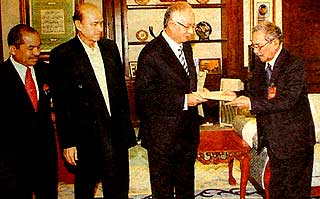 Another panel member Lee Lam Thye chairs the National Service Council and reports directly to Najib who is also defence minister. Lee is also a director of Media Prima Bhd which controls a vast media empire of newspapers, TV stations and radios. It is mainly through Media Prima that Umno exercises its stranglehold on information dissemination that has kept vast sections of the populace in the darkness with regards to the real crises confronting the nation precipitated by Umno's serious misrule. And Umno, as the real political power controlling the country, is of course the beneficiary of the unholy politician-judiciary nexus, and therefore a hugely interested party in the investigation of the Lingam tape.
In addition to these questionable links to interested parties, Lee suffers from an image problem arising from his sudden and mysterious resignation as No.2 leader in DAP that caused a party crisis on the eve of the 1990 election. Many continue to hold Lee in suspicion, citing his move against his party as part of a plot that enabled then Mahathir to call a snap election at the enemy's weakest moment. And of course, Lee's subsequent elevation in social status (a Tan Sri now) and wealth (directorship of many companies) - much of which arrived through goodwill of the ruling coalition - does not help to shed his image as someone deeply beholden to Barisan Nasional.
An important purpose of the inquiry is to restore confidence to the judiciary in particular and the government in general, whose image has been much tattered by a series of grave scandals in recent days. The appointment of members of a panel with such a questionable background can only deepen the people's mistrust of the entire establishment.
Royal Commission
It will be seen that all these weaknesses can be overcome if the King exercises his power under the Commissions of Inquiry Act 1950 to appoint a royal commission of reputable individuals to probe the video clip. This commission, which will be vested with legal power to summon witnesses, compel evidence and provide protection to witnesses, will ascertain the extent of decadence of our judiciary and recommend appropriate remedies. The report will be submitted to the King for deliberation by Parliament.
There is of course no guarantee that a good Royal Commission report will lead to the salvation of the judiciary, as shown in the case of Royal Commission Report on the Police completed several years ago. Although it is excellent, the police force continues to deteriorate as reflected by continuing scandals and rising crime rate, despite huge fortunes being spent in upgrading facilities and increasing manpower. This is due to the lack of political will to eradicate the root causes of rampant corruption and wanton human right abuses.
Nevertheless, a Royal Commission is an important first step, as effective exposure by a dedicated commission will open the eyes of the people to the gravity of our weaknesses, thereby giving impetus to the mass movement that will compel the hands of the government to initiate the necessary changes.
 Allowing the status quo to continue is not an option, as a deteriorating judicial system will hasten the slide in investors' confidence that was set in since the Asian financial crisis a decade ago. The consequential damage to our economy and national well being will only accelerate under the intensifying pressure of globalisation. These mounting economic challenges, added to worsening racial and religious tensions - as has been taking place under Umno leadership - will surely drive this nation towards disintegration.
It is therefore vital that all Malaysians treat the current judicial crisis as a life-or-death issue that must be tackled with full force until it is resolved. In this respect, it is heartening to see that PKR has submitted its petition to the King for a Royal Commission, and there are indications that other bodies will follow suit. This is the time when the people must unequivocally exert their collective will to make this commission a reality.
Finally, it is hoped that the Malaysian Bar will urgently review its position with regard to Najib's panel and once again take the lead role, as natural guardians of law should, in a renewed charge towards thorough cleansing of our judiciary. That means Najib's panel must be rejected forthwith.
KIM QUEK is a retired accountant with an interest in current affairs.


