


/file/publisher-c1a3f893382d2b2f8a9aa22a654d9c97/2025/08/45a733ddd7bc156b8252794a232a8c76.jpg)

COMMENT | The paradox of rising approvals and falling FDIs
FDI between the first and second quarters of this year plunged 90 percent. Is this a cause for serious concern?
It depends on the reasons for that fall and what constitutes FDI. What makes it confusing is the confounding and astounding claims the government routinely makes of securing hundreds of billions in FDI.
In their much-publicised overseas missions, both Prime Minister Anwar Ibrahim and Investment, Trade, and Industry Minister Tengku Zafrul Abdul Aziz...
COMMENT | It was an astonishing announcement last Friday by the Statistics Department (DOSM) on foreign direct investment (FDI) into Malaysia - inflow plummeted from RM15.6 billion in the first quarter to RM1.6 billion in the second quarter of this year.
FDI between the first and second quarters of this year plunged 90 percent. Is this a cause for serious concern?
It depends on the reasons for that fall and what constitutes FDI. What makes it confusing is the confounding and astounding claims the government routinely makes of securing hundreds of billions in FDI.
In their much-publicised overseas missions, both Prime Minister Anwar Ibrahim and Investment, Trade, and Industry Minister Tengku Zafrul Abdul Aziz (above) routinely announce huge investment commitments made.
But do these commitments have much meaning, even if some of these are translated into investment approvals by the Malaysian Investment Development Authority (Mida)? The evidence says no.
Mida said in February, Malaysia attracted RM378.5 billion of approved investments in the services (RM252.7 billion), manufacturing (RM120.5 billion), and primary (RM5.3 billion) sectors last year, a 14.9 percent increase compared to RM329.5 billion in 2023.
Domestic investments accounted for a substantial 55.0 percent or RM208.1 billion of the total approved investments, while foreign investments contributed 45.0 percent, amounting to RM170.4 billion.
Impressive numbers, but why are these figures not being translated into actual FDI on the ground years later, for example, in the second quarter of this year? The short answer is that commitments and even approvals don’t become investments until much later.
There is therefore no point making such a big deal of large commitments and approvals made without mentioning time frames and the period over which such investments will be made.
Inadequate explanations
The sad thing is that when that plunge in actual investments happened, there was hardly any explanation. At least if the Finance Ministry, the central bank, or the Investment, Trade, and Industry Ministry offered good explanations, it would be some form of mitigation.
DOSM’s explanations were wholly inadequate. How much sense can one make of this for the second quarter drop in FDI: “This was underpinned by sustained equity injections and inflows in debt instruments, partially offset by higher income repatriation to parent companies abroad.
“Most of the FDI inflows were channelled into the services sector, particularly within the financial activities and information and communication subsectors, notably related to data centre activities.”
There may be legitimate explanations, but we don’t know about them. The fact that none has been offered leads us to believe that there is no other legitimate explanation but that the approvals over the years before, nearly RM380 billion in 2024 and RM330 billion in 2023, were not translating into investments.
That’s a situation which hardly leads to confidence in our commitment and approval numbers for FDI, which might as well not be added to the list of statistics, as it seems to provide no clue to future investments whatsoever.
It smacks of a situation where numbers may be deliberately inflated to show the success of our efforts to obtain FDI, with no corresponding match in the actual FDIs.
There are some valid explanations. Foreign investments are lumpy in nature but might take some time to materialise. There may be changes in investment decisions or even higher repatriation of income by foreign investors. But why not explain them if they were the actual reasons?
Mida does not provide actual FDI figures - they should. The DOSM does. It is instructive to note that actual FDIs in 2024 were RM51.5 billion, up from RM38.6 billion in the preceding year.
A far cry
That’s still a far cry from the approval figures of RM380 billion and RM330 billion for 2024 and 2023, respectively, and indicates that these figures must be used with considerable caution instead of being bandied about as major successes of foreign and domestic policy. They are not.
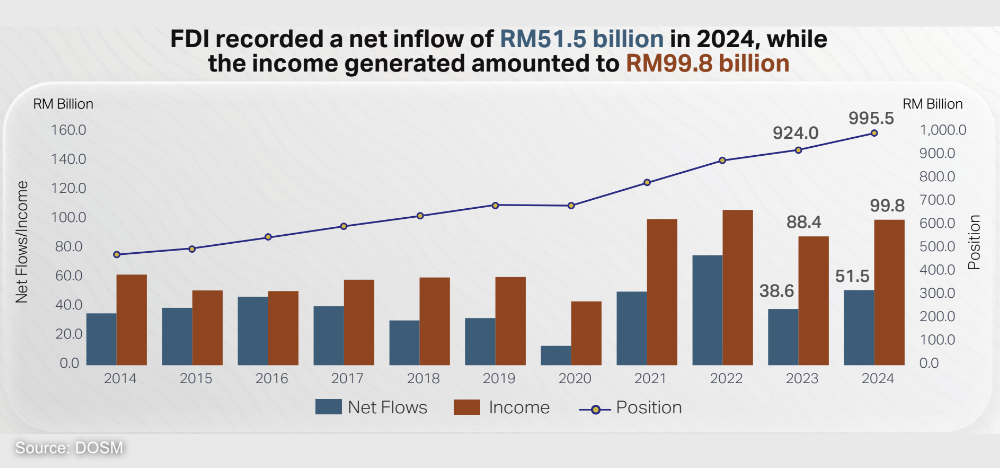
Perhaps the most instructive of charts for FDIs is this one, which shows volatility in yearly figures but a steady uptrend for cumulative FDIs. But note that the actual FDI (in blue) peaked in 2022 when the Madani government was in power for barely a month and therefore could not claim credit.
In 2023, when it was in power for a full year, the actual FDI declined, but made a good recovery in 2024, but still below the 2022 figure. Considering that actual FDI for the first two quarters was just RM17.2 billion (15.6+1.6), the full-year figure is likely to be much less than last year’s RM51.5 billion.
We can safely conclude that in the short term, FDIs simply don’t reflect the quality of the government, although in the longer term, it is likely to, especially if investment conditions and incentives remain steady.
The seeming paradox of rising approvals and falling FDIs is likely to remain and paint the wrong picture, which some people are not averse to using.
P GUNASEGARAM says governments should not take credit for what is not due to them - and yes, they should not be blamed for what they are not responsible for.
The views expressed here are those of the author/contributor and do not necessarily represent the views of Malaysiakini.
/file/publisher-c1a3f893382d2b2f8a9aa22a654d9c97/2025/07/f0b937528bea08ddead4373f89e8f079.jpg)
/file/publisher-c1a3f893382d2b2f8a9aa22a654d9c97/2021/08/663cd188c61b80e85d3e0be9d20f6def.jpg)
/file/publisher-c1a3f893382d2b2f8a9aa22a654d9c97/2024/10/b0604e71c2c76e58ffea999662584609.jpg)


Report this comment
Are you sure you want to delete this comment?
This action cannot be undone.