




Judicial rot: From one nightmare to another?
Just as the nation is heaving a sigh of relief at the exit of the scandal-ridden Ahmad Fairuz as Chief Justice, in comes another dubious candidate poised to take his place.
Just as the nation is heaving a sigh of relief at the exit of the scandal-ridden Ahmad Fairuz as chief justice, in comes another dubious candidate poised to take his place.
 Prime Minister Abdullah Ahmad Badawi’s sudden announcement of the appointment of Zaki Azmi to the second highest post in the judiciary – President of the Court of Appeal – must have jolted and dismayed many who have cherished hopes of judicial reforms following the reluctant retirement of Fairuz. After all, Zaki Azmi, who had not spent a single day as a judge in the Court of Appeal or the High Court, was parachuted to the nation’s highest court – the Federal Court – only three months ago. He has not even warmed his seat as a judge, and yet he now looks poised to succeed Chief Justice Abdul Hamid Mohamad five months from now when Hamid retires in April 2008 upon reaching 66 years of age. (Both Zaki’s and Hamid’s appointments were simultaneously announced by the prime minister on Dec 5).
In fact, when Zaki was appointed a Federal Court judge in September, he was instantly recognized at home and abroad as the person planted to the highest court to succeed Fairuz, whose request for a six-month extension of service beyond his mandatory retirement on Oct 31 was not accepted by the Yang di-Pertuan Agong. Such instant recognition of Zaki’s mission came from his deep involvement with Umno as a key party player. He was chairman of the party’s election committee, deputy chairman of its disciplinary board of appeal, party legal adviser etc.
As Umno’s legal man, he was involved with the party’s myriad of scandalous financial misadventures that were bailed out by the government in the heydays of Mahathir’s crony-capitalism during the last Asian financial crisis. One prominent example is the RM3 billion loan scam in the disastrous acquisition of Philippines’ National Steel Corp (NS) by Umno’s financial proxy Halim Saad. When the shares of NS became scrap, four top Malaysian banks were made to stomach the entire RM3 billion losses. And Zaki was then a director of the investment vehicle - Hottick Investment Ltd of Hong Kong – which borrowed the RM3 billion and embarked on the acquisition of NS.
Messy divorce
Apart from acting as Umno’s nominee, Zaki also has held directorship in scores of major companies including some of the most well known names such as Berjaya, Metacorp, Pan Global, SP Setia, Malaysia Airports, Hume, Matsushita Electric, Pharmaniaga etc. Zaki was reported by Bernama on April 21 this year to have said that his 58% owned Emrail Sdn Bhd, a railway specialist company, had only the government as employer, and that he was earnestly soliciting contracts in the northern and southern portions of the double-tracking project to turn the cash-strapped Emrail around.
 Such political and business background would already have made him a poor candidate for any judicial appointment, Zaki is battered by yet another serious handicap – the question of his moral integrity arising from his controversial marriage and divorce from his second wife Nor Hayati Yahaya, who was half his age.
Zaki married Nor Hayati in a ceremony conducted by a kadi from Thailand in a textile shop in Perlis in March 2005. They separated three months later. In the messy divorce that ensued, it was revealed that Zaki burned the original marriage certificate to hide the marriage from his first wife. Further, the marriage was ruled by the Syarah Court as illegal.
Following the revelation of Zaki’s marital trouble, he resigned as deputy chairman of Umno’s disciplinary board, for which he commented: “Considering that members of the disciplinary board are of the highest integrity, I have made this decision following reports in the media ….” ( New Straits Times, 9 Aug 2005)
The question we must ask now is: If Zaki is morally unfit to serve in Umno’s disciplinary board, how could he be considered morally fit to be a federal court judge, not to mention his lightning elevation to the No.2 position, and anticipated imminent rise to the top job in the judiciary?
Is this country so poor in legal talent and integrity that we have no choice but to appoint some one so glaringly unsuited for such important judicial position arising from his multiple conflicts of interests and questionable integrity? If not, then why did the prime minister make such a move? If it is not to advance the prime minister’s and Umno’s interests, then what motivated such an appointment?
We have already seen in the infamous Lingam video clip how the former chief justice betrayed his oath of allegiance to the country and the Constitution by crawling to serve the parochial interests of his political and business masters, thus confirming the common knowledge of the depth of degradation our judiciary has sunk. While the prime minister and his cabinet is still dilly-dallying over the appointment of a proper royal commission of inquiry to probe into the Lingam tape scandal almost three months after its public display, are we now made to swallow another Umno atrocity – the instant elevation of an Umno stalwart in the nation’s highest court?
However, in the midst of despair over Umno’s latest move, we detect something amiss in the Prime Minister’s announcement of this dual appointments (Hamid and Zaki). While the PM claimed that upon his advice, these appointments were assented to by the Agong after consultation with the Council of Rulers, no effective date had been decided for Zaki’s appointment, while Hamid’s was fixed on Nov 1 - the day he started duty as Acting Chief Justice. Neither had any date been decided for the handing over of the appointment letters. If these dates had not been decided, why was PM in such a hurry to make an incomplete announcement?
A problem of royal assent?
Knowing that the King and the Council of Rulers had previously declined to accept nominees deemed inappropriate to fill the vacancies of the President of Court of Appeal and Chief Judge of Malaya respectively, as well as having turned down Fairuz’ request to continue as chief justice, the suddenness of PM’s claim of royal assent – particularly in reference to Zaki’s controversial promotion – came as a surprise to many people. Did the Agong also assent to Zaki’s appointment? If so, why couldn’t Zaki’s date of appointment be also decided alongside with Hamid’s? Or was there a problem of royal assent?
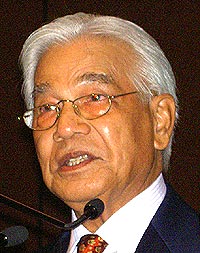 Whatever the case may be in regards to Zaki’s appointment, it is pertinent to take serious note of the view expressed by the Sultan of Perak, Raja Azlan Shah, on public perception of judicial impartiality in his opening address to the 14th Malaysian Law Conference on 29th Oct 2007.
Raja Azlan Shah, one of the most illustrious Lord Presidents of Malaysia, said that judiciary loses its value and service to the community if there is no public confidence in its decision-making. And the principal quality in judiciary is “impartiality”, which exists in two senses – the reality of impartiality and the appearance of impartiality. Of these two, the appearance of impartiality is the more important, stressed the Sultan.
Taking cue from this observation, Zaki’s appointment is an unmitigated disaster, as even if he has the superhuman capability to totally severe his umbilical cord to the ruling party and his commercial interests to eliminate conflict of interests, there is still the insurmountable problem of public perception. With Zaki’s questionable background, there is no way he can command complete public confidence, particularly when the interests of Umno or his businesses are involved.
Coming at a time when Malaysia’s competitiveness is fast losing ground, which has been contributed in no small way by its worsening judiciary image, such a daring raid on the sanctimonious ground of neutrality as the judiciary through planting a party stalwart to take over its control is destined to bring ruinous consequences to this country. Not even in the height of Mahathir’s autocracy would such a reckless adventure be contemplated.
Knowing Umno’s arrogance and supreme confidence over its political hegemony, we do not think that it is open to advice from the public. We therefore earnestly appeal to the Agong and the Rulers to exert their benevolent influence empowered by the Constitution to protect our judiciary from further injury, as they have so valiantly done in the recent past.


