




I disagree with Hindraf but... (Part 2)
The vexed issues of conversion to Islam, divorce, custody and family matters could have been dealt with by an inter-faith commission but as this idea is no longer workable because of mutual suspicions, recriminations and open hostility, the government should consider opening a consultative channel between the representatives of all the non-Muslim religious groups in the country with the Islamic religious authorities at the federal and state levels to deal with these issues without the aggrieved parties going to court unless no agreement or consensus can be reached.
The vexed issues of conversion to Islam, divorce, custody and family matters could have been dealt with by an inter-faith commission but as this idea is no longer workable because of mutual suspicions, recriminations and open hostility, the government should consider opening a consultative channel between the representatives of all the non-Muslim religious groups in the country with the Islamic religious authorities at the federal and state levels to deal with these issues without the aggrieved parties going to court unless no agreement or consensus can be reached.
Both the civil and syariah laws should be amended to clarify the position and remove any inconsistencies or ambiguities in accordance with the Constitutional provisions. At the cabinet level, a committee should be set up to deal with religious issues of this nature so as to avoid unnecessary speculation, accusations and unhappiness. These issues must be dealt with expeditiously and amendments to the necessary laws implemented without further delay.
The Penal Code should be amended to also introduce a new law to deal with inciting racial and religious hatred, discord and intolerance. Such a new law should be applied objectively and in a fair and reasonable manner. The offence of sedition is in my opinion is obsolete and no longer sustainable in a democratic society that values free speech. Offences against the state and terrorism are adequately covered in the Penal Code.
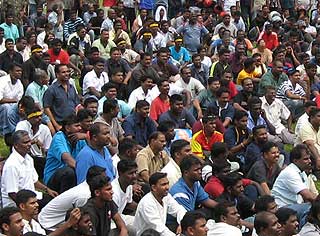 What is important is that subjects relating to race relations, religious toleration, coexistence and appreciation of cultures and values should be encouraged and taught at all levels from primary school to university. Such courses should also be extended to the public sector to create awareness and mutual respect. Regrettably, such thinking is seriously lacking in several government departments, universities, schools, hospitals and even in police stations where because of the predominance of one ethnic group, sometimes, others are treated in a derogatory, rude and offensive manner. These sort of incidences only reinforce the view that there are different classes of citizens in this country, however mistaken, and not just between the haves and the haves not. Very often it is poor and marginalised communities that face the brunt of this kind of racism and discrimination.
The Hindraf letter has made same valid criticisms of the government in terms of the perceived discrimination, marginalisation and neglect of Indians. While the government has denied these allegations it suffers from a very bad case of not being able to explain itself convincingly and adequately to the Indian community. It is pointless to talk about facts and figures when statistics can be interpreted and interpolated in many ways just like opinion polls to serve an agenda.
MIC leaders out of touch
Leaving it just to the MIC would not be advisable either because the MIC itself may be the cause of some of the anger, frustration and disappointment. There is a question mark surrounding the effectiveness, usefulness, integrity and viability of the MIC leadership at present which seems to be out of touch with most Indians, insensitive, dismissive and obsessed with a personality cult of its leader. But the necessities of coalition politics and inter-communal interests effectively means that the prime minister cannot ignore the MIC and its present leadership.
Perhaps the prime minister with all his good intentions is not being told the whole truth and nothing but the truth about the problems of the Indian community. It would be better if he sounded out members of the community such as academics, intellectuals, professionals, businessmen and others not related to the MIC on a strictly private basis without any public statements or recognition to compile and collate data and information on the grievances of the Indian community, the effectiveness of government policy, the remedial steps to be taken and other problematic areas that need urgent attention.
These persons of impeccable integrity, independence and objectivity without any association to political parties and other non-governmental organizations can play the role of a very private and secret kitchen cabinet to keep the prime minister informed and appraised of the Indian problem.
The key areas that need attention would be education and not just limited to Tamil schools (these should be addressed by being transparent about the number of new Tamil schools to be built under the 9th Malaysia Plan, their location, the allocation for buildings and facilities and for teacher training) but also entry into public universities and the granting of scholarships, the estates and plantation sectors, the minimum wage, urban migration and the associated problems like unemployment, housing and health care, employment in the public sector including the police and armed forces (where Indians are grossly under-represented and there are concerns about recruitment and promotions), the granting of business licenses and permits, loans for small and medium sized businesses and the declining Indian equity ownership.
While special privileges and affirmative action is good provided that it does not create a culture of dependence and complacency, it should be targeted at all underprivileged groups irrespective of race and religion. But that does not mean that an across the board solution should be applied for all groups. The problems of the Indian community may differ from that of the Malay or Chinese communities. These should be addressed separately. It is a fallacy to refer to a few Indian billionaires and millionaires in the country or to the Indian professionals and conclude that the community as a whole is doing very well and should be contended. These people make up less than 20% of the whole Indian community. If you take them out of the equation, the Indian equity ownership will be less than 0.5%.
Besides that these businessmen and professionals are not the product of any affirmative action policy, public scholarships or any other subsidies. Most of them have got where they are through the sacrifices of their parents who probably sold or mortgaged all their worldly possessions so that their children could have a better future. It is heartening to know that even among the poor and working class Indians they strive to give their children the best on so little but not all succeed because of a system that is not responsive or sympathetic to their needs.
I feel that the cry for help from the Indian community including the silent majority and even the much maligned and demonised Hindraf protestors that represented a cross-section of the Indian community, which probably explains the government's anger and dismay, is genuine and needs to be addressed in an objective and detached manner without pandering to petty prejudices, racial ideologies and political supremacy. I would hardly view this demonstration as a challenge to the social contract and Malay special privileges.
On the contrary it was about decades of frustration, misrepresentation, misuse and abuse at the hands of persons and parties who claimed to represent Indian interests but who instead failed to appreciate and understand their needs and grievances while privately enriching themselves. The Indians are now asking to be heard, to be respected, valued and appreciated as equals to any other ethnic group in this country and to become effective and valuable partners in the nation building process so that their future and their well-being can progress in tandem with the rest of the country.
Crisis of confidence
The government should not be angry just because harsh words and unjustified terminology was used in the Hindraf letter. It is better to address these issues rather than vilify their leaders and supporters. The government is now facing a crisis of confidence with the Indian community. Every move of the government is being watched and commented upon publicly and privately. The government's reaction to the protest and the prosecution of the demonstrators is seen as being excessive, vindictive, over-zealous and selective. The unhappiness of the Indian community has been simmering for decades just beneath the surface but the events of the last few years, their perceived discrimination, marginalisation, oppression and subjugation as a minority community that has lived in this country for more than three generations has became more pronounced and focused recently.
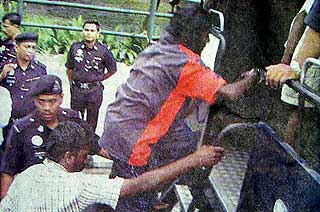 Hindraf has seized and capitalised on this discontent. Hindraf began to espouse, associate itself with and encourage this new Indian cause. In fact one can say that after 50 years of independence and for perhaps the wrong reasons, Hindraf has managed to achieve an Indian renaissance in this country in the sense that the community is now willing to stand up for its rights independent of the MIC and other political parties and demand to be heard. The government should not shut out these voices unfairly but engage them in an open, frank and honest discourse. It does not need to be in the public or through a media that is neither free nor objective.
I am certain that Hindraf leaders while being angry and intemperate in their language and actions, which may be designed to give them some leverage in future discussions with the government, are not racist or extremist by nature but probably just frustrated and dejected. The government should stop giving the impression that Indian votes do not count or that their influence in the country is marginal at best. Such sentiments are only making the community more angry. If they decide not to support the government in the next general election, Umno and the BN may be in trouble.
But to associate Hindraf with terrorism and accuse them of seeking the support of the LTTE of Sri Lanka and the RSS, a Hindu right-wing party in India, is laughable if not unbelievable. It is akin to suggesting that our government may have supported terrorist and separatist groups in Pattani in Southern Thailand or Mindanao in the Philippines or better still does deals with the Abu Sayaff in the southern Philippines or allows Al-Qaeda operatives to meet in Kuala Lumpur?
The LTTE is a proscribed terrorist organisation in the US, the EU and India. It is facing defeat in Sri Lanka, it has had most of its leadership killed or dead, it is short of funds and weapons and it has lost all international support, credibility and goodwill. Even the Tamils in India are not sympathetic to the LTTE any more after they assassinated the former Indian prime minister Rajiv Gandhi in Tamil Nadu itself. Why would Hindraf want to associate itself with such a discredited organisation? If Hindraf was inclined towards terrorism it would have carried out acts of violence, murder and terror by now rather than staging a peaceful demonstration or holding meetings and gatherings around the country to explain its cause to the Indian community.
If Hindraf has links to terrorist organisations, our intelligence services and those of other countries like the US would have had them under surveillance for a long time and compiled volumes of intelligence reports on their activities. Why is it that our police and the attorney-general are only now investigating these allegations and trying to compile evidence? Is there any other evidence apart from the solitary police report made against Hindraf alleging these links? Who made the report? Was it the police itself or the political opponents of Hindraf? The statements made by the inspector-general of police and the attorney-general on this issue that clearly border on hysteria without any credible evidence only lends credence to Hindraf's accusations that both are neither impartial, independent or objective and take their orders from their political masters in Umno.
Outmoded forms
Sometimes I wonder why our government still wants to rely on outmoded forms of counter-insurgency and reverse psychology against its own people as if they were subversives that need to be ferreted out and persecuted in some Kafkaesque manner just because they protested or dissented in public against the government. Is the government being advised by some Cold-War strategists or some one left behind after the Malayan Communist insurgency of 1945 to 1960? Or is it just a power play that has gone out of control?
The suggestion that Hindraf has terrorist links is as ludicrous as the attorney-general's attempted murder charge against 31 and soon to be 61 persons who were caught for the alleged illegal assembly, rioting and mischief inside the Batu Caves temple on the day of the Hindraf rally. I suppose the attorney-general wants to go into the annals of legal jurisprudence as the first public prosecutor ever to establish intent and a criminal act on the part of 61 persons for attempting to murder a single police officer who incidentally escaped from the clutches of his 61 assailants alive and with a small cut on his head. The whole episode smacks of a political agenda and it has eroded public confidence in the prosecution service and the police.
If the government feels that the police action or response was justified and necessary, it should conduct a public inquiry into the events at Batu Caves and other parts of Kuala Lumpur on that day. There are serious discrepancies between the eyewitness accounts, the foreign and local media, observers on the ground and the numerous photographs that were taken and plastered all over the internet and the official police version Such an inquiry may vindicate the government or perhaps the truth may come out as to who provoked the violence on that day and if there was excessive use of force by the police.
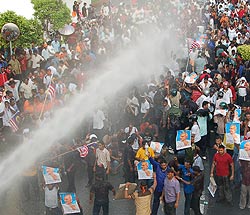 It is these unjustified and reactionary actions of the government and its response to the adverse publicity generated abroad and the concerns that have been expressed by foreign governments to the brutal manner in which the Hindraf rally was suppressed, the victimisation of its supporters and the grievances expressed by the Indian community, that alienates the government further even from the more restrained and rational members of the Indian community. Why threaten Hindraf leaders with the ISA and even depravation of citizenship just because they have canvassed foreign support? Hindraf has made a case for discrimination, marginalisation and oppression of Indians in Malaysia. It has accused the government of systemic discrimination.
The response in countries like India was overwhelming to the Hindraf cause. The government, politicians, the media and the public have expressed their concern, anger and disappointment. Even our acting high commissioner in New Delhi was summoned to the Indian External Affairs Ministry to receive a protest note (a news item that was not reported in any of our mainstream media).
The Indian government while expressing concern through its prime minister and external affairs minister have decided not to interfere directly in the matter or give Hindraf unqualified support, this would be in breach of international protocol and diplomatic conduct. But their position has been made clear. Our government should heed these concerns rather than trying to bury its head in the sand and hope that the problem will go away.
No moral high ground
This attempt to link Hindraf to the LTTE is not going to sell in India because of its far superior intelligence. The Indian government would not have taken even a notional stand in support of Malaysian Indians unless it had all the facts and intelligence about the protest rally and the activities of Hindraf.
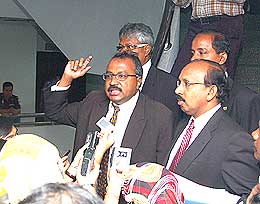 The Hindraf leaders have now gone to the UK and after that to the US. It would seem that they have many influential contacts in these countries. Rather than condemning them, the government should use diplomatic channels to present its own case. Why are our foreign missions there if not for purposes like this? There is nothing wrong in what Hindraf is doing. Since their numerous memorandums to the king, the rulers, the prime minister, the inspector-general of police and the attorney-general went unread and were probably consigned to the dustbin, one cannot blame them for taking their cause to the international community.
If only the government had had the decency to even respond to these appeals, things would not have gone so far. In a borderless world where globalization is the key word, issues relating to democracy, the rule of law and human rights transcend borders and governments. We should not pretend otherwise. Malaysia certainly does not have the moral high ground. We have condemned and criticised other countries. Why are we averse to criticism from our own people and other countries? There is nothing treacherous about telling the truth even if it may be embellished to an extent but the government should engage its detractors in debate and reason rather than threatening them with confinement and detention under undemocratic laws.
It is not the government that makes Malaysia but its people. After too many years of single party rule in this country, it is the government that now empowers the people and not the other way around. This is a distortion of democracy and it should end now. If the government continues to react in the present fashion to the Hindraf issue it is likely that most Indians will prefer to live without representation in this country while drawing the world's attention to the inequitable, unfair and unjust system that prevails in Malaysia when it comes to the treatment of its minorities. The choice is for the government to make and it is indeed a stark one.
I disagree with Hindraf but... (Part 1)
GERARD LOURDESAMY is a lawyer who has been in practise for about 15 years with an interest in government and politics.


