


/file/publisher-c1a3f893382d2b2f8a9aa22a654d9c97/2025/11/c0fb55afe72c9a9ebdfd3a5b20a4ac5e.jpg)

COMMENT | 'Chinese Murdoch' takes final bow - what's next for Ming Pao?
With this, an era in which the Malaysian timber tycoon dominated the Chinese-language newspaper industry comes to an end.
He acquired Hong Kong’s Ming Pao Enterprise in 1995, marking the 30th year of his ownership in 2025. In 2008, he merged Ming Pao with Malaysia’s Sin Chew Media Corporation and Nanyang Press Holdings to form MCIL.
Now that he has departed, whether MCIL will sell off Ming Pao warrants close attention and analysis.
As early as March 31, 2013, his youngest daughter, Tiong Choon, was appointed a non-executive director of MCIL, signalling the tycoon’s plan for her to eventually take over the company.
After Hiew King (above) suffered a stroke at 82 in April 2017, Choon was appointed an executive director on July 17 of that year. On Dec 1, 2022, she was re-designated as a non-executive director and made chairperson of the board, cementing her position as Hiew King’s successor.
Will MCIL divest from...
COMMENT | The former helmsman of the Media Chinese International Limited (MCIL), Tiong Hiew King, who once harboured the grand ambition of becoming the “Chinese Rupert Murdoch”, passed away on Nov 11 at the age of 91.
With this, an era in which the Malaysian timber tycoon dominated the Chinese-language newspaper industry comes to an end.
He acquired Hong Kong’s Ming Pao Enterprise in 1995, marking the 30th year of his ownership in 2025. In 2008, he merged Ming Pao with Malaysia’s Sin Chew Media Corporation and Nanyang Press Holdings to form MCIL.
Now that he has departed, whether MCIL will sell off Ming Pao warrants close attention and analysis.
As early as March 31, 2013, his youngest daughter, Tiong Choon, was appointed a non-executive director of MCIL, signalling the tycoon’s plan for her to eventually take over the company.
After Hiew King (above) suffered a stroke at 82 in April 2017, Choon was appointed an executive director on July 17 of that year. On Dec 1, 2022, she was re-designated as a non-executive director and made chairperson of the board, cementing her position as Hiew King’s successor.
Will MCIL divest from its Hong Kong media operations following his death? The first question to consider is: to what extent does Choon, or other members of the Tiong family, possess the passion to continue operating Chinese-language newspapers regardless of profit or loss?
‘Overseas Chinese patriot’
From 1988, when Hiew King acquired Sin Chew Daily, which had been suspended by then premier Dr Mahathir Mohamad’s government in Ops Lalang, he spent the next two decades (1988-2008) ambitiously expanding his media empire while cultivating the image of a “cultural entrepreneur” (or ru shang) emotionally tied not only to Malaysia’s Chinese community but also to his cultural roots in China.
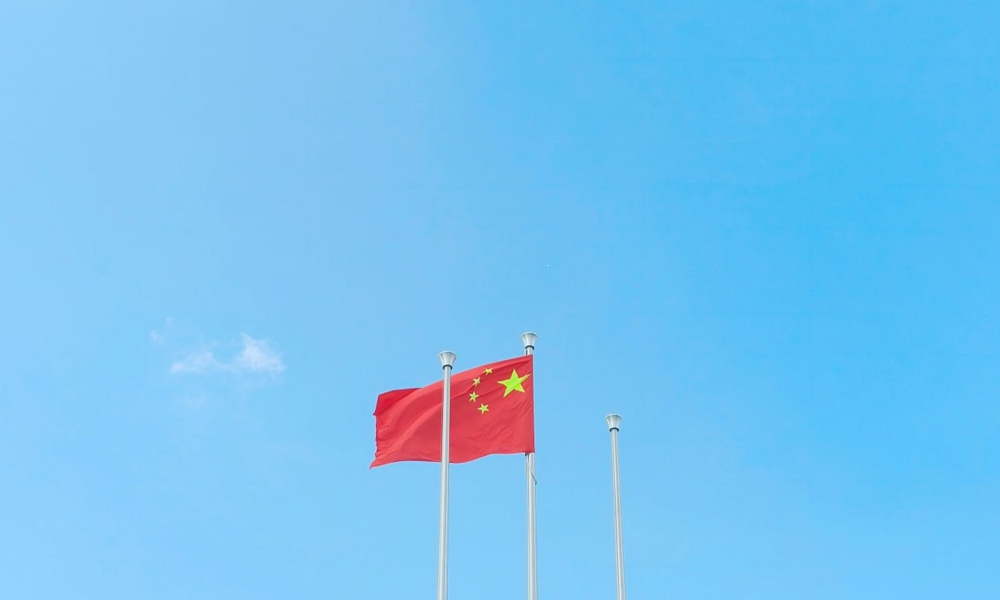
As his media empire grew, so did his personal reputation and access in China. The level of officials he met there kept rising, and he was granted audiences with three Chinese presidents: Jiang Zemin, Hu Jintao, and Xi Jinping. Chinese officials and media even praised him as an “overseas Chinese patriot”.
Hiew King’s affection for China may have reflected a personal cultural sentiment, but it was also a business strategy to strengthen ties with Chinese political circles and broaden investment opportunities.
However, Choon and the next generation do not necessarily share this sentiment, nor are they likely to replicate his approach.
Choon, 56, holds a Bachelor of Economics from Monash University, Australia. Since joining the Tiong family’s Rimbunan Hijau Group in 1991, she has held various managerial and senior positions in the plantation and hospitality sectors, and now serves as an executive director of the group.
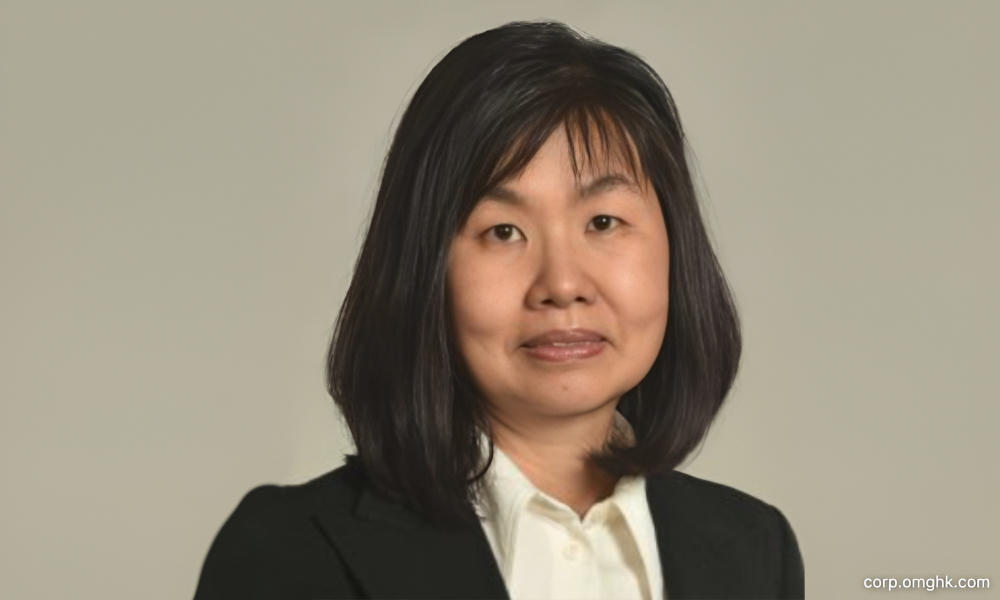
Among MCIL’s four executive directors is her cousin, Tiong Yijia, who is also the chief executive officer of Ming Pao Newspapers Limited and a director of Ming Pao Holdings Limited.
Aged 40, she graduated from the University of Melbourne, Australia, with a Bachelor’s in Commerce (Economics and Management) and a Bachelor of Arts (Art History and Politics). Joining MCIL in 2011, she oversees business development and marketing.
Given their age, education, experience, and past performance, there is little indication that either of the two possesses the same “Chinese sentiment”.
Although Yazhou Zhoukan and Sin Chew Daily continue to publish elegantly worded New Year messages and speeches under the name of Choon, and she has served as president of The Chinese Language Press Institute since 2018, she has not shown the same determination as her father in cultivating a public persona deeply tied to China.
Declining business
The next reality to confront is that MCIL’s overall performance has deteriorated, and its publishing and printing operations in Hong Kong, which historically contributed little to group profits, have now become a liability.
From 1993 onwards, Hiew King aggressively expanded his media empire in Malaysia and abroad. The eventual formation of MCIL in 2008, listed in both Hong Kong and Kuala Lumpur, appeared to be the triumphant unification of his media empire, yet ironically, this peak also marked the beginning of its decline.
Ming Pao’s inability to enter the Chinese market limited its growth, and its North American operations underperformed: in 2009, the West Coast edition ceased publication and the East Coast edition was converted into a free newspaper.
In Southeast Asia, the Cambodia Sin Chew Daily, established in 2000, ceased publication in 2018; the Harian Indonesia, purchased in 2006 and renamed Indonesia Sin Chew Daily, changed hands in 2021 and reverted to its original name.
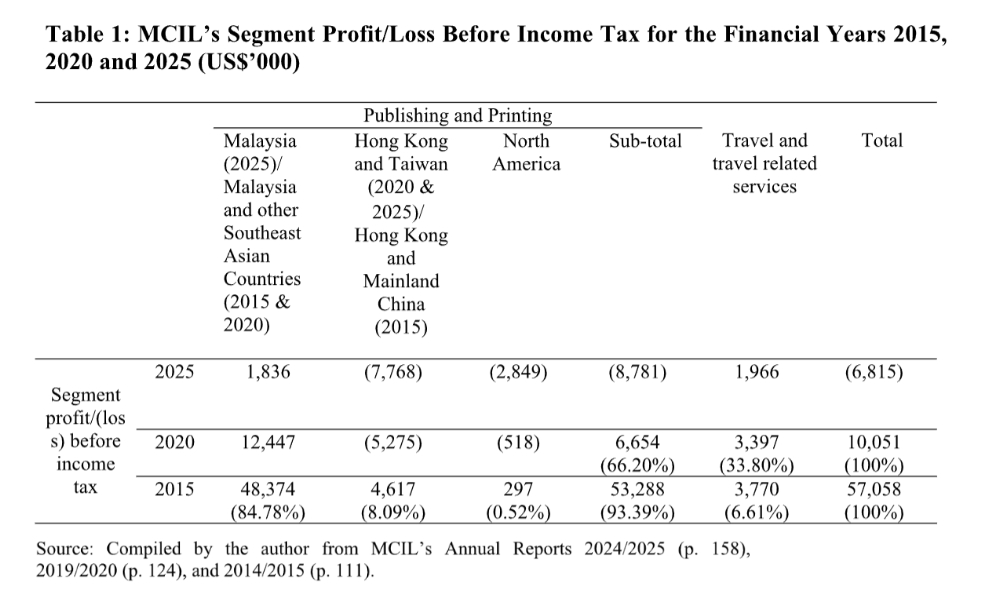
In the 2015 financial year, the bulk of MCIL’s profit before income tax came from publishing and printing in Malaysia and other Southeast Asian countries. Hong Kong and Mainland China, as well as North America, contributed less than 10 percent combined.
By 2020, the group’s publishing and printing profit before income tax dropped to 66.20 percent, while travel and travel-related services rose to 33.80 percent.
More critically, the loss before income tax from Hong Kong, Taiwan, and North America exceeded the profits generated by travel services, substantially reducing overall earnings.
The 2025 results paint a clearer picture: operations in Hong Kong, Taiwan, and North America dragged the group into the red.
While Malaysia’s publishing and printing segment, along with the travel and travel-related services segment, delivered a combined profit before income tax of US$3.8 million (RM15 million), it was insufficient to cover the massive loss before income tax of US$8.781 million from Hong Kong and Taiwan, and North America. As a result, MCIL posted a loss before income tax of US$6.8 million.
Shrinking media freedom
Besides facing bleak financial prospects in Hong Kong, MCIL must confront a far harsher political and media environment following the implementation of the National Security Law in 2020.
In 2024, Chung Pui-kuen, former editor-in-chief of Stand News, and Patrick Lam, the publication’s ex-acting editor, were convicted for conspiring to publish seditious articles, marking the first time in Hong Kong’s modern history that journalists were jailed for their reporting work.
The rapid passage of the Safeguarding National Security Ordinance to implement Article 23 of the Hong Kong Basic Law in early 2025 further worsened the climate.
In the 2025 World Press Freedom Index by Reporters Without Borders, Hong Kong plummeted to 140th place (135th in both 2023 and 2024), entering the same “very serious” situation category (“red zone”) as China - a stark warning.
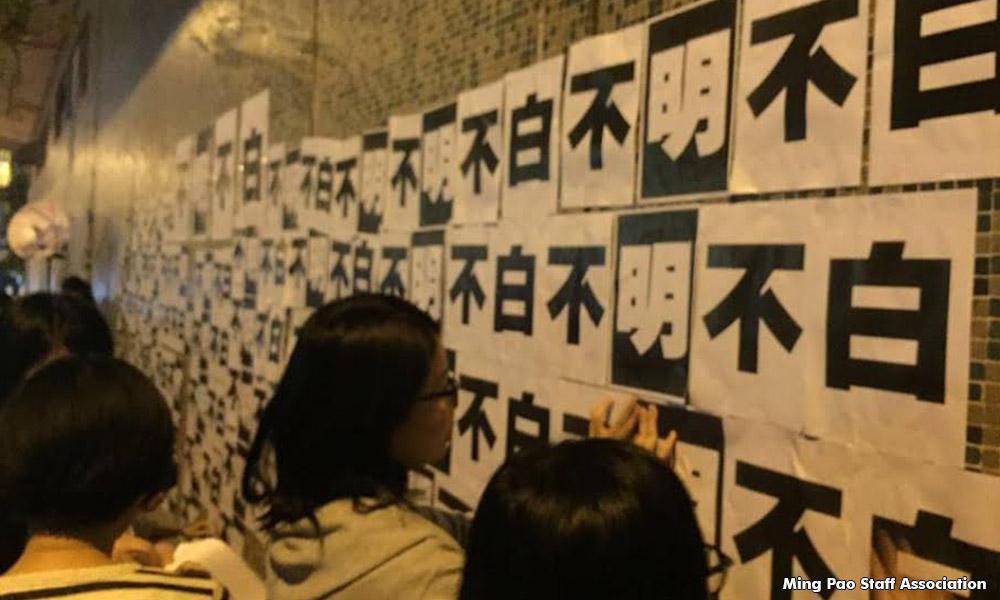
Although Ming Pao is regarded as politically moderate, the uproar over the dismissal of editor-in-chief Kevin Lau in 2014, the appointment of Malaysian Chong Tien Siong as editor-in-chief, the controversial removal of the Tiananmen anniversary front-page story, the unfair dismissal of executive chief editor Keung Kwok-yuen, and attempts to forbid columnists from publishing empty columns exposed the limits of Tiong’s or MCIL’s ability to “tame” Hong Kong editorial staff.
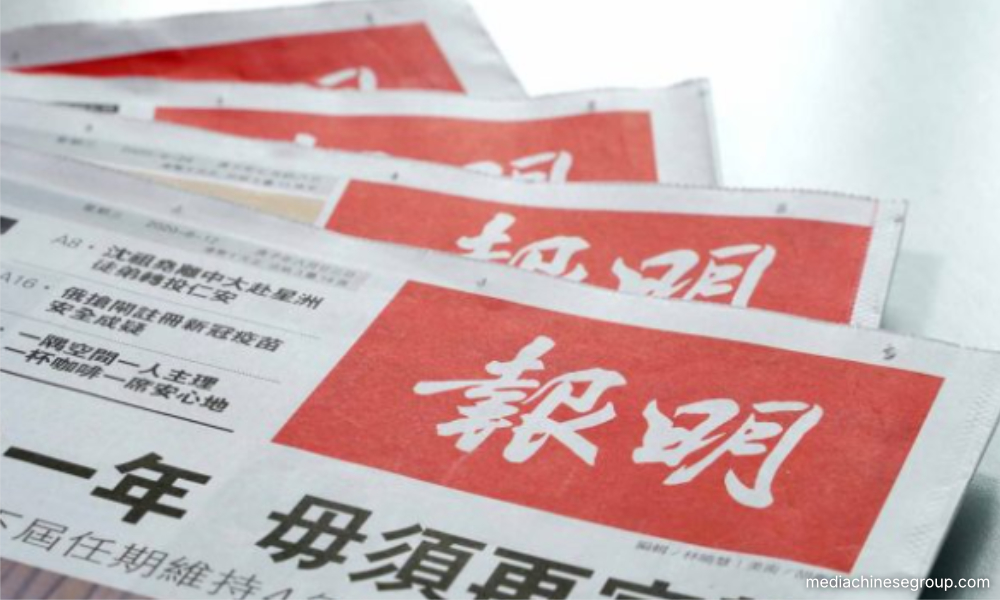
In an environment where press freedom and democratic space have drastically shrunk, continuing to operate Ming Pao risks crossing Beijing’s red lines, potentially provoking retaliation that could endanger the Tiong family’s vast business interests in China through the Rimbunan Hijau Group.
If the Tiong family lacks emotional attachment to “Chineseness”, if Hong Kong operations are unprofitable, and if the political climate is riddled with landmines, holding on to Ming Pao defies business logic.
Moreover, Hiew King is gone, and the dream of becoming the “Chinese Murdoch” is now impossible.
Today’s Beijing is fully capable of producing its own narrative-driven media to “tell China’s story well”; the importance of MCIL to Beijing has therefore diminished.
As for whether Beijing would “bless” a particular buyer to take over Ming Pao, that is another question entirely.
CHANG TECK PENG is an associate professor at the Faculty of Communication and Creative Industries, Tunku Abdul Rahman University of Management and Technology.
The views expressed here are those of the author/contributor and do not necessarily represent the views of Malaysiakini.


Are you sure you want to delete this comment?
This action cannot be undone.