




'Asian Renaissance' revisited
To know a politician, listen to what he says. To know a leader, read what he writes and observe what he does. To know a man, listen to his soul and the rumblings of his heart. That is more complex.
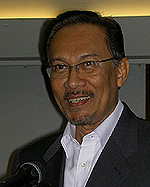
(PKR de facto leader) Anwar Ibrahim, whose name is inextricably linked to Asian Renaissance, is indeed a complex man, a humanist, politician and a leader. We know him by his many roles in Malaysia and abroad where he is respected as an outstanding leader from our region.
In Malaysia, he is a challenge to his political opponents and critics. He has been a prisoner of conscience for having stood up for his ideals and principles. He paid a heavy price, spending six years in solitary confinement in Sungei Buloh prison until he was released in 2004.
To know a politician, listen to what he says. To know a leader, read what he writes and observe what he does. To know a man, listen to his soul and the rumblings of his heart. That is more complex.
 (PKR
de facto
leader) Anwar Ibrahim, whose name is inextricably linked to Asian Renaissance, is indeed a complex man, a humanist, politician and a leader. We know him by his many roles in Malaysia and abroad where he is respected as an outstanding leader from our region.
(PKR
de facto
leader) Anwar Ibrahim, whose name is inextricably linked to Asian Renaissance, is indeed a complex man, a humanist, politician and a leader. We know him by his many roles in Malaysia and abroad where he is respected as an outstanding leader from our region.
In Malaysia, he is a challenge to his political opponents and critics. He has been a prisoner of conscience for having stood up for his ideals and principles. He paid a heavy price, spending six years in solitary confinement in Sungei Buloh prison until he was released in 2004.
In a speech in Istanbul, Turkey, in April last year, he said: “At this pivotal moment in history, when East and West are growing increasingly alienated from one another over issues of freedom and justice, I am reminded of our upbringing in multi-cultural and multi-ethnic Malaysia. It was this upbringing that infused the Malaysian psyche with what Nobel Laureate Amartya Sen has described as ‘a plurality of identities’ (Sen, Identity and Violence, New York: WW Norton, 2006).
“By nature, we Malaysians are inquisitive people, interested in other faiths and cultures. We studied the Koran and the traditions of the Prophet Muhammad at the same time that we devoured the works of Dante, Shakespeare and TS Eliot. For me there has never been any doubt that our world and the West are compatible, and that this spirit of inclusiveness and pluralism will continue to be a source of inspiration in bridging the gaps between cultures and civilizations.”
He goes on to state that: “...we see fundamental liberties being trampled upon and abused, fueling discord among nations and civilisations. My own struggle against those who seek to keep humanity shrouded in tyranny led to my incarceration for six years, a time during which I realised with blinding clarity that freedom is the very essence of being which unlocks the full potential of the human spirit”.
In a recent private conversation with this writer, Anwar said: “I know what is to be free and what freedom means. It is priceless and must be protected and preserved for all times.”
Anwarian Philosophy
Let us now proceed with some excerpts from ‘The Asian Renaissance’ (Kuala Lumpur: Times International, 1996) and then we can decide whether Anwar’s ideas which were first articulated in 1996 still have relevance in the 21st century.
He defines Asian Renaissance as “... the revival of the arts and the sciences under the influence of classical models based on strong moral and religious foundations; a cultural resurgence dominated by a re-flowering of art and literature, architecture and music and advancements in science and technology”.(p18)
Our renaissance, he states, is different from that Europe in that it has its foundations in Islam, Confucianism, Buddhism, Hinduism and Christianity, among others. Ours is of renewed Age of Faith, which the West has abandoned in favour of Cartesian dichotomy (the clear separation of body and mind).
So Anwar says: “...Asia, despite centuries of change and transformation, retains its essential religious character. The Asian Man at heart is persona religiosus.” (pp18-19)
His conception of renaissance of Asia is one of “…growth, development and flowering of Asian societies based on a certain vision of perfection; societies imbued with truth and the love of learning, justice and compassion, mutual respect and forbearance, and freedom with responsibility. Faith and religious practice is not confined to the individual, it permeates the life of the community.”(p19)
Anwar draws inspiration from great Asians of a bygone era, men like Chuang Tze, Ibn Arabi, Muhammad Iqbal, Sarvepalli Radhakrishnan (author of ‘An Idealist View of Life’), Jose Rizal, Rabindranath Tagore, Jamaluddin Al-Afghani, Nishida Kitaro, and others to reaffirm his basic belief that “[N]ations can actually grow and prosper by accepting the fact of cultural diversity, strengthening themselves by learning about their differences as well as by reinforcing the values they share in common”. (p24)
Asian renaissance is thus holistic, inclusive and all embracing. It is about accepting our cultural diversity and celebrating the dignity of difference, cultural re-awakening, economic empowerment, and good governance.
Asia must renew its commitment to universal values of justice for all, virtue and compassion. Our task is by no means easy, but there is hope yet if we prepared to deal with these with creativity, imagination and courage.
Humane economy
In the process of reconstituting itself, Asia must first secure its social and political order. This order must be founded on the idea of the dignity of man. Uppermost in his mind is his acceptance of democracy, despite its imperfections, as still the best way, but democratisation must also involve the creation and preservation of social order.
Anwar says: “In a truly democratic regime, such an order is to be achieved through the exercise of authority with accountability... Democracy should not be an end onto itself, but merely the means by which we can ensure humane governance: the restoring of the dignity of the human person and the satisfying the hunger for justice. There can be no dignity in poverty, sickness, deprivation, illiteracy and ignorance. Nor can there be dignity when women continue to be denied equal status, opportunities and remuneration. There can be no justice when the individual is oppressed and fundamental rights are denied him...Our ultimate goal must be nothing less than the establishment of a just and equitable society”. (p50)
Cynics will say that democracy is not possible in our part of the world. Asians lack sophistication. They are traditionalists, and respond only to authoritarian leaders. It is true that regular elections are held regularly but elections do not make for a truly functioning democracy. We need a free and independent media, an active and caring civil society, and other tools of governance such an independent and impartial Judiciary which upholds the rule of law, and incorruptible civil service.
 In Malaysia, the media is far from free and civil society is just emerging as a force. Even our elections are rigged and fraudulent. The political elite is said to be corrupt, and in recent years, corruption has been on the rise. The judiciary’s impartiality and integrity have been called into question as result of the Lingam tape. Public administration is punching below its weight to the point of being completely dysfunctional.
Anwar's response is that we must change and improve, get better and be more competitive. In response to cynicism, he is fond of quoting Dr Sun Yat-sen who reportedly said: “Alas! This is like telling a child that he cannot go to school because he is illiterate.”
We must seek answers. In Anwar’s view, the answer lies “in treading the middle path between anarchy and absolutism”. (p53)
I find the Anwarian conception of a humane economy most intriguing. It is based on a “philosophy of development which is holistic, guided by ethical and social concerns and founded upon the principles of justice and virtue” (p85). It offers hope for the region and Malaysia. For far too long, we have ignored the consequences of seeking material wealth to the exclusion of other social and cultural considerations.
He says that: “In a humane economy...there is optimum utilisation of scarce resources, discipline in fiscal management, promotion of a clear social agenda, and a profound respect for the environment. The prudent use of resources entails the protection and conservation of the environment for the benefit of future generations.”
Malaysian economic agenda
With the 12th general election looming, Anwar has crafted an ‘Economic Agenda for Malaysia’. It incorporates ideas that relate to his conceptualisation of the humane economy. His plan includes strategies for achieving strong and sustainable rates of economic growth through productivity gains and enhancement of national competitiveness. It includes a conducive business environment for domestic and foreign investment and promoting good governance.
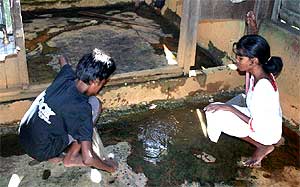 Programmes for public investment in quality education and human resources, healthcare, and social security including minimum wage are critical to achieving the goal of justice for all. Poverty-eradication schemes will be founded on needs, not race or class. The emphasis is on economic growth with distributive justice based on an expanding economic cake.
The Anwarian economic agenda forms part of his overall philosophy of human development which seeks to balance the material with the spiritual development, a potent blend of market economics and benign state interventionism. We need efficiency and we also need compassion for those among us who are less endowed or less fortunate.
An Asian reawakening awaits us. We need to rise above the clouds of despair to see a new dawn which men of intellect of Asia in the last century had envisioned.
Tagore is right when he said that:
The night has ended.
Put out the light of the lamp of thine own narrow corner smudged
with smoke.
The great morning which is for all appears in the East.
Let its light reveal us to each other who walk on the same path
of pilgrimage.
That is my wish for Malaysia. Let us take the pilgrimage in search of a humane economy where we can rediscover our dignity from the ravages of corruption, incompetence and mismanagement of our scarce resources.
Let us earn our pride of place in the community of nations of Asia.
DIN MERICAN is programme director of PKR.


