
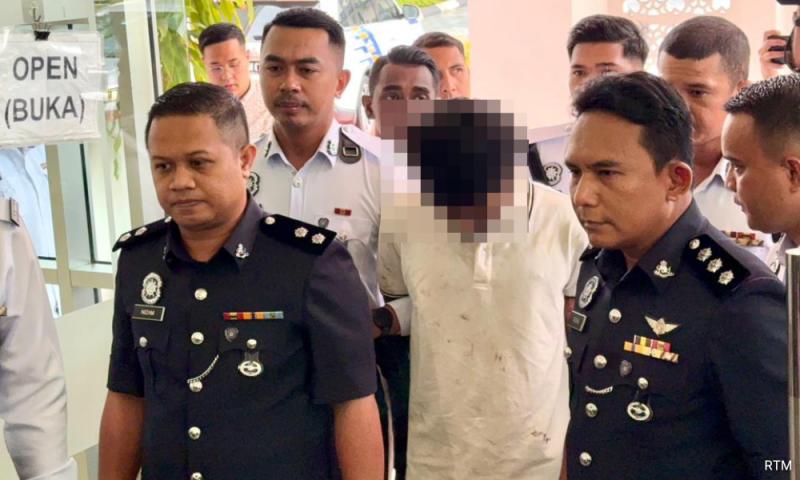
COMMENT | Justice or optics? Where is real road safety reform?
COMMENT | The death of Amirul Hafiz Omar, a father of three killed while on a simple errand to buy a mathematics book for his child, has rightly provoked grief, anger, and demands for justice.
However, here is the uncomfortable truth: What we are seeing now is not justice. It is noise.
Justice must be more than a performance. Justice is not about sounding strong. It is about being effective.
Take the decision by Attorney-General Dusuki Mokhtar to charge the accused with murder, which in itself raises a serious and uncomfortable question: Is this a legal strategy designed to secure a conviction, or is it merely a public gesture designed to satisfy outrage?
In law, those two are not the same...
COMMENT | The death of Amirul Hafiz Omar, a father of three killed while on a simple errand to buy a mathematics book for his child, has rightly provoked grief, anger, and demands for justice.
However, here is the uncomfortable truth: What we are seeing now is not justice. It is noise.
Justice must be more than a performance. Justice is not about sounding strong. It is about being effective.
Take the decision by Attorney-General Dusuki Mokhtar to charge the accused with murder, which in itself raises a serious and uncomfortable question: Is this a legal strategy designed to secure a conviction, or is it merely a public gesture designed to satisfy outrage?
In law, those two are not the same.
Dusuki’s decision satisfies public anger and echoes Amirul’s widow’s understandable cry for “a life for a life”.

It signals seriousness, but the question must be asked: Is this about securing justice, or performing it?
What happens when charge fails?
Some probably wonder if the AG’s decision is deeply questionable. The murder charge requires the prosecution to prove intent, or that the accused knew his actions were likely to cause death.
Even if the driver is convicted of murder, even if the harshest sentence is imposed, it will not fix the deeper, systemic failures that made this tragedy possible in the first place.
On the other hand, driving under the influence (DUI) of alcohol or drugs is reckless, dangerous, and highly irresponsible, but it is not automatically proof of intent to kill.

By choosing the most severe charge and not clearly pursuing the more straightforward offence of DUI causing death, the prosecution risks weakening its own case.
If murder cannot be proven, it risks collapsing entirely, and if the murder charge fails, what then?
Justice is not strengthened by choosing the hardest charge. It is secured by choosing the most effective and provable one.
Duzuki’s approach appears less like a legal strategy and more like a response to public pressure. He is aligning himself with calls for maximum punishment, and he may ultimately fail to deliver it.
That is not strength; that is risk.
The widow’s call for “a life for a life” is one which most of us will find understandable in her grief, but a justice system cannot and must not mirror that emotion in its legal reasoning.
As Mahatma Gandhi once warned: “An eye for an eye makes the whole world blind.”
Yet increasingly, public discourse, and sadly, it now seems, prosecutorial decisions are being shaped by that very instinct.

The AG is not tasked with echoing public anger. His duty and responsibility are to deliver justice that holds up in court. That effort requires discipline, not drama.
Root causes remain unaddressed
Malaysians may reasonably question the consistency of charging decisions. In past cases involving illegal street racing, including one in 2014 where “Mat Rempits” were charged with murder but later acquitted, the difficulty of proving intent has been evident.
This raises a broader concern, not that such cases should be escalated to murder, but whether current decisions risk repeating the same legal overreach, driven more by public outrage than by what can realistically be sustained in court.
Let’s assume that the prosecution succeeds, the driver is convicted of murder, and a heavy sentence is imposed. What changes?
Does this reduce drug use among drivers on Malaysian roads?
Does it strengthen enforcement on our roads?
Does it address a driving culture that tolerates recklessness?
Does it resolve our long-standing concerns about inconsistent policing or selective enforcement?
The answer is “No!” Punishment alone, no matter how severe, does not fix systemic failure.

In times of crises, Malaysians in positions of power have often resorted to knee-jerk policies, whilst ignoring attempts at serious reform.
Alongside the murder charge, other proposals have emerged, including from a former board member of the Malaysian Institute of Road Safety Research, to confiscate and sell the vehicle to compensate the family. But this is riddled with practical flaws.
What if the vehicle is a total write-off? What is left to sell? Scrap metal? What if the car was borrowed, leased, or owned by someone else? In a society where cultural sensitivities matter, who would willingly buy a car associated with death?
This is not policy, but theatre (wayang).
Someone suggested that the offender financially support the victim’s children. Again, this is emotionally satisfying, but fundamentally impractical.
How does a man in prison earn an income? It may be possible to compensate the victim’s family if he were from a wealthy family. What if he is unemployable upon release? What if he has no assets to begin with?
Justice cannot be built on assumptions that collapse under basic scrutiny. What is evident is that these responses share a common weakness: They are reactive, emotional, and superficial.
Systemic issues need to be addressed
Most avoid the harder question of “Why do these incidents keep happening?”
Malaysia does not lack laws. It does not lack enforcement agencies. It does not lack road safety committees. What it lacks is consistent, credible enforcement.

Until the issues associated with drink/drug-impaired driving, reckless road behaviour and allegations of selective enforcement and leniency are addressed, no amount of harsh sentencing will prevent the next tragedy.
If we are serious about road safety, we must move beyond optics and focus on:
Consistent, visible enforcement
Serious action against drug-impaired driving
Cultural change in driving behaviour
Institutional accountability
Faster and more transparent legal processes
These measures do not generate headlines, but they save lives.
Ultimately, Dusuki's well-intentioned decision is a dangerous gamble and may fail the very people it seeks to serve.
Truthfully, Malaysia needs smarter, not louder responses to prevent the next Amirul.
MARIAM MOKHTAR is a defender of the truth, the admiral-general of the Green Bean Army, and the president of the Perak Liberation Organisation (PLO). Blog, X.
The views expressed here are those of the author/contributor and do not necessarily represent the views of Malaysiakini.
/file/publisher-c1a3f893382d2b2f8a9aa22a654d9c97/2026/04/aadecdc943a6ff98ddf65a2d416f1f5e.jpg)

/file/publisher-c1a3f893382d2b2f8a9aa22a654d9c97/2025/11/d15c2dc02f975e944427bcb5ff15a6a5.jpg)
/file/publisher-c1a3f893382d2b2f8a9aa22a654d9c97/2023/10/9d07dac4b6cf0a399c65ac91748b900d.jpg)
/file/publisher-c1a3f893382d2b2f8a9aa22a654d9c97/2025/11/5e6b75f7247881960379d76a7331b8ef.jpg)
/file/publisher-c1a3f893382d2b2f8a9aa22a654d9c97/2025/09/603cb4593ba2db9b731c42159faf69f7.jpg)
/file/publisher-c1a3f893382d2b2f8a9aa22a654d9c97/2026/04/bf49e261408c3b50fc9f815849798901.jpg)
/file/publisher-c1a3f893382d2b2f8a9aa22a654d9c97/2026/01/73cfbbd1169a0aac9b75ccefb724c3e5.jpg)
Are you sure you want to delete this comment?
This action cannot be undone.