




New Rudd gov't challenges in 2008
The election of the new Rudd government has aroused expectations of hope and for change amongst many sections of the community. There was a widespread feeling that the Howard government had lost touch and become very tired; it was pursuing policy initiatives that lacked depth.
The fact that the old prime minister himself lost his own Benelong seat in Sydney further emphasised how firm the desire for change had become. Amongst various factors, he paid the price many years down the track, for his stand on Asian immigration in the 1990s.
The election of the new Rudd government has aroused expectations of hope and for change amongst many sections of the community. There was a widespread feeling that the Howard government had lost touch and become very tired; it was pursuing policy initiatives that lacked depth.
The fact that the old prime minister himself lost his own Benelong seat in Sydney further emphasised how firm the desire for change had become. Amongst various factors, he paid the price many years down the track, for his stand on Asian immigration in the 1990s.
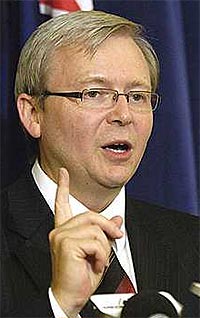 People will be looking to the Rudd government to take things forward with energy, thought and depth. During the election campaign, a certain cynicism developed about just how close the two main parties' policies had become. This seemed to be especially true of the Rudd team. The phenomenon of "me-tooism" emerged and left many people wondering just what they would do if elected. People were asking when will the rhetoric end and substantial things begin?
It is now only a couple of months since the election; it obviously takes time for such a large operation as a new government to get going. It would probably be unwise to take major steps without full briefing and a little caution.
However the Australian community as a whole, including Chinese-Australians, will be looking for action in coming months, on key matters such as: Follow up on Labor's election commitment to an "education revolution". The proposed boost in government spending must ensure greater equality of opportunity in accessing education. Plans for greater integration of curriculum across States and Territories should be advanced. The content of curriculum must be set by the professionals. Whimsical proposals, such as Howard's history teaching, must be buried deep.
At a tertiary level, higher commonwealth spending is clearly required to ensure there is greater access to all. The attempts by universities to maintain their work through huge fees imposed on overseas students predominantly from SE Asian countries and, more recently from India and China, needs review.
Likewise, there is expectation that Labor will take initiatives to improve equality of access to public hospitals and community health services. Amongst the advances must be a reduction in the length of waiting times for surgery and other treatments. Meeting people's health needs should not in anyway be on the basis of a person's income, locality of access, ethnic background, age or any other social factors. The shortage of doctors is also a serious issue long-term. Expanding medical training in universities and other educational institutions may be the only option.
Indigenous community
There is increasing hope too amongst diverse parts of the Australian community that the new government will pay keen attention to the position of Australia's indigenous community. It is hoped that the Howard government's "intervention" on indigenous people's needs in the Northern Territory, will be carefully reviewed. Positive aspects of the intervention should probably be maintained – especially commitment to greater commonwealth special services support for indigenous people. But attempts to wind back previous gains on land rights must be stopped. There is probably much that community based bodies can do to help their membership and communities better understand what indigenous people have faced since European settlers commenced coming to Australia more than 200 years ago.
The Howard government was not known for its strong support of the policies and values of multiculturalism, which have emerged in Australia these past decades. Whatever difficulties remain in promoting one society out of many peoples, it is clearly an area where the Rudd Government can inject new energy. Hopefully, old-fashioned and paternalistic Howard "initiatives", such as the "citizenship test" will also be turned back.
Steps already taken by the new government to end detention of refugees and "boat people" in external countries (eg. Nauru) are very welcome. When it comes to refugee policy, there will always be difficulties in determining who is fleeing genuine persecution, but clearly it is an area which needs much greater humanity and awareness in its handling.
The credit crisis that has emerged within the world economy over recent times is another challenge for the Rudd government. This year looks like being one of considerable difficulty in many countries. In truth, there are limited things a government – especially of a middle sized economy such as Australia – can do to stop these economic ups and downs. But where things can be done the new government needs to act in an intelligent way, aiming to balance the interests of all sections of the community as much as possible.
Australia is a rich country but that is not to say that it is without people who live in bad poverty. We need to ensure that these people are the first protected and assisted in an economic downturn.
War in Iraq
Also on the economic front, the work choices policy did much damage electorally to Howard's government. It had been aimed at weakening the traditional influence of the "blue-collar" unions. But clearly it also unnerved many "white-collar" workers and professionals, who also felt they needed their unions to protect living standards and rights. The old government paid dearly at the polls for this ill-move. The Rudd team has promised to repeal this unwelcome proposal. People will be waiting to see what they do.
Increasing concern about the Howard government's Iraq War involvement showed itself during the election. Voters with diverse political loyalties could see no reason for the tangled web of kill and be killed that has come out the American-led intervention going back to the early years of this century. It has become obvious to many that the 2002 US invasion was based on many lies, especially about Iraqi development of nuclear weapons.
The Iraq War to date has killed nearly half a million people, including several thousand American soldiers. Enormous suffering has come from this blunder. It is utterly unjust and tragic. The Bush, Howard and other governments are paying a high price.
Hopefully, the Rudd government will follow the example of the UK government and bring to a decisive end this futile policy. It is also hoped that they will do a full review of how and why Australia allowed itself to be drawn into this disastrous event, and of how to prevent any recurrence.
These are some of the most important issues that we see the new government facing in its first term in office. None are easy, but we believe taking them up and achieving results will revitalise and improve Australia's whole society in many ways. We wish the new Rudd government well in its work.
RICHARD WONG is an executive member of the Chinese Professional and Business Association and a council member of the Federation of Chinese Associations in Victoria, Australia.


