




Seeds of fascism germinate
Fascism in Malaysia is indeed a realistic scenario - albeit a
low-probability and long-term scenario - but one that we cannot
ignore.
The 2008 election earthquake has toppled some decayed trees, and today we bask in the sun in this small jungle clearing. But the jungle can fight back; federal powers can strangle any seedlings of change.
Federal budgetary grants to the states, federal development
departments (to disburse oil income), the police, little napoleon
bureaucrats, and federal control over local infrastructure, are
instruments that the BN has used to obstruct and usurp the power of the Pakatan Rakyat state governments.
Fascism in Malaysia is indeed a realistic scenario - albeit a
low-probability and long-term scenario - but one that we cannot
ignore.
The 2008 election earthquake has toppled some decayed trees, and today we bask in the sun in this small jungle clearing. But the jungle can fight back; federal powers can strangle any seedlings of change.
Federal budgetary grants to the states, federal development
departments (to disburse oil income), the police, little napoleon
bureaucrats, and federal control over local infrastructure, are
instruments that the BN has used to obstruct and usurp the power of the Pakatan Rakyat state governments.
While we hope a new Pakatan federal government will plant the
tree of liberty, it is not a certainty that it will have the will,
ability, and duration to do so. Our corrupted culture may not support
Pakatan. External economic accidents can overwhelm it. Pakatan is
also vulnerable in its reliance on the force of personality of a
single person to hold it together, as argued in Who will succeed
Anwar Ibrahim?

So despite our post-election euphoria, we must not dismiss these seven seeds of fascism that lie in wait:
First there is a litany of bad laws that may take decades to repeal
and reform: ISA, OSA, Printing Presses and Publications Act (PPPA), University and University College Act (UUCA), Sedition Act, Society Act, Police Act, Import Publication Act, election laws, and
communication/broadcast related laws, etc. Pakatan may not last long enough to complete the task, or would need to gain BN-like hegemonic (and oppressive) power to ramp through changes quickly.
Second is NEP, a racist-socialist policy. NEP has become a ‘zombie’
policy that transcends laws and even its own expiry. Most
intellectuals view NEP as a problem only because it is badly
implemented. No. I have argued but twice that as a socialist policy, NEP will inevitably degenerate into fascism. NEP is intrinsically evil because it starts with unjust laws, requires a strongman to implement, requires centralised ‘planning’ power, and will eventually implode into authoritarianism - oppressing precisely the group that NEP is supposed to protect.
Respects power over law
Even in retirement, former PM Mahathir is painting the current PM
Abdullah as ‘weak’ and undeserving, attempting to resurrect the
dangerous idea that only a strongman can implement NEP optimally. This is the Malaysian version of The Road to serfdom .
Who is really in charge at the Home Ministry?
Third is our political culture that respects power more than law, and
ends more than means.
At the top of the government, we have a prime minister and his deputy who have hung on to both the powerful security portfolios – home ministry (the police guarding internal security) and defence ministry (the military guarding external security).
While the PM has officially given up the home ministry portfolio, his replacement has a weak political base and leans on the PM for political support.
Further, the ministry seems to have -judging from police brutality,
police rejection of the Independent Police Complaints and
Misconduct Commission (IPCMC) , the stubborn and inhumane detention of Hindraf leaders that seems to run counter to the PM's wishes, recent attempts to reassert control over the media (punishing Makkal Osai and Raja Petra), unequal investigation of Opposition MPs, chief ministers and NGO protestors, and the minister being clueless regarding Hindraf chairman's flip-flop passport status- grown a mind of its own, quite apart from the home minister himself.
We have a developing mystery, who is really in charge of the home affairs ministry these days? Who are the real masterminds? How will
this ‘free will’ at the ministry develop?
At the mid-level of our political culture, aspiring-ministers and
retired premier continue to expound racist and seditious rhetoric, to hope to win influence. At the ground level, the ruling party is infatuated with Mat Rempits, who are prepared to do the dirty deeds during election campaigns and toll road protests.
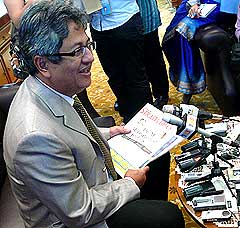 Fourth is the deterioration of the rule of law. Within the government, the de-facto law minister Zaid Ibrahim who proposed judiciary reform is also
the one most attacked by his cabinet and party colleagues, and is substantially cowed by now. All kinds of theatricals from our former premier are allowed to obscure the need for follow-up investigation into the royal commission's report on the Lingam tape affair.
Fifth, there is a subtle blurring of the border between the police and the military. The police are a civilian security force, but use
military-like IC numbers to identify themselves and to vote. Recently, the police plans to recruit retired soldiers. Although retired soldiers are valuable assets, such a targeted recruiting plan must have assumed that military training is somehow valuable for injection into the police force, a dangerous contention.
Disparage detractors
As government budget is squandered such that we underpay the police, the government turns to a less disciplined Rela to do the job. But Rela has an incredibly wide range of roles. From policing, crime-fighting (rarely done), immigration raids (their chief's pet project), crowd control, traffic control for political parties and corporations, to disaster relief.
Blurring the distinction between ‘voluntary’ police and military.. These roles can easily expand to raiding civilian homes on the excuses of ‘national security’ or ‘patriotism’, the latter already used by the Rela chief to disparage detractors
Rela should be disbanded. Yet the government plans to give Rela
enforcement power that will only deeply threaten civil rights.
In contrast, the government undermines the enforcement powers of
important civilian institutions: Suhakam, the Election Commission,
ACA, and Securities Commission.
 If Rela is meant to be as professional as the police, why not just
merge it into the police? Otherwise, why give it more power?
The only reason to elevate Rela would seem to be to create a paramilitary group, with its own budget, weaponry, and command structure, unbridled by professionalism and scrutiny that civil society and police/military conventions demand.
Sixth, we have a conformist culture and education system which is an ideal fascist breeding ground. UUCA and our school system prepare students for obedience, nationalism, and endeavour to cut down dissent. Our schools are churning out unemployable youths, a hotbed for extremist ideas if coupled with sustained economic downturns . It will require Pakatan to have the right mindset and time to reverse these trends.
We have an increasing number of youths being militarised by the
National Service program. And why does a ‘pro-unity’ educational
programme fall under the Ministry of Defense? Then the nation's
heir-apparent to the PM position is a multi-term Minister of Defense.
The World in 1920s would not have been able to imagine that down-to-earth and sensible Germans could have turned into the fascist Nazi conformers of the 1930s.
Free trade gets no respect
Seventh, we may face a looming economic and employment downturn - both self-made and international in origins. Yet, BN's past corruption has mistakenly turned off Malaysians from the economic alternatives that will save us: privatisation, free trade, and liberalisation.
We have an increasingly inflexible government finance that relies on
high oil and commodity prices, debts, and excise taxes. The year 2008 will be the 11th year of consecutive federal budget deficits - of about RM20 billion each year - through mostly good years. Federal debt has tripled from RM90 billion in 1997 to RM280+ billion estimated for 2008.
 While free trade has helped us beat communism by 1970s, given us
growth since 1980s, and saved us from our self-inflicted crisis of
1998, free trade gets no respect from our Malaysian institutional intellectuals.
We allow our government to damage Afta with Proton and rice
protections. With vested interests, we stall the Malaysia-US FTA
negotiation, inadvertently helping our government to protect its
cronies via government procurement. WTO negotiation is stalling and
these intellectuals are happy.
Further, ‘privatisation’ has become a dirty word. Our former PM
Mahathir has made sure of that, with shameful examples like Renong,
UEM, MAS, Proton, toll roads and bridges, rescued mass transit
systems, bad buses, and dozens more. He completely discredited
privatisation as a tool for economic growth through these
pseudo-privatisation and de-facto feudalism that ‘privatises profits
and nationalises losses.’ We will now have great difficulty
revisiting privatisation.
Ironically, if we face any economic crisis, we will need
properly-implemented privatisation to save us, to (1) strengthen
government finance, (2) release the pent-up creativity trapped around our GLCs, (3) rapidly create employments by revitalizing our domestic service industries, and (4) hold down domestic prices.
Our neighbours are teetering too, no thanks to our Afta sins and their own mistake of emulating the Mahathiran model. The Thai pendulum keeps swinging between corrupted strongmen and the threat of military coups. Indonesia and the Philippines are not out of the woods with their own economic and social reforms.
Too few of our intellectuals give credit to free trade for delivering
60 years of world peace. Our intellectuals who have not absorbed the lessons from the abject poverty and oppression of communist China, USSR, central Europe of the 1970s are so much more tolerant and romantic about protectionism than today's officials from mainland China and Central Europe. The current South Korean political storm protesting US beef import only emphasises how misled and emotional the mob can become, biting the hand of free trade that feeds them.
In all likelihood, only two key factors will determine the world
economic future for the next decade (we will feel that in the stock
market, interest rates, inflation, our property prices, and employment outlook): We'll have no place to hide, no place to stash our savings, no place to find employment for our children, if (1) WTO negotiation collapses completely, and (2) the US turns inward and protectionist, manifested in their choice of the next US president.
Help Umno change
With the above seven elements, we can chart a path to a
low-probability but severe scenario of fascism in Malaysia within a
generation. We may even have under-estimated this probability because of the optimism surrounding the outcome of the 12th General Election.
 Like a strangling fig, fascism can't take root overnight. It will take a generation's worth of economic problems, world trade protectionism, and increasing youth unemployment, for these seeds of fascism to germinate, grow, and strangle a country. But a generation's time passes in a flash.
While we hope GE 2008 will change everything, such an accidental
political landslide is not stable ground. We need to do more foundation work.
We need to strengthen our systemic foundation and pillars:
parliamentary and legislative reforms, judicial reform (including
repealing Emergency Ordinance and ISA that interfere with the
judiciary), law enforcement reform (putting ACA under the parliament, implementing IPCMC), financial reform (free up ringgit, liberalise ownership, reform EPF), electoral reforms (including direct local election), and information reform (repeal of PPPA at the same time enacting Freedom of Information Act and reform of OSA).
All these are ground-shifting rules, where a few rule changes can
change the whole ecosystem. The benefits are more extensive and far reaching than even we the supporters can realise. As for the power of free trade, well, that is another set of arguments for another day.
Yet Umno, MCA, and Gerakan, are wallowing in the mud, too preoccupied with self-pity to carry out any of these reforms. Perhaps Ezam has made the right move. We should help BN and Umno out of the funk. After all, democracy is about helping the weak and the down-trodden -I mean also the down- trodden political party - to ensure enough competition among political parties, so that the minority people will have their rights protected.
Perhaps BN should even lose federal power for a while. The Taiwan
story in which the corrupted and oppressive Kuomingtang (Nationalist Party) lost presidential power for 8 years, split internally, and completely reformed itself into fresh-breathe, cheerful-faced, young party, and won over the electorate again, is a worthwhile inspiration.
CHEAH KAH SENG, trained in investment and portfolio analysis,
considers himself a student of the Austrian School of liberal
economics. He is currently interested in how Web databases reflect
individual freedom of choice and the aggregate learning process.


Are you sure you want to delete this comment?
This action cannot be undone.