




Malaysians dam away Laos
 In mid June 2008, the Lao English language newspaper -
the Vientiane Times
- announced that the Malaysian owned Rohas Euco Industries Berhad is to construct a dam in the northern province of Xieng Khouang.
In mid June 2008, the Lao English language newspaper -
the Vientiane Times
- announced that the Malaysian owned Rohas Euco Industries Berhad is to construct a dam in the northern province of Xieng Khouang.
My friend groaned at the news. Then he got depressed.
The 4,000 plus villagers had lived there for over 250 years, only leaving to flee into nearby caves to escape bombing. This province was one of the most heavily bombed during the American’s secret war in Laos and is still the focus of de-mining operations.
Using Darwinist principles one can assume that the land that is farmed is free of unexploded ordnance.
The resilient and hard working community had planted fruit orchards and endless rice fields that melded into the low hills surrounding the valley. Healthy cows, horses, and a gaggle of poultry clucked, neighed and moo-ed around them.
 In mid June 2008, the Lao English language newspaper -
the Vientiane Times
- announced that the Malaysian owned Rohas Euco Industries Berhad is to construct a dam in the northern province of Xieng Khouang.
In mid June 2008, the Lao English language newspaper -
the Vientiane Times
- announced that the Malaysian owned Rohas Euco Industries Berhad is to construct a dam in the northern province of Xieng Khouang.
My friend groaned at the news. Then he got depressed.
The 4,000 plus villagers had lived there for over 250 years, only leaving to flee into nearby caves to escape bombing. This province was one of the most heavily bombed during the American’s secret war in Laos and is still the focus of de-mining operations.
Using Darwinist principles one can assume that the land that is farmed is free of unexploded ordnance.
The resilient and hard working community had planted fruit orchards and endless rice fields that melded into the low hills surrounding the valley. Healthy cows, horses, and a gaggle of poultry clucked, neighed and moo-ed around them.
Signs of modest prosperity were everywhere: painted houses, tiled roofs, and healthy children.
The women pick medicinal herbs and dye stuffs from the nearby forest. They heal their sick children and weave their dreams into the silk textiles for which the province is famous.
They may have survived the bombing, but they will not survive the dam. The dam is forever; drowning their lands and communities in perpetuity.
My friend reported that the stream (the Nam Xan) hardly rendered a feasible rate of flow. Even in peak season it raged like a large municipal drain.
That did not stop the company’s environmental scientist being drowned in the rapids two years ago. Crossing a log bridge across the cataracts, he was called back for a photo op. As he re-crossed the bridge, he slipped and fell; his heavy pack dragging him under. It was hoped that this sacrifice might have dampened the company’s enthusiasm for the project.
Apparently not.
‘Kinder, gentler dam’
Lao - one of the poorest countries in Asia - is cursed by having only 6% of its land suitable for rice agriculture. This reservoir, which will need to be vast and shallow, will drown all of the rice fields, most of the fourteen villages along with almost all the arable land around. Which then begs the question: What to do with the resettled community?
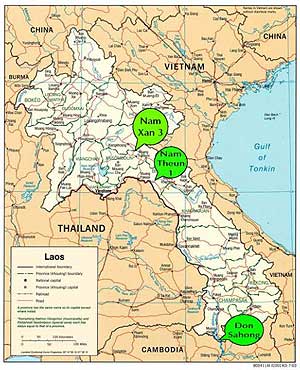 Malaysian companies are building what are arguably the three most socially and environmentally controversial dams in Laos. They are distributed nicely. One in the north, another in the middle and the last way south.
While the world focuses its critical attention on the Nam Theun 2, cavalierly and erroneously labeled by Newsweek as a “kinder, gentler dam”, the Nam Theun 1 has spun below the video screens and reporter’s cameras.
But it threatens to bisect what has been described by the IUCN as “one of the world’s biodiversity hotspots” exposing areas intact since the last ice age to poaching and habitat loss.
Despite not being given the final go-ahead, the company, Gamuda Berhad with its partner EGCO (Thailand) is going like dam busters, building roads through nominally protected areas on which to carry the huge turbines.
The roads like keloid scars, have already polluted the until now pristine Nam Kading river and the work camps are littered with ‘protected’ trees they have felled.
The river to be dammed is one of the major fish spawning areas for the Mekong. The environmental impact statements were clear: because the dam wall will be 175 meters high, no mitigation measures would be possible.
Short of using ropes and pitons, a romantic piscine escape up the river is out of the question.
The height of the dam wall exacerbates and increases the amount of the omnipresent, ‘black’ bottom water. The oxygen depleted water, with its cargo of anaerobic organisms, is known to kill fish and livestock far downstream. Lao’s first dam, the Nam Ngum completed in 1975, still garners complaints about bank erosion and animals deaths that come from the regular flushing.
Around 4,000 people will be displaced, and another 2000 households partially affected by NT1.
Social surveys indicate some unwillingness to move. Sacred caves will be submerged, along with ancestral resting places. Lao women of the ethic groups residing in the area, like to bury their baby’s placentas at the base of the house steps, ensuring that the soul of the child will be tied to the family and thus have its’ protection. Rational dams have no place for such quaint customs.
Finding suitable agricultural land upon which to resettle people is proving difficult. In other dam projects, such as the Nam Theun 2, communities face hunger as the new land is less fertile. It takes many years for farmers to understand their land, to become well acquainted enough to understand its’ moods and eccentricities and to build a community. This takes longer than a dam’s project cycle.
Fish diet people
The Lao rely on fish for 70% of their dietary protein and the lower reaches of the Mekong are major fish migration routes for the species that make the region so famous. Disruption of fish breeding areas have major international implications.
 If the Mekong and its tributaries itches, then many Mekong communities end up scratching.
Malaysia’s well-connected Goh family enterprise Mega First, is planning to dam the major fish migration channel in the celebrated Khone Falls of Southern Lao immediately adjacent to the Cambodian border.
In an unprecedented move, a public letter was signed by around 20 scientists, declaiming the project as being of such potential damage to regional fishing that is was remarkable that the dam was even considered. Despite this, the government of Lao is understood to be finalising the go-ahead order.
A government fishing agency official told me that he thought the project would benefit tourism by providing electricity, and besides, the fish would find another route.
The area, otherwise known as Siphandone (Four Thousand Islands) in the extreme south of the Peoples Republic of Laos, along with its sister area, the Tonle Sap in Cambodia, has the reputation of being one of the richest freshwater fishing grounds in the world.
Wild fish capture is a vital part of the Lao economy, contributing 6-8% of the GDP and comprising around 78% of the nation’s fish production.
Estimates indicate that the value of wild fish capture to all Mekong riparian nations amounts to USD2 billion per year; and of that, the lower Mekong region contributes 2.6 billion tones of fish annually.
Some 106 species have been enumerated. Even now 30 kg fish are not rare. Virtually all species brave the rapids and to make the arduous migratory ritual upstream. The larger fish running in the middle of the year when the river is highest, and the risks to the fishermen greatest.
 The old people are fond of saying that when they were young and felt hungry, they would build a fire next to the river and wait for the fish to jump into the cooking pots.
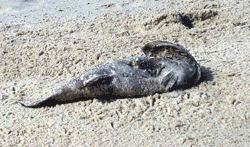
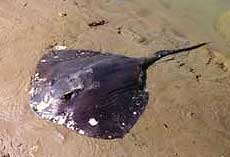
Now, they told me, many of the species have disappeared, the large fresh water rays for instance. Next to go they nodded sadly will be the fresh water dolphins, only 7 of which remain in the pools that straddle the Cambodian Lao border.
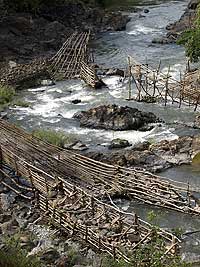
Two major channels allow fish to migrate through the steep rapids and falls. The Lao call these hoos. Hoo Sahong and Hoo Sadam are littered with fish traps known as li , owned by the 200 plus families who fish there. Damming Hoo Sahong, the larger of the two will effectively devastate fish migration and consequently threatens the fishing industry of the riparian nations of the lower Mekong: Thailand, Vietnam, Cambodia and of course Lao.
Dam mad
To be fair, Malaysian companies are also involved in ‘good’ projects such as one in Bokeo that traps water in a steep narrow and largely unoccupied valley. No farm land will be lost.
But Lao’s mad rush to dams as a source of investment revenue is undermined by several factors. The returns are grossly undervalued. The Thai offer to buy the electricity at 5 cents per kilowatt, while global oil prices are skyrocketing, is laughable.
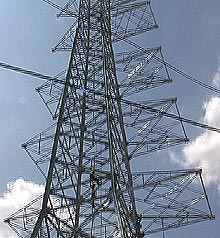 Lao negotiators have so far been unable to put a stronger case. It hardly seems worth the pain and misery for such a low return. Should Lao people have to suffer so that Thai industry can gain?
The Thai people have ferociously protested new dams within their borders, for the same reasons they should be resisted in Laos. But the government of Laos brooks no protest, and the press is not free.
There are questions about safety. The usual contractual agreement is for 30 years, after which the national government takes over. The Lao government is not known for either its, procedural transparency or responsiveness to public pressure, other than to jail those responsible.
The recent China experience indicates that seismic activity can place great engineering strains on dam walls, as well as dams being implicated in actually causing deadly quakes.
Lao has no detailed seismic maps. Risk can only be extrapolated from neighbouring country data. In a nation that publicly places it’s faith in being “the battery of Asia” this is inexcusable.
Hydro is not as clean and green as its exponents proclaim. Methane emissions are much higher than originally thought. Twice or three times higher in actual fact. And there is all that habitat loss and biomass destruction that goes with submersion.
It cannot be clean and green if it leads to species extinction.
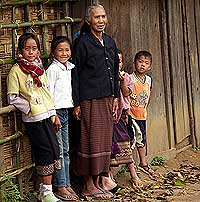 In a nation with so little arable land free from Unexploded Ordnance (UXO), flooding most of the fertile valleys where farmers have made a good and self sufficient life seems suicidal, particularly at a time when food security is increasingly uncertain.
The companies have to seek funding from banks as these projects cost millions to build. Recently it was suggested that the ANZ bank was funding a dam in the central Lao Hinboun area, that reports said might cause great hardship.
Banks like the ANZ, ABN Amro, Citibank, HSBC and Chinese banks are all signatory to the Equator Principle, a voluntary code which requires banks to consider social and environmental consequences of major capital loans.
It is hoped that banks approached to fund any of these projects will consider the implications before going ahead.
BEAUMONT SMITH is a freelance journalist.


Are you sure you want to delete this comment?
This action cannot be undone.