




Who is a Singaporean?
On the evening of Aug 17 2008, Singaporeans were faced with a dilemma: do we cheer for the table-tennis girls that are standing on podium at the Beijing Olympics?
On the one hand, this was the first Olympics medal that Singapore has won for the last 48 years. On the other hand, many were still skeptical whether these athletes – donning Singapore colours – were actually Singaporean at all: after all, they were born in China and had been acquired by the Foreign Talent Scheme to boost our sporting success.
On the evening of Aug 17 2008, Singaporeans were faced with a dilemma: do we cheer for the table-tennis girls that are standing on podium at the Beijing Olympics?
 On the one hand, this was the first Olympics medal that Singapore has won for the last 48 years. On the other hand, many were still skeptical whether these athletes – donning Singapore colours – were actually Singaporean at all: after all, they were born in China and had been acquired by the Foreign Talent Scheme to boost our sporting success.
The overall reaction was rather predictable: “of course we are glad that Singapore won a medal, but only if the girls were actual Singaporeans.” And in this you see the typical liberal reaction of "yes all is good, but if only it was better." The question that we have to ask of course it, “what is this better that we are thinking of?”
Clearly the discomfort that arises is a question of nationality, or more precisely, the issue of ‘what constitutes a Singaporean’, and by extension what makes us who we are. And as if by a gut-reaction we reach for the time-tested notion of Singaporean-ness being defined by whether someone was born within the geographical boundaries of the country.
Home, apparently
This of course leads us to the very source of the discomfort: this is a nation of immigrants, and besides the few Malays that were on the island, everyone else here is a foreign import. In this manner, the Chinese girls standing on the podium only reminds us that the term ‘Singaporean’ is an empty signifier: it can define both anyone and no one at the same time. Having obviously foreign-born athletes wearing the nation’s colours displays all too clearly that we are all immigrants: by extension not only do we only belong here as much as they do, but that somewhere, there is someone that begrudges us being here.
 However this leads us to another question: if all of us are foreign imports, then why begrudge another their moment in the sun? Even more bizarrely, no one seems to begrudge the fact that Tan Howe Liang – Singapore’s only other medalist, having won a silver in the Rome Olympics of 1960 – was born in China as well.
The difference lies in the fact that Howe Liang was never considered a ‘foreign talent’ as opposed to the girls in question. This is not mere semantics for it exposes the perverse core of nationality: only Singaporeans that are ‘talents’ – that is those who are productive and can generate surplus value – are important.
 It is wholly appropriate that on the day that Li Jiawei, Feng Tianwei and Wang Yuegu were battling for their status as ‘talents’, Prime Minister Lee Hsien Loong was offering Singaporeans another way of being productive at the National Day Rally with his message of ‘marry early and have more children’. This translates to, “it’s perfectly alright if you cannot be talents, at least do the least you can and furnish the nation with some people.” The brutal translation would have been: “as long as you conform to some form of surplus value, you’ll make the grade to be Singaporean.”
Pink Island
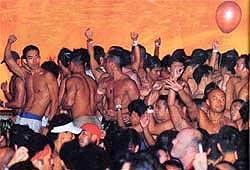
This logic has long been hinted at by the state’s policy towards homosexuality. Officially it is outlawed: but at the same time everyone knows that Singapore is the gay-hub of Asia. The reason is rather clear – it is due to the pink dollar that is generated. Whoever said that in terms of human relations, the only surplus value that could be generated was via reproduction?
 But even though the daily reality shows that there is no impingement over one’s sexual preferences, the gay-rights movement continues to decry the fact they are discriminated against in the penal code. This is where they have continued to miss the point: the system is completely uninterested in who you sleep with and even less so with human rights (Kafka has taught us that a long time ago); it is only interested in its own logic.
So the only hope the gay-rights activists have of changing the law is by showing that it has an effect on productivity. It is of no coincidence that the official relaxation of the attitude towards homosexuality coincided with the concern of the international community over whether expatriates in Singapore who engage in homosexual relations would be persecuted: a draconian stance would have clearly affected the ‘brain flow’ into the state.
This brings us back to the dilemma that Singaporeans faced. If we had cheered whole-heartedly for the girls, we would also have to acknowledge the system in which we live: more importantly the illusion that we are a
 ll valued-citizens and unique individuals would forever be quashed. If we failed to cheer for them, this would only make us seem like begrudging individuals: in this case, the illusion that we actually care for our fellow man, and are happy with the achievements of others, would be shattered. In ether case our realities would be disturbed as the illusions that allow us to carry on our daily lives – that allow us to think ourselves as decent, uncalculating beings – is ruptured.
And it is not that we never knew the reality: the state has mentioned over and over again that in Singapore, people are our only resource. On Aug 8, as the girls stood on the podium, we were forced to face this reality, a little too closely …
JEREMY FERNANDO is a Teaching Fellow in the English Division of the School of Humanities and Social Sciences, Nanyang Technological University. He is also the author of Reflections on (T)error.


