




A tale of three Malays
When Abdullah Ahmad Badawi first became prime minister, I remember him saying that the Malays must develop and advance their mindsets to the extent that they can cast away their crutches; that they must have mertabat (dignity and honour) and that they must join the rest of the world socially, economically and intellectually.
He wished for the Malay community to be equipped with the ability to think, to deal with things and solve problems on their own, with no assistance from the government. He wished for a community oozing with self-confidence when facing the challenges of human survival.
When Abdullah Ahmad Badawi first became prime minister, I remember him saying that the Malays must develop and advance their mindsets to the extent that they can cast away their crutches; that they must have mertabat (dignity and honour) and that they must join the rest of the world socially, economically and intellectually.
He wished for the Malay community to be equipped with the ability to think, to deal with things and solve problems on their own, with no assistance from the government. He wished for a community oozing with self-confidence when facing the challenges of human survival.
Now that Abdullah is in the twilight of his premiership, it’s worthwhile to see if his wishes have come to anything at all.
For this, let’s take the example of three individuals: Zaid Ibrahim, Dr Mohd Asri Zainul Abidin and Ramlang Porigi. In all intents and purposes they are ‘Malays’.
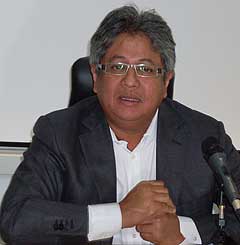 Zaid Ibrahim (
left
) has a chequered
curriculum vitae
. He rose from humble beginnings to found the largest legal firm in the country, and is reputedly one of the most influential philanthropists in Asia.
Zaid Ibrahim (
left
) has a chequered
curriculum vitae
. He rose from humble beginnings to found the largest legal firm in the country, and is reputedly one of the most influential philanthropists in Asia.
He has actively dabbled in politics and addresses issues according to his principles and conscience.
He became the de facto law minister and in this capacity, tried to restore public confidence in the tarnished judiciary. Specifically, he tried to abolish the Internal Security Act (ISA). By all counts he is a perfect example and role model of a ‘towering Malay’.
Asri Zainul Abidin came into prominence when at the age of 32, he became the youngest mufti in the country. He too addressed issues according to his principles and conscience.
For example, he advocated that ulamas should not go snooping about, trying to catch people in compromising situations. I suppose he wanted the dubious moral police to be involved in more substantive and praiseworthy activities in the name of religion than delving in such pointless and pedestrian trivialities.
Ramlang Porigi hails from Sabah, so technically in this race-conscious country he is not ‘Malay’ but perhaps a Muslim ‘native’ although for the purpose of this tale he is assumed as one.
He was an imam , that is to say, an official of a mosque or a religious department. He came to prominence when he witnessed Saiful Bukhari Azlan swearing on the Quran that former deputy prime minister Anwar Ibrahim had sodomised him.
The fact of the matter has been that Ramlang was aware all along that the event was staged. The Permatang Pauh by-election was imminent and Anwar was leading in the opinion polls. Barisan Nasional wanted Anwar to lose, or should he win at all, by a smaller majority. What better way to demonise him than by character assassination?
All this playing around with religion and blatant creation of lies in the name of religion gave Ramlang a serious bout of guilt.
'Mental pioneers'
These three cases have one thing in common beyond the fact that the players are Malays. It is that they have rational thinking capabilities.
They see truth in their own independent ways and have their own reasoned interpretations of ideas, things and events. More importantly, they make decisions based on their own individual and best professional judgment, the sort of capability Abdullah wanted to see among the Malays.
They are examples of the towering Malays the premier must have had in mind all along. Yet these three mental pioneers are facing difficulties in their efforts to champion the truth. The reforms suggested by Zaid have been cast aside by the authorities. Being true to his profession and conscience, he resigned.
Zaid was even issued a show-cause letter for behaving the way he did while receiving mocking remarks from people like Syed Hamid Albar who said Zaid should feel lucky to be born a Malay.
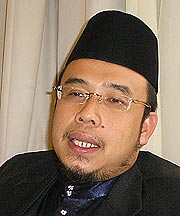 Asri (
right
) resigned from his job and has pledged not to seek reinstatement even when the Raja of Perlis requested him to stay on as
mufti
. He has refused to play ball, choosing instead to remain true to his profession, belief and conscience.
Asri (
right
) resigned from his job and has pledged not to seek reinstatement even when the Raja of Perlis requested him to stay on as
mufti
. He has refused to play ball, choosing instead to remain true to his profession, belief and conscience.
As for Ramlang, he related to the voting public what he knew. They believed him, and voted massively for Anwar, who handsomely won the election. After this sobering revelation, it was reported that Ramlang was under pressure to resign from his job. When he refused, he was transferred from one place to another. It would appear that his career path has been ruined.
Why are these three people facing problems when they demonstrated independent thinking? Is this not the capability the Malays have been called upon to develop? What is Abdullah doing about it? Posing questions is actually the easier part of this writing. Suggesting a meaningful answer is not so easy.
It is not that the issue is so complicated or complex, as to defy human reason. Mankind has seen this sort of problem many times before and has come up with solutions. Any well-meaning person with an open mind (one free of prejudice and is ready and prepared to discuss issues without fear or favour) can come up with an understanding of the issues.
My explanation is as follows.
Truth is right, truth is might
The three individuals above were thinking along the lines that truth is might, truth is right and what is true is invariably right. To illustrate this fact, Zaid believes that the ISA is a draconian law, it is the truth that the people want it abolished and it is the truth that the authorities are ignoring or suppressing the people’s sentiments.
The authorities however, are working on the premise that might is right. They do not deal with the truth. To them, truth can be one thing, but how they want the people to perceive it is another matter altogether.
They reserve the right, so to say, of doctoring truth and then forcing the people to accept this doctored truth. So to them the ISA is still needed and not to be abolished for it is a useful tool for ‘protecting national security’, among other things.
How do they do this? This is a contentious issue and again I’d like to make it simple: by way of constant repetition, indoctrination, intimidation and fear.
Why are they doing this to their own people? This is yet another contentious issue and I shall be brief with my hypothesis: it is because they have tasted power, and basking in its worse version – absolute power.
Power corrupts and absolute power corrupts absolutely, says Lord Acton. And this is another truth the authorities are not willing to admit, why should they, when they are enjoying all of the advantages and benefits that absolute power in the status quo brings?
Won’t Abdullah do something about it? After all he was returned to office on the platform of getting rid of corruption. This is yet another contentious issue he keeps saying he will address before he retires in March.
But time is running out and soon this magical month of March will literally march in. Will he have time to do whatever he wants to do before disappearing into the political twilight zone?
 My hunch says no, he will not be doing anything. For him, it makes sense for people like Zaid, Asri and Ramlang (
left
) to be silenced and suppressed. Make life difficult for them so that the mental freedom they have demonstrated will not develop a critical mass.
My hunch says no, he will not be doing anything. For him, it makes sense for people like Zaid, Asri and Ramlang (
left
) to be silenced and suppressed. Make life difficult for them so that the mental freedom they have demonstrated will not develop a critical mass.
And so, in the kingdom of the blind, the one eyed man rules supreme. In other words, our leaders are treating us like blind people with them being the one-eyed men.
Little do they know that time and time again in human history, truth is right, truth is might and truth will in the end, prevail. The leaders may be one-eyed, but the three individuals are not at all blind. Instead, the three have what the leaders do not have – each of them has two perfectly working eyes.
AB SULAIMAN is a retiree but is finding little cheer in the social upheavals gripping the country. He hopes to provide some understanding to the issues at hand and wherever possible, suggest some solutions.


Are you sure you want to delete this comment?
This action cannot be undone.