




Origins of the 'Malays' - Final Conclusion (Pt 1)
Let us begin this with a simple analogy. We start with one cup of pure black coffee. And we have a cup of pure white milk. Add the two of equal amounts, and we have a nice brown concoction.
Let us begin this with a simple analogy. We start with one cup of pure black coffee. And we have a cup of pure white milk. Add the two of equal amounts, and we have a nice brown concoction.
If we continue to add milk, this coffee will turn lighter and lighter. However, if we continue to add coffee, this cup will become darker and darker.
But regardless of how much milk we keep adding, this cup will always smell of coffee. And even with a thousand cups of milk added, we will always continue to detect a whiff of the wonderful aroma of this coffee.
 So too with people. Let's take a negroid, and a caucasoid. Let's assume these two individuals mate. You will end up with someone who looks pretty much like Mariah Carey. Now, the look of her offspring would be determined by whom she mates with. And so too, will her offsprings’ offspring, and so on.
If Mariah Carey's future descendants skew towards marrying caucasoids, then they will continue to look fairer and fairer, while if they skew towards marrying negroids, then they will begin to look darker and darker.
But no matter how many generations down, we will always be able to trace their ancestral genetic makeup back to Mariah Carey. This would be known as the mitochondrial genetic trail. It is conclusive. It is wonderful. Just like the graceful hint of the aromatic coffee.
Hold those happy thoughts of Mariah and step back into history. Actually, pre-history. In fact, let's take a huge step, all the way back in time, until the days of Pangaea. This is the time of the dinosaurs.
There was no mankind. No homo sapien-sapien. No homo sapiens, No homo hablis, No homo neanderthalis, and not even the homo erectus. The entire homo family tree simply did not exist. Yet. This is 65 million years into the past. Way before even whales existed.
When dinosaurs roam the earth
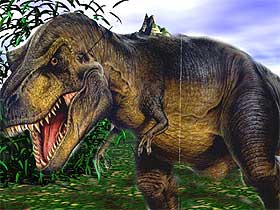 Africa and America were joined together, and dinosaurs roamed the earth. As the world started to split up, these dinosaurs were left stranded on tiny bits of floating land continents. One of the ways, to know if the land was fertile or otherwise, would be to see if there were dinosaur fossils in the area.
Remember that the earth was still pretty unstable, and entire dinosaur clans were wiped out by often violent volcanic eruptions. Some of these dinosaurs roamed in Asia.. Their fossils are still actively excavated in China, Korea and Thailand. This simply tells us that Asia was already fertile land from 65 million years ago.
Ice ages came, and ice ages went. Global warming came, and global warming went. Pleistocene, holocene, paleolithic, neolithic. Yes, we all watched Jurrasic Park. Fast forward till the homo erectus. The date? 120,000 years ago. The location? Laetoli, East Africa. Here, descendants of Lucy, and the Taung Girl, left distinct footprints in rock.
The Africa of today looks different from the Africa of before. It had scores of volcanoes, and spewed hot gases and ash into the air. This ash landed on the ground and man stepped on it. The high calcium carbonate content of this ash quickly hardened, thus preserving those footprints in rock, forever.
We also find such footprints in rock at Lake Mungo, West Australia. But these footprints would be of a different time period. They are from 50,000 years ago. So, sometime, between 120,000 years and 50,000 years ago, the Australo Melanesians (Africans) walked out of East Africa, through the Middle East, India, Bangladesh, Burma, Thailand, Malaysia, Indonesia, and into Australia.
Today, these Africans are known as the aboriginals in Australia. Their close cousins would be the Papuans, Fijians and the Negritos of Malaysia. Were there any other people living in the area at that time? Probably not. Not of the Homo Sapien-Sapien stock anyway.
We do know that these Australo Melanesians (orang asli’s) made their way into the Malayan peninsula circa 60,000 years ago. Proof of which is in Niah Caves. That skull of an Australo Melanesian woman is 40,000 years old.
No South China Sea then
And how did they “swim” across the South China Sea from the Malayan peninsula? They didn't. Because there was no sea back then. At 60,000 years ago, there was no South China Sea. It was simply just one huge land mass called the Sunda Lands.
You could in fact walk from Hanoi till Kuching over land. And it would have been very easy walking too. Because this land would have been pure savannah grassland. So you see, these “Africans” never realised that they left Africa. The entire Asia, had a climate, flora, and fauna exactly identical to their motherland. Volcanoes and all too.
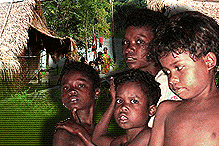 These orang asli’s then lived quietly, and alone, in Malaysia, and the rest of Southeast Asia, for at least 54,000 years. Slowly, they migrated their way into Borneo, Australia, Papua, New Zealand, and the entire Oceanic regions, right through Tahiti, Hawaii, and eastward all the way until Easter Island. They might even have reached America and became “re-labeled” as the Olmecs of the south.
The trip from Indonesia till Australia would also have been relatively easy, as they only had to raft from Bali, till Lombok. You see, Lombok used to be joined with Australia, on another tectonic plate called the Sahul Lands.
The pointed eastern tip of Bali (just across from Java) is still full of such archaeological evidence of this early migrational Australo Melanesians (orang asli/aboriginals) from the period. Yes. The Negrito in Malaysia are the ancestors of all of the Oceanic tribes (known as the Polynesian or Oceanic Islands today).
About 60,000 years ago, the first waves of the Dravidic race of India started moving eastward. Along the southern ridge of the Himalayas today, through the northern belt of Burma, into the golden triangle, into Thailand, past Laos, Hanoi, and skirted around the northern Hainanese peninsula, and managed to reach as far as the Amoy coast in China, across the channel from Formosa, today known as Taiwan. There is no further archaeological evidence of them moving further north.
This is the parallel journey also made by their African cousins, who made the journey from Africa on the other side of the Himalayas, on the northern ridge, via the Khyber Pass. These Africans settled in a place today known as southern Mongolia.
Skin whitens due to lack of sunshine
Over the next 60,000 years, they would lose their epidural melanin content and their skin would start to pale. Probably due to the frigid cold weather and lack of tropical sunshine. Today, they are called the Mongoloids.
As the Dravidic Indians walked towards Taiwan, only three races existed on the globe. The Negroids, the Mongoloids, and the Dravidics. The Caucasoids would not surface for another 30,000 years, originating from Uzbekistan.
By the time the Dravidics reached the Amoy coast, they would have met with the Mongoloids, who were already well-camped there. These Mongoloids would have migrated first eastward, from Mongolia, and then southward from Beijing eventually till Hainan and into the Indochine regions.
Some other Mongoloids however, would have made bee-lines from Mongolia directly towards the Himalayan mountains and the China coastal regions, and a little beyond.
The time is now 4,000 BC. As history shows time and again, the exchange of daughters, and sons, avoided the exchange of blows, fists, stones and wars. On the coast of Amoy in China, we would have witnessed many cross-breeding of the Dravidics and the Mongoloids.
The simple example we still see today, of this Dravidic-Mongoloid early inter-breeding would be the Nepalese. Even their music reflects this. They continue to use the Chinese “Pei Pa” stringed instrument, and the Indian tabla drums to create the hypnotic Nepalese music. All Nepalese look part Dravidic, and part Mongoloid.
Abour 35,000 years ago, the Caucasoids would have moved into Europe from Uzbekistan, the Neanderthals would have either died out, or became fully integrated with the Caucasoids, and migrated into the Nordic regions 30,000 years before the first Austronesian was born on the Amoy Coast.
And 15,000 years ago, the Ainu of Japan would have traversed the Bering Straits, become the Eskimos, and moved southward to become the Red Indians, Mayans, Aztecs, Incas, Peruvians and Bolivians. The entire world was now populated.
The Aryans invaded India
Six thousand years ago, this new Austronesian race, as a result of the successful Dravidic-Mongoloid cross-breeding in southern China, started migrating towards Taiwan. Today, the leftover tribe of this earliest migration is known as the Alisan.
From Taiwan, they crossed the sea into the Philippines. They then split into two groups. One moving into the Celebes Islands (Sulawesi), and the other into Borneo. While this was happening, the Austronesians who were left behind on the Amoy Coast decided to start migrating again.
But this time, south-westward. These brown skinned Austronesians walked right past Hanoi, and settled on the entire central Vietnamese coast. Proof of this lies in the archaeological sites of Hoa Binhian, Sah Hyun, and Dong Song. The artefacts will include uni-facial and bi-facial stone tools, curved axes, pottery, and the detail-etched copper drums of the Dong Song.
These Austronesians would be known today as the Cham people, of the Champa Kingdom. At this same moment, their Austronesian cousins (who travelled from Taiwan, to the Philippines, via the Celebes, into Java, Sumatera,) would have arrived on the Malayan peninsula on the very same day.
Before the sun set, the Aryans would have invaded India, from Mohenjo Dara and Harrapa, bringing along with them the Sanskrit language.
And who exactly are the Aryans? They would have been of the Caucasoid stock, who migrated from the Middle East circa 6,000 BC.
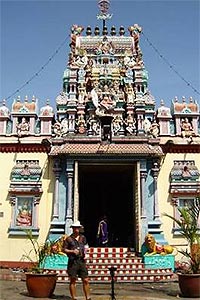 Around that same time, Hinduism was born. Hinduism slightly predates the Egyptian civilisation. The Hindu caste system prevented the Aryan-Dravidic inter-breeding on a large scale.
Back to the Malayan peninsula. When these Austronesians first arrived from Sumatera on boats and rafts circa 1,000 BC, they were greeted by the Australo Melanesians (read Africans or orang asli) who were already living on this Malayan peninsula for the past 54,000 years.
These orang asli's lived to see the savannah-like Malayan peninsular change into the lush tropical forest we see today, but not before having survived an Ice Age 10,000 years ago.
The Perak Man would have been of that time period. Being of smaller stature, these Negritos (“mini Negros” in Spanish) were easily forcefully driven, by the relatively larger Austronesians into the forests, where they remain living till this very day.
MICHAEL CHICK is pursuing his Masters in history at the National University of Singapore.


