




Origins of the 'Malays' - Final Conclusion (Pt 3)
Ironically, it was not the Arabs or Persians who brought Islam into the region. In the second century, all Arabs would have either been Christian, Judaic, Animistic Pagans or Hindu. Prophet Muhammad was only born 500 years later. And Mohenjo Daro and Harrapa were just next door.
Ironically, it was not the Arabs or Persians who brought Islam into the region. In the second century, all Arabs would have either been Christian, Judaic, Animistic Pagans or Hindu. Prophet Muhammad was only born 500 years later. And Mohenjo Daro and Harrapa were just next door.
However, it was the Gujerati traders (India) who brought Islam to southeast Asia. The very same people who brought Hinduism to Malaya at the location called Lembah Bujang in the second century.
From then, it was the local Austronesians who brought Hinduism to the Cham kingdom in the fourth century, then into Java, in the sixth century, and later to Angkor in the eight. Hinduism stayed in southeast Asia for a full 15 centuries, and is known as the Golden Hindu Era.
Prior to Hinduism, all of southeast Asia was either Animistic or Pagan. The Austronesians worshiped the sun, moon, stars, rocks, trees, seas and so on.
The southeast Asians are also known to be pragmatic. They are known to combine religions. In Vietnam, you have CaoDai-ism, which is a combination of Buddhism, Taoism, Confusianism, Catholism, and Islam.
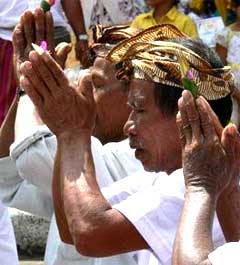 The Balinese practice a mix of Animism and Hinduism. Most Javanese practice Kejawen, which is a mix of Animism and Islam, while the Cham practice what is known as Cham Bani, which is a combination of Hinduism and Islam.
I guess, when in doubt, these Austronesians decided to choose a cocktail of religions, just to be on the ‘safe side’. This is parallel to the Sai Baba concept, whereby "all religions lead to the same righteous path".
As mentioned earlier, Islam was first brought to Asia at Pasai (Banda Acheh region), by the Gujeratis. Most famous religious schools were centered in Pasai, and the religion spread throughout the Nusantara.
For Malaysia, it was Parameswara's son who first converted to Islam, but only because he wanted to marry this Pasai lady, who was then a Muslim. He allegedly said, "What is this strange new religion?"
He then became a Muslim, and married his Pasai wife. Were there three more wives after her? Or was she the second wife? Due to inaccurate local records, perhaps we will never know.
However, we do know that Pasai was the epicentre for the spread of Islam in southeast Asia, and with the arrival of this new religion, came the Arab traders. The Arabs had cargo that was deemed exotic to the east, and vice-versa.
Exotic mix of spices, people
With the arrival of foreigners came inter-breeding again. In fact Aceh, is actually an acronym for Arab, Cina, Eropah, and Hindia (in the local Indonesian language). A visit to Aceh will attest to the enticing Persian eyes which trail your every move amidst the scents of foreign spices and jingle-jangle of an exotic atmosphere.
When the colonial masters showed up at their doorstep, this feverish pitch was brought to even greater heights. But always to the financial advantage of the bigger, stronger, and well-armed Dutch East India Company.
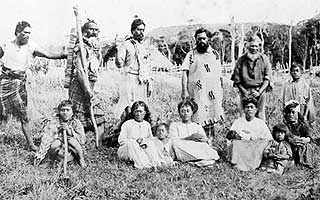 These colonial masters went deep into Autronesian territory. From the spice islands of Molukas, to the swanky ports of Hoi An in Vietnam, and eventually, up into China.
Malacca would have been a side-show in comparison with these huge ports of Pasai, Batavia, Bancoolen, Phan Tiet, Hoi An, and even Macau. Each of the river mouths at these ports can fit at least 15 small barges, while the Malacca river can barely fit 3 side by side (at the Jongker Street bridge).
Even the Singapore River can fit at least 8 where the Cavanaugh Bridge stands today. Huge modern day container vessels can also go directly up-river in Qui Nhon in Vietnam and berth, without the use of any barges at all, and was once the bastion of the Champa kingdom.
Genetically speaking, the Austronesians would have been a ‘superior race’, as they were a mix of Dravidic, Mongoloid, African, Arab, Persian, Hindi, Gujerati, Tamil, Portuguese, Dutch and other blood.
However, incest brought degenerate descendants. And the more varied the bloodline, the healthier the offspring. Perhaps this is what ‘ Ketuanan Melayu ’ is all about. This is the only superiority one can think of.
Genetic superiority because of having bloodlines from around the globe. This by the way, is reflected in Bahasa Malaysia and Bahasa Indonesia. Circa 15 percent of these languages is Portuguese, Dutch, and the rest, Sanskrit, Tamil, Arab, Persian, Hindi, Tamil, Chinese, and so on.
All these word origins are explicitly described and detailed in the third edition of the Dewan Bahasa dan Pustaka dictionary. These references were completely removed from the fourth edition onwards.
The conclusion? The people Malaysians call ‘Malay’, are actually only a tiny sub-component of the much larger Austronesian group. And all Austronesians are the end-product of extensive inter-breeding between the Taiwanese and Dravidic Indians.
All this has finally been irrefutably proven by independent DNA testings from world-class faculties.
My tour of southeast Asia has been extremely enlightening. Every day was a new and fresh learning experience. Every moment, an illuminating and exhilarating one.
It is hoped that by detailing who the Austronesian race really are, the rest of the world will no longer view them as outsiders, strangers, or barbaric savages. Every race in the world has direct or indirect blood-lines with the Austronesians. And that the entire world is much more integrated than people think.
MICHAEL CHICK is pursuing his Masters in history at the National University of Singapore.
Origins of the 'Malays' - Final Conclusion (Pt 1)
Origins of the 'Malays' - Final Conclusion (Pt 2)


