Exchange rates often make headlines when the ringgit rises or falls sharply. In 2025, the ringgit emerged as Asia's best-performing currency by strengthening nearly 9 percent against the US dollar to close out the year around 4.07.
The momentum continued into February 2026, when the currency strengthened past the psychologically significant RM4 threshold against the US dollar, appreciating to approximately RM3.97—its strongest level in seven years.
This positioned the ringgit as Asia’s top-performing currency, surpassing major peers such as the Japanese yen and the Singapore dollar. However, by mid-2026, the ringgit came under renewed pressure, weakening back above RM4.10 as markets reacted to a more hawkish US Federal Reserve and shifting regional risk sentiment.
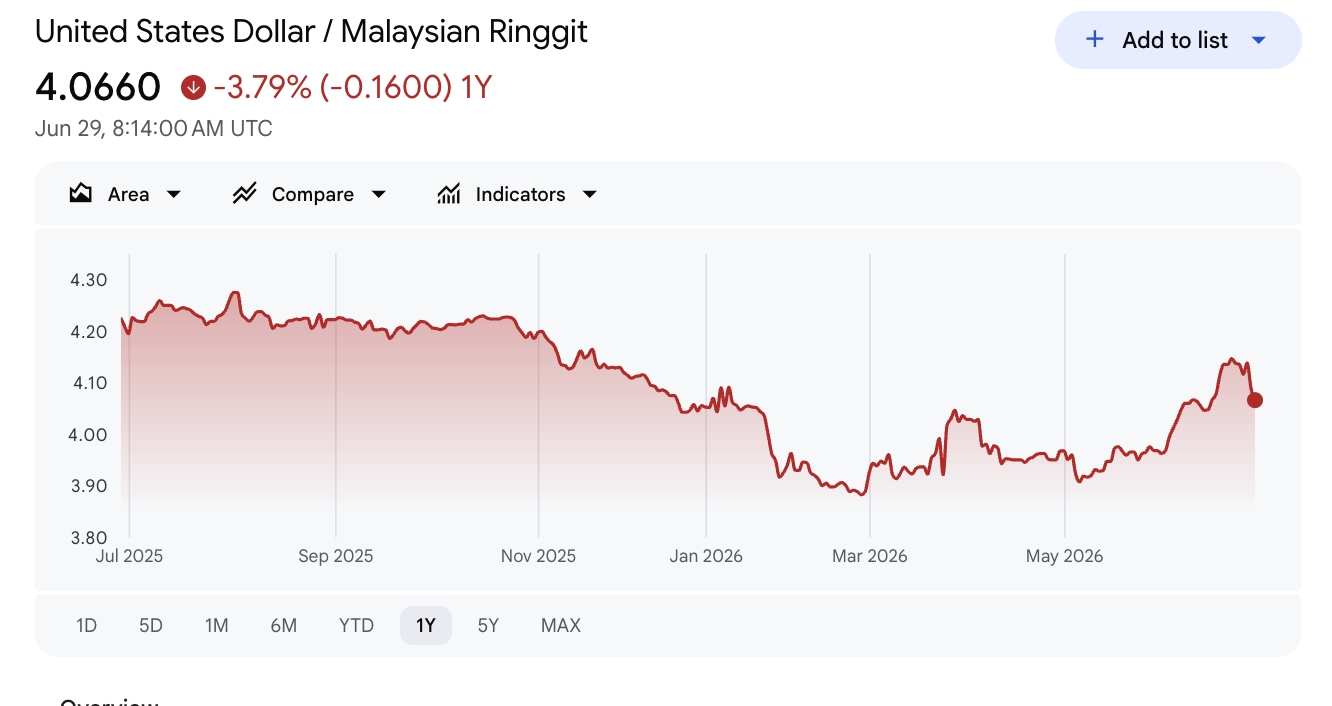
While the ringgit remains fundamentally resilient and aligned with regional peers over the longer term, these sudden swings serve as a stark reminder of currency volatility. It begs the critical question: should we really be jumping over these ringgit movements?

According to Doris Liew, economist at IDEAS Malaysia, the ringgit's appreciation since July 2024 signals improving external confidence in Malaysia’s macroeconomic position. For ordinary folk, the most immediate effect is through prices. A stronger ringgit makes imports cheaper, helping to cushion importers' price pressures.
It can reduce the pass-through from global commodity volatility and ease pressure on businesses that rely on imported materials. For households, this may not always translate into dramatic price drops, but it can slow the pace of cost increases and support purchasing power stability.
What is driving ringgit’s movements today?
Like most currencies, the ringgit is shaped by a mix of short-term market dynamics and long-term economic fundamentals. Because its value is market-determined, daily fluctuations simply reflect the shifting demand and supply conditions within global financial markets.
External factors also play a significant role. For instance, the ringgit’s appreciation last year was largely impacted by anticipated US Federal Reserve rate cuts, which reduced the attractiveness of US dollar assets and encouraged capital flows into emerging markets.
This year, however, heightened geopolitical uncertainties such as the Middle East tensions, paired with a more cautious Fed stance, with rates staying higher for longer and possible tightening and hiking expectations, have kept markets watchful. As a result, the ringgit has fluctuated amid shifting global risk sentiment. While geopolitical uncertainties have partially eased following an interim peace deal signed by the US and Iran, global financial markets remained focused on prospects of higher policy rates in the US amid elevated inflation risks.
Domestic factors are equally important. Improved political stability and clearer economic policy direction have strengthened investor confidence. Healthier fiscal positioning and more stable macroeconomic conditions reinforce Malaysia’s appeal as an investment destination.
At the same time, optimism surrounding Malaysia’s role in the global technology and artificial intelligence supply chain, alongside resilient domestic demand, is supporting growth expectations. These underlying fundamentals help anchor the ringgit’s longer-term trajectory, even as short-term volatility persists.
Malaysia’s own economic strength helps cushion these movements. The country continues to record steady growth, supported by exports, domestic spending and ongoing investment. The banking system remains robust and well-regulated.
Reforms such as targeted subsidy adjustments under BUDI, the National Energy Transition Roadmap (NETR), and improvements in trade infrastructure signal a focus on long-term competitiveness.
Overall, external developments and domestic factors are expected to continue driving the ringgit's performance, but Malaysia’s solid fundamentals will help to provide enduring support to the ringgit.
How will ringgit perform going forward?
Exports remain a foundational pillar in supporting the ringgit, while the country’s diversified export base, ranging from electrical and electronics (E&E) to palm oil and LNG, continues to generate steady external earnings, said Liew.
“Malaysia’s external sector generates sustained foreign currency inflows that underpin the balance of payments. A healthy trade surplus strengthens the current account position and provides structural support to the currency.
“Beyond trade, foreign direct investment and portfolio flows also play a role, especially as global investors reassess emerging markets in light of shifting US interest rate expectations and regional growth prospects.
“The ringgit’s strength is therefore not solely about short-term flows; it reflects stronger export receipts, resilient domestic growth, and a partial recalibration of global capital allocation back toward Asia,” she added.
At the same time, improvements in governance and policy clarity are helping to anchor investor confidence. Measures such as subsidy rationalisation, clearer fiscal direction and efforts to strengthen the tax base signal a more sustainable economic path. For investors, predictability matters and when that improves, so does willingness to commit capital.
That renewed interest is already showing up in investment flows. Foreign direct investment (FDI) has remained healthy, particularly in high-value sectors such as semiconductors and data infrastructure. These inflows don’t just reflect confidence; they also directly support the currency, as foreign funds are converted into ringgit for use within the country.
The ringgit is market-determined
Malaysia operates under a flexible exchange rate regime, where the value of the ringgit is determined by market forces of demand and supply. This allows the currency to adjust to changing economic conditions and external developments, helping the economy absorb shocks while reflecting underlying fundamentals.
Bank Negara Malaysia’s role in the foreign exchange market is to maintain stability. It does not set a fixed value for the ringgit. The central bank has several tools at its disposal: it can intervene in the foreign exchange market to smooth excessive volatility, and conduct money market operations to neutralise liquidity impacts.
Importantly, many market disruptions are temporary. Events such as policy announcements or remarks by key figures can trigger sharp movements, but these are often driven by short-term investors seeking to capitalise on price changes.
Market prices tend to stabilise once the uncertainty subsides and policies announced become clearer. In such situations, a measured approach rather than aggressive intervention is often more effective.
The ringgit’s strength ultimately depends on Malaysia’s fundamentals: a diversified economy, sound fiscal management, ongoing reforms, and the country’s ability to stay competitive and attract investment.
The strengthening ringgit reflects a broader recovery in confidence in Malaysia's economic direction. While currency movements may fluctuate in response to global developments, stronger trade performance, policy clarity, and renewed investor interest support a more stable outlook over the longer term.