




Tmn Negara threatened by new road
The upgrading of Federal Route 8 from Kg Relong, Pahang to Gua Musang, Kelantan which includes realignment of the existing road at certain stretches, threatens the critical ecological link between Taman Negara National Park and the Main Range.
On-the-ground investigations reveal that parts of forests have been cleared for Phase 1-Segment 5 of the upgrading project. Information on how many more phases or segments there are in this project remains sketchy.
We are greatly concerned that the upgrading and realignment of the existing road may not only impede wildlife movement between the Main Range and Taman Negara, but also accelerate forest conversion and fragmentation in surrounding areas.
This in turn will disrupt ecological functions and lead to the loss of biodiversity. We propose that this project be extensively reviewed and urge JKR to reconsider if the road realignment is necessary.
WWF-Malaysia also calls for the Public Works Department (JKR) to share information on the technical aspects of the project with key government agencies and NGOs as they may be able to provide useful recommendations on how to minimise the environmental impacts of the project.
Should the realignment in certain stretches of the Kg. Relong - Gua Musang road be absolutely necessary, measures such as elevated roads and tunnels as well as wildlife crossings to maintain forest connectivity should be incorporated at the design stage of the project.
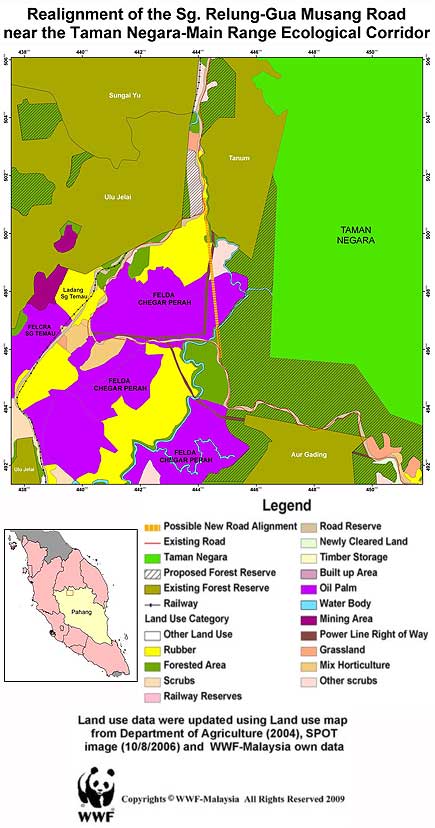 WWF-Malaysia strongly feels that wildlife crossings should be constructed at crucial areas even on the existing road. Sufficient funds for these measures should also be allocated in the project cost from the very initial stages.
Parts of the surrounding forests along the road are also vulnerable to conversion to other land uses as they are currently state land forest with no protection status.
It is also feared that the upgrading and realignment of the road and the resulting land development would allow for easier access by trespassers and poachers into Taman Negara, as the closest distance between the new realigned road and Taman Negara is less than two kilometers.
The Taman Negara is already facing threats from poaching, with the park management authority, the Department of Wildlife and National Parks (DWNP), recently revealing that nearly 500 snares were recovered and destroyed in a single operation in November last year.
In line with the National Physical Plan, it is therefore absolutely crucial and urgent that a buffer zone is demarcated for Taman Negara to address a range of mounting concerns such as forest conversion and potential poaching pressures. No development activities should take place in this buffer zone.
We strongly urge the Pahang state government to gazette the remaining state land forest in the area as Permanent Reserved Forest under the National Forestry Act 1984, to reduce the risk of forest conversion and maintain the connectivity between the Main Range and Taman Negara.
Taman Negara is the largest national park in Malaysia, covering 4,343 km² of forest in three states: Kelantan, Terengganu and Pahang. Rare and endangered species such as the elusive Sumatran rhinoceros (Dicerorhinus sumatrensis), Malayan tiger (Panthera tigris) and seladang (Bos frontalis) can be found in the primary rainforest within this protected area.
The Federal Department Town and Country Planning Department is currently spearheading a project to identify important forest linkages. This project, which involves various stakeholders, is in line with the National Physical Plan which states that forest connectivity shall be reestablished between major forest complexes. One of the linkages identified is between the Main Range and Taman Negara.
The writer is executive director/CEO of WWF-Malaysia .


