




Transparency needed in announcing tariff review
The Association of Water and Energy Research Malaysia (Awer) is concerned over the non-transparent manner the Energy, Green Technology and Water Ministry and Energy Commission announces the tariff review for January to June 2016. Information is manipulated to portray a different view compared to the actual situation.
The ministry and Energy Commission must not manipulate and misrepresent data in such a manner that erodes public and businesses confidence in our economy.
1. Jan 1, 2014 to Dec 31, 2017 tariff review cost breakdown
First and foremost, let us revisit the tariff setting mechanism that is using the Imbalanced Cost Pass Through (ICPT). Beginning Jan 1, 2014, the new average tariff is set at 38.53 sen/kWh. This average tariff (38.53 sen/kWh) consists of the fuel cost, capacity charges, transmission, distribution and other costs. Fuel cost will be implemented via the ICPT mechanism which will pass the savings or additional fuel cost back to electricity tariff every six months.
The capacity charges, transmission, distribution and other costs are covered via base tariff. Based on the tariff breakdown as shown in Table 1, fuel cost component is 15.68 sen/kWh which will be reviewed every six months to reflect latest fuel costs.
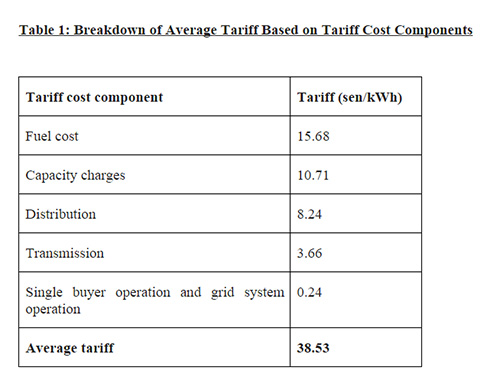 The base tariff that is fixed from Jan 1, 2014 until Dec 31, 2017 is 22.85 sen/kWh. Piped gas was priced at RM 15.20 per mmBTU, Liquefied Natural Gas (LNG) was priced at RM 41.68 per mmBTU and coal was priced at USD 87.50 per tonne.
If fuel cost rises above the values used during tariff setting (piped gas at RM 15.20 per mmBTU, LNG at RM 41.68 per mmBTU and coal at USD 87.50 per tonne effective from Jan 1, 2014) in the current six months, the additional fuel cost will be passed through in the following six months. If the fuel cost reduces in the current six months, the savings from the fuel cost reduction will be rebated in the following six months.
2. ICPT and what actually happened
Since early 2015, the LNG and coal prices started to decline and assisted in generating saving in the fuel cost. These are monies that are paid by domestic and business consumers which will have to be returned back as rebates under ICPT mechanism.
Beginning July 1, 2015, the piped gas price has been increased by RM1.50 per mmBTU. This caused the piped gas to increase from the tariff setting price of RM15.20 per mmBTU to RM16.70 per mmBTU. Every RM1.50 per mmBTU increase in piped gas price will increase the fuel cost by approximately RM280 million.
Yesterday, the minister announced that piped gas price will increase RM1.50 per mmBTU to RM18.20 per mmBTU effective Jan 1, 2016. However, the piped gas price was actually increased by RM3.00 per mmBTU based on the piped gas price RM15.20 per mmBTU that was used during the tariff setting for Jan 1, 2014 until Dec 31, 2017.
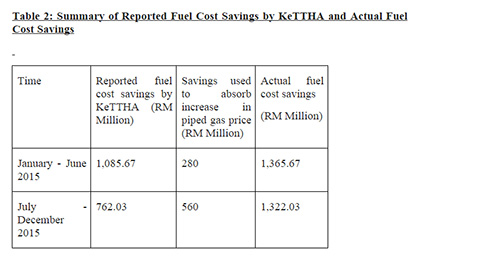
This means approximately RM560 million from the fuel cost savings between July 2015 and December 2015 will be used to cover the cost increase in piped gas price between January 2016 and June 2016. In other words, consumers will have RM560 million less to be rebated between January 2016 and June 2016.
If the government did not increase the piped gas price and has pass through the RM 560 million as tariff rebate, consumers will get additional 1.117 sen/kWh as tariff rebate. This means the actual tariff rebate should be 2.637 sen/kWh and NOT 1.52 sen/kWh as announced by the minister yesterday.
The actual reason for lower rebates to be passed on between January 2016 and June 2016 is due to the increase in piped gas price. Table 2 summarises the reported fuel cost savings by the ministry and the actual fuel cost savings.
3. Government must be transparent in piped gas price
RM31.317 per mmBTU is the current LNG market price. However, piped gas would not incur additional cost like LNG that comprises cost of converting natural gas to liquid, transportation cost from port to port and regasification cost.
It is important for Malaysia to remain competitive in manufacturing and services sector to become a developed nation by 2020. Competitive and transparent pricing of energy resources is vital for Malaysia's growth. Awer urges the government to reveal calculation mechanism that reflects both piped gas and LNG price. Therefore, the government must reveal audited capital expenditure, operational expenditure and profit margin for piped gas pricing.
Costing of the gas grid must also be made transparent so that the cost breakdown is clear. If electricity tariff costing can be broken down to detailed parts, LNG, piped gas and gas grid costing can also be made transparent in a similar manner.
4. Direct negotiation blunder again?
Why are the ministry and Energy Commission carrying out so many direct negotiations for fossil fuel power plants and utility scale solar (USS) power projects? While the federal government promised competitive bidding process in both the 10th and 11th Malaysia Plan, the reality is that many direct negotiations are being carried out through back door. This will definitely give negative impact to future tariff settings as cost are set to increase due to direct negotiation.
Some new power plants awarded via direct negotiation such as Track 4A have delayed and giving path for Power Purchase Agreement of old junks (inefficient gas power plants) to be extended while the levelised tariff for the extension still remains a mystery.
Therefore, Awer urges the federal government to make public and publish all planning forecast and decisions made by Planning and Implementation Committee for Electricity Supply and Tariff (JPPPET). All decisions made by JPPPET will give direct impact to electricity tariff and these decisions must be made public.
The ministry and Energy Commission are making a fool of everyone by still using fast tracking reason for plant up of new power plants to justify direct negotiations. Such idiotic reasoning must be stopped before investors lose confidence in Malaysia's electricity sector and pricing structure.
PIARAPAKARAN S is president, Association of Water and Energy Research Malaysia (Awer).


