


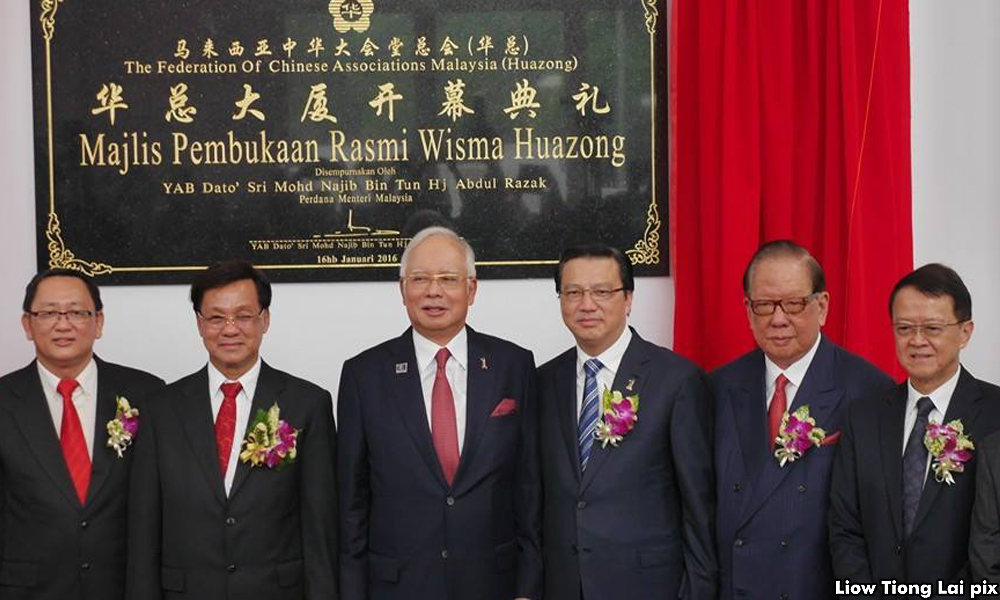

How Hua Zong and gov’t can help realise PM’s proposal
Prime Minister Najib Abdul Razak rightly urged “more Chinese and bumiputras to form business enterprises to take advantage of new opportunities, at the opening of the impressive Wisma Hua Zong, on Jan 16.
He was obviously referring to the vast business potentials in China. We could surely do more to work more closely with China on the new Silk Road and Belt projects. I suppose he would also later address the potential of doing joint businesses in the Indian sub-continent and in the Middle East as well.
And why not? After all our diverse society should be regarded as our strength, and certainly not our weakness. We have a comparative advantage in business and economics with our delightful diversity. Thus our bumi businessmen would also do well in working closely with Muslim countries.
But the prime minister, at Wisma Hua Zong, was focussing on how we could all work together to optimise our combined strengthen in our economic and business ties with China and also other countries.
I think he strongly implied that bumi and Indian companies should not also benefit from trade and investment in China?
As in other countries, by all “working together”. But we need all hands to clap. We need commitment all round.
How can Hua Zong help?
How could the Hua Zong help to achieve the prime minister’s aspiration “to cultivate and promote the spirit of working together across the racial divide in this country”?
Hua Zong could form a working group of all major Malaysian businessmen, to seek ways and means of bringing them together, to establish ‘1Malaysia joint companies’, to do business in China. For a start, Hua Zong could invite the government-linked companies (GLCs ), to “work together” and actively participate in the huge Silk Road and Belt Projects.
But the government must lead with tax incentives.
The government, however, has to lead by follow-up action on the prime minister’s useful proposal and he should not just sound theoretical and good to hear. The prime minister could give a real boost to his proposal by initiating some tax incentives to form these proposed 1Malaysia joint companies (1MJC) to do business in China and elsewhere. Policies must be backed up by solid tax incentives to encourage actual Implementation on the ground.
1Malaysia joint companies can achieve unity and progress with tax incentives.
Indeed the government can help promote national unity and progress and help overcome the racial divide and some unproductive competition and protectionism, among the Malaysian races, by introducing more collaboration and cooperation instead among our different racially-based companies. This would be in line with the basic second thrust of our economic policy, which aims to remove the identification of race with occupation.
These racially-cooperative 1Malaysia joint companies could be given a tax incentive of just about 5 percent to promote the prime minister’s proposal for Malaysian Chinese and bumiputras “to form business enterprises” for business in China and later elsewhere, too.
Indeed if this (1MJC) is promoted with reasonable tax incentives provided by the government, this whole new policy promoted by the prime minister will, I believe, take off sooner rather than later - and not fizzle out as many good proposals in the past? A small tax incentive can bring in big results - so why not be innovative and think outside the box as we are always told?
SMEs and big corporations can gain
The proposed 1MJC formula could also be addressed across the board, from all small medium enterprises (SMEs) up to the big corporations and GLCs, for the full benefit of all businesses, and not only those dealing with China.
This would be an exciting policy approach which will benefit the economy especially during this time of slowdown and further promote the government’s economic transformation. It could also help us break out the Middle Income Trap and move on faster, without the present unfair and unproductive racial competition for business and investment, both at home and abroad.
The proposed 1MJC would make Malaysia more competitive, particularly if the Trans-Pacific Partnership Agreement (TPPA) is hopefully signed.
Let’s give more substance to the prime minister’s challenging proposal, for the benefit of all businessmen and not only one group, in the interests of national unity and sustainable socio-economic development in the future.
RAMON NAVARATNAM is chairperson of Asli/Centre of Public Policy Studies.


Are you sure you want to delete this comment?
This action cannot be undone.