


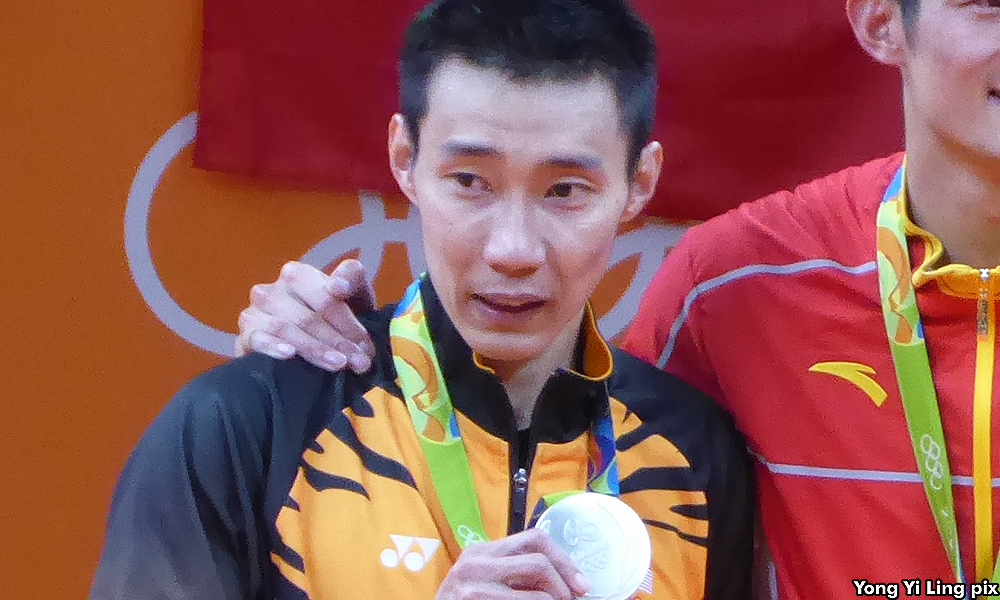

Who is next, after Lee Chong Wei?
We cheered for our athletes in the Rio Olympics, but if there is one thing to pick up from the Olympics, it is the necessity to improve and churn out potential title contenders, quickly.
Sure, we congratulate the athletes, but let us not get carried away. We sympathise with the so-near-yet-so-far attempts at our first gold, but we have to also correct existing shortcomings.
The Chinese badminton team head coach, Li Yong Bo, said it perfectly in an interview with Sina: “If Lee Chong Wei was in his (China) team, Chong Wei would have been a world champion.” This of course, offended many Malaysians, but the merits to what he said struck the perfect chord.
For most of the last two decades, the burden for Malaysia’s first gold or any medal for that matter, has lied solely on his shoulders.
If not for Pandelela Rinong’s unexpected feat in London, nobody would have paid attention to our divers. In Rio, not many expected our cyclist Azizulhasni Awang either, to bag a medal in the velodrome.
With Lee Chong Wei looking certain to retire, the question that looms is to whom shall we turn to for a gold in Tokyo?
This is the problem with our sports. We only pay attention to potential winners when they are near to success. In other words, we do not unearth or churn out potential talents from the early stages. We merely come in later on to harness those who have ‘proven’ their worth.
Where have we gone wrong?
A system to take care of existing talents is absent. Apart from the likes of Lee Chong Wei, Nicol David, and a few others, how many will choose a career in sports knowing it barely puts rice on the table?
The fastest Malaysian for 17 years, Watson Nyambek, was declared a bankrupt earlier this year, because he could not repay a RM80,000 loan meant for his father’s surgery.
Our Olympic cyclist Pocket Rocket Man, upon clinching the bronze medal, bemoaned the way the Terengganu menteri besar had treated him.
We also lack initiatives to scout and train potential talents from an early stage. Apart from those who won district competitions, nobody else from any sport receives the assistance to fully unleash their potential. For the selected ones even, many have to fork out their own resources to receive higher level exposure and experience.
Under such circumstances, the ones who can afford would get a chance to realise their potential. On the other hand, the other talents who cannot afford it, will have to simply bow out.
At this point, we may think that with the resources individuals possess, it is possible to go far. But this is not necessarily the case.
‘Floorball given the cold shoulder’
For example, the Malaysian Floorball Association in a statement in July noted that it regrets the treatment given by the Malaysian sports authorities.
Despite resounding achievements in both the Myanmar (2013) and Singapore (2015) SEA Games, they were simply ignored and given the cold shoulder.
The Malaysian Floorball team in the course of flying the national flag and trying to prove their worth, have even spent money from their own pockets, but it was not enough to be recognised by the authorities, let alone receive assistance.
The ones at the executive level have failed our athletes.
Remember Misbun Sidek’s resignation from the Badminton Association of Malaysia (BAM) in January 2011, and Rashid Sidek’s resignation in September 2013 and March 2015?
Know why they say politicians or businessmen should never be involved in sports? Because when glory is achieved, the same people who are part of all these stumbling barriers will be also the ones most eager to milk the situation for mileage. How ironic, right?
So what is wrong with our sports? Why are we not able to churn out title contenders?
ADRIAN LIM CHEE EN is a former SEA Games Silver Medallist and currently the chairperson of the #BebasAnwar campaign.


