


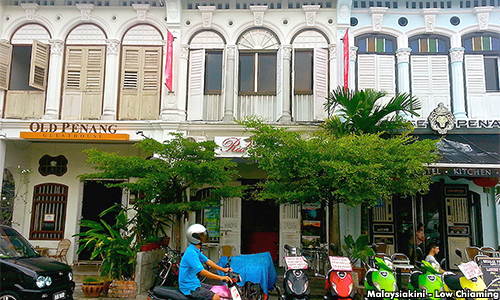

‘Waive conversion charges for guesthouses within heritage zone’
Ever since the Special Area Plan (SAP) came into force in September, guesthouse operators have been feeling the pressure to cease operations if they do not comply with the Penang Island City Council’s (MBPP) regulations. The SAP is one of the requirements imposed by Unesco upon the inscription of George Town as a heritage site.
The SAP delineates the heritage area into zones such as tourism and leisure zone, financial zone, enterprise zone and institution zone which includes public institutions such as schools, police stations and fire stations. The SAP also allows the MBPP to monitor and manage restorations and developments in the heritage core zone which covers 2,569 buildings and 2,444 buildings in the buffer zone.
The recent protest by 70 guesthouse operators at Steward Lane are up in arms with the SAP in force as all are small-time business owners who do not have the means to fork out large sums of money for the submission of building plans to convert their properties from residential/commercial status to hotel status.
Budget guesthouses should not be treated like hotels and simply cannot compete with all the big players in the tourism industry. By that, guesthouses should not fall under the hotel category where the expectations of tourists are totally different. Other complaints were regarding a one-off payment to the MBPP for motorcycle and carpark bays which costs RM2,500 and RM25,000 per lot respectively.
As the protesters mentioned, guesthouses are a boost to local tourism. The centre of tourist activities used to be in Chulia Street where backpackers would simply check into one of the guesthouses without government intervention.
No doubt, George Town needs to also comply with Unesco’s requirements for a Special Area Plan to maintain its Outstanding Universal Values (OUV). Who among us, Penangites, cannot attest to Chulia Street and its surrounding areas as an ‘Intangible Cultural Heritage’ asset - a distinctively unique identity which will be lost with the closure of guesthouses that do not comply with ‘strict’ and ‘unreasonable’ regulations?
As stated at the Convention for the Safeguarding of the Intangible Cultural Heritage that was adopted by the General Conference of Uneco in 2003, intangible cultural heritage refers to the practices, representations, expressions, knowledge and skills handed down from generation to generation.
It is truly unimaginable that the near future excludes these quaint little guesthouses which cannot continue to operate simply because they do not fit the description of a perfect heritage city as defined by the local council.
The social and economic value is just as important as these guesthouse operators give personalised services to their guests and help promote Penang and its famous food. These guesthouses, in my opinion, should be preserved and given leeway to continue their businesses as it nourishes cultural diversity and encourages human creativity.
Not every tourist can afford expensive boutique hotels. Do not penalise the tourists and do not penalise the guesthouse operators. Find an amicable solution which works for everyone. With all the restictions to budget accomodation, who can afford to visit costly Penang island? As such, the MBPP should also waive conversion charges from residential/commercial to hotel within the heritage zone.
If safety was an issue, then solve the problem of safety with the guesthouse operators. PKR will raise this issue with the local government until such a time when there is a win-win solution. The state government should engage with these striving small-time business operators to ensure a continued livelihood for them and their families.
NG CHEK SIANG is Tanjong division PKR chief.


