



Sure we’re better than the Philippines - what say you?
Over a week ago I wrote about ‘We are better than the Philippines’.
Mabuhay, President Rodrigo Duterte in his four-day work visit to China brought home US$24 billion worth of funding and investment pledges. It is US$9 billion in soft loans and economic deals including investments of $15 billion. These would translate into two million jobs in the Philippines.
Now, China is not just a friend but a big brother to the Philippines.
Sorry, President Duterte, we did better and thanks to our prime minister and his delegation to China last week. In a supposed one-week visit, he brought back RM144 billion (US$34.4 b) of deals. It is a historic achievement with 14 agreements signed. Well done.
Now let us look at the details and realities.
Out of the 14 agreements, I think only three are real commitments and supposedly binding.
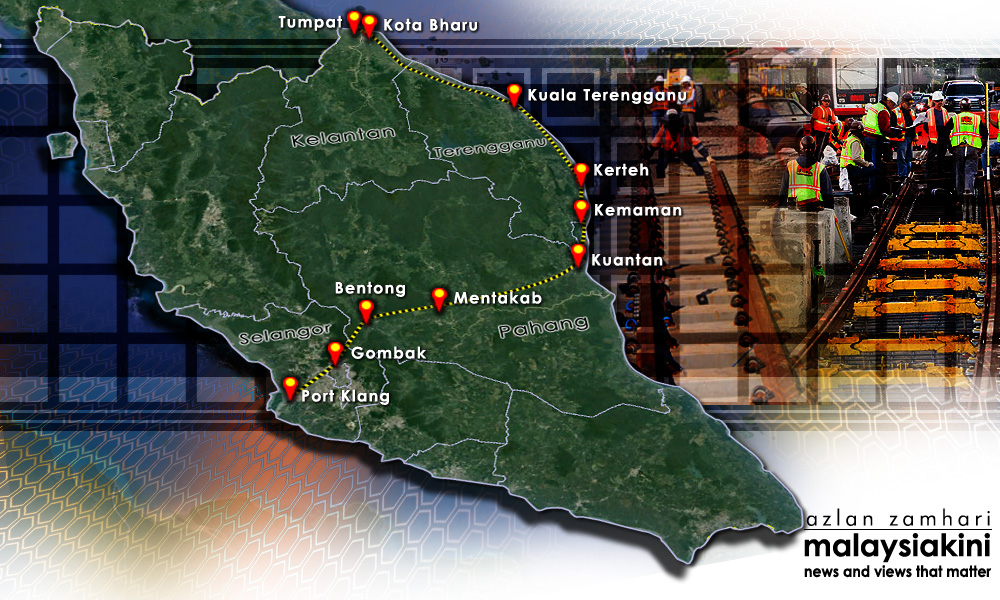
1. The Engineering, Procurement, Construction and Commissioning Agreement (EPCC) for the East Coast Economic Region (ECER) rail link.
2. Granting of banking licence to China Construction Bank (Malaysia) Bhd
3. Research and Development Collaboration Agreement on Standardisation of Edible Bird’s Nest Extract and Medical Properties for Pharmaceutical Drug Discovery.
The other 11 are either Memorandums of Understanding (MOU), Memorandums of Agreement (MOA) or Heads of Agreement (HOA). Typically, all of the these are not legally binding.
Let us have a look at the biggest deal, the EPCC for the RM55 billion (US$13.2 billion) East Coast Rail Line (ECRL). The construction of the project is expected to start next year and it is due to be completed by 2022. The original plan was only to update the railway system and to connect with railway lines operated by Keretapi Tanah Melayu Berhad. The master planners for ECER are Petronas and IOI Group.
There are so many concerns on this deal. There seems to be different cost figures. Three years ago, it was estimated at around RM30 billion by the East Coast Economic Region (ECER) Development Council CEO.
Now, the transport minister claimed that the RM55 billion is the value of the Financing Framework Agreement. It is more interesting when China’s Foreign Ministry spokesperson said he was “unclear on the specifics of the situation”. The problem is, we have indeed signed the EPCC Agreement.
In March 2016, the Land Transport Commission (Spad) invited Request for Information (RFI) with a closing date at end May. Spad must have worked at lightning speed to finalise the submissions and later to negotiate a multi-billion ringgit deal with the winning party in five months. Kudos to Spad. But, that was only the RFI and not a Request for Proposal (RFP) or tender.
Assuming it is a good deal from the China Communications Construction Company Limited (CCCC) at RM55 billion (RM91.7 million/km) without any open competitive tender. Why was it awarded to CCCC when the World Bank debarred CCCC and all its subsidiaries for fraudulent practices under Phase 1 of the Philippines National Roads Improvement and Management Project?
CHEC, a subsidiary of CCCC, also attracted controversy (inflating costs) in Uganda and several other countries for alleged shady deals.
Economic viability
How about the economic viability? There are so many analyses in social media that shows it is not viable/feasible without giving subsidies. Many countries offer subsidies to their railways. Rail subsidies are largest in Europe (€73 billion) and China (US$130 billion). Are we not religiously promoting ‘subsidy rationalisation’?
I am not sure anyone has seen the details of the project. So far, only verbal statements. At least when the KVMRT was launched, we were offered some details including the Executive Summary of the Environmental Impact Assessment Study. I hope Petronas and IOI Group have the details.
When was this humongous project launched since the EPCC agreement has been signed?
The other concern is why, again like KVMRT, this project is not under the Transport Ministry but the Prime Minister’s Department. At least KVMRT is financed locally but this is 100 percent foreign!
There are other priorities for ECER like construction of the Lebir Dam in Kelantan to ensure sufficient potable water supply, flood mitigation projects in Kelantan and Terengganu, protection against coastal erosion and upgrading and construction of new solid wastes facilities.
I hope we know what our priorities are and not trying to show off to the world. European development economists have argued that the existence of modern rail infrastructure is a significant indicator of a country’s economic advancement.
The biggest beneficiary of this project will arguably be the main contractor.
There was another landmark deal when Malaysia agreed to buy four Littoral Mission Ships from China. Strangely it is not shown in the Defence Ministry website and not in the 14 agreements signed.
Another agreement signed was for a proposed development of a steel plant in Sarawak.
The 12th MISIF Conference in October 2016 showed domestic steel consumption of 10 million tonnes has been flat for four years. The industry continues to be hampered by dumping from China which depressed selling prices. Overcapacity in China will remain for a very long time. This is further compounded by the global oversupply situation.
In addition, the recent hike in electricity and gas tariffs has driven up operation costs of the steel industry. The outlook for the Malaysian steel industry is expected to be tough with uncertainties in the operating environment. Megasteel closed its Banting plant.
Do we still want to build a steel plant?
In closing, I would like to make one final point. Does the 14 agreements add up to RM144 billion? Or put it another way. Take out the RM55 billion for the ECER rail link, will the other 13 agreements add up to the balance of RM89 billion? Or was there double-counting!
Are you sure we are better than the Philippines?
What say you...


