


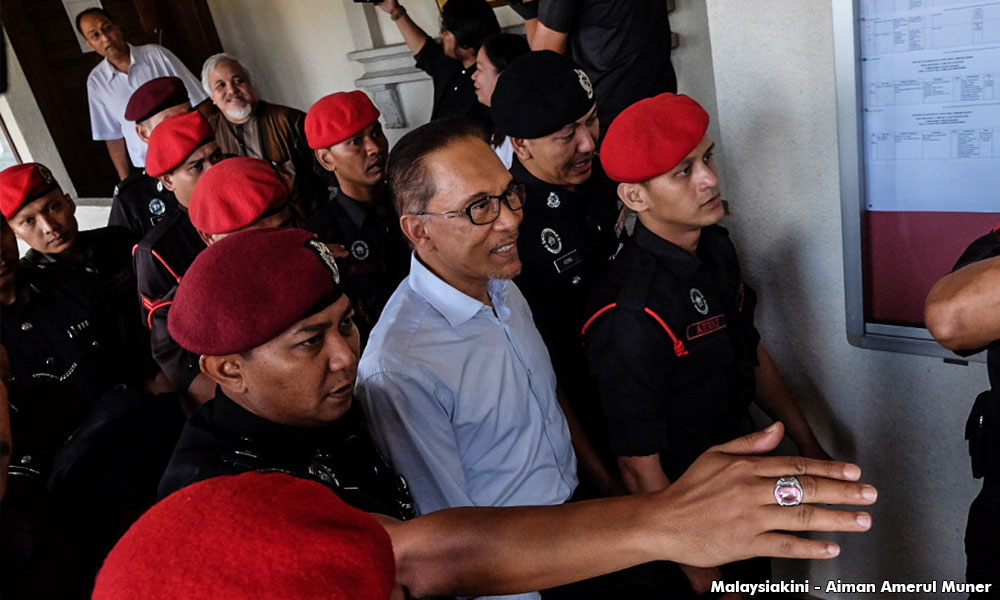

How Anwar's release and pardon can be accomplished
LETTER | At a press conference this morning, Prime Minister Dr Mahathir Mohamad raised the matter of PKR de facto leader Anwar Ibrahim’s release from prison as well as a full pardon.
Several people query as to whether and how this can be accomplished.
First, the highest prison official – the commissioner general of prisons – has the discretion to release any “prisoner” on licence and subject to conditions. This can be done as swiftly as possible.
However, the relevant Act says that this power is subject to regulations. And the regulations provide that a person must serve four years to be entitled to release. Anwar has served less than this period.
To get a person’s conviction wiped out completely, he needs to be given a pardon. This power resides in the Yang di-Pertuan Agong.
It is unclear whether the Agong has personal discretion to do so; or whether he can act only after consultation with the Pardons Board. Generally, the Agong consults the Board.
The relevant Pardons Board of the Federal Territory comprises the attorney-general (AG), the federal territories minister and three others appointed by the Agong.
The Board must consider the AG’s written opinion before giving its advice to the Agong.
A slight possible glitch: The credibility of the AG has been seriously and openly questioned by Mahathir and by the new coalition that will take over the reins of the government. There is provision for the AG to delegate his function to any other person, but that person would probably act on the AG’s directions.
Significantly, the Agong only needs to consult the Board. Any recommendation it makes is not binding on him. And the Agong’s decision cannot be questioned or set aside by any court.
A pardon wipes out the conviction as if it had never occurred, and the convicted person is treated as innocent. More specifically, the Federal Constitution removes a person from any disqualification to contest any election.
How soon can this be done? If there is a will, it can be done as soon as the Pardons Board meets and makes its recommendations to the Agong. Thereafter, the Agong can act expeditiously to pardon Anwar.
GURDIAL NIJAR is a former law professor.
The views expressed here are those of the author/contributor and do not necessarily represent the views of Malaysiakini.


Are you sure you want to delete this comment?
This action cannot be undone.